

Special Correspondent
July 11, 2026.
According to the latest data from Bangladesh Bank, fresh foreign direct investment (FDI) in the country in the January-March quarter of 2026 fell by 70.34 percent compared to the same period in 2025 and 58.47 percent compared to the same period in 2024 to just $78.26 million—the lowest in the last four quarters. Economists have identified political uncertainty surrounding the elections, a weak investment climate, and rising economic risks as the main reasons for this decline, although the twelfth national election was held in the first quarter of 2024 as well.
Comparison of the first quarter of three years
| Index | Jan-Mar 2024 | Jan-Mar 2025 | Jan-Mar 2026 |
|---|---|---|---|
| Fresh Equity Investment | $188.43 million | $263.87 million | $78.26 million |
| Total Net FDI (Equity + Reinvested Profit + Intercompany Debt) | $403.44 million | $796.57 million | $447.31 million |
This table shows that in the first quarter of 2025, both fresh equity and total FDI in Bangladesh increased significantly compared to the previous year. Analysts saw this as a sign of investor confidence returning after the formation of the interim government. But by the same quarter of 2026, the trend had completely reversed—fresh equity investment had fallen by more than 58 percent compared to the first quarter of 2024, and by almost 70 percent compared to the first quarter of 2025.
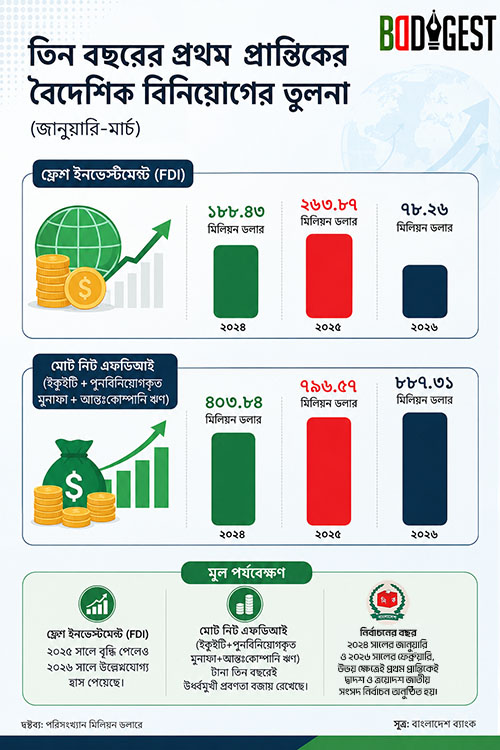
The same trend is evident in the total net FDI picture: after almost doubling from 2024 to 2025, it almost halved in 2026.
Reinvested profits trust
However, the reinvested profits of existing foreign companies increased significantly to $342.92 million in the first quarter of 2026, compared to $191.22 million in the same period of the previous year. According to economists, real investment growth depends on fresh equity, not on the accounting adjustment of reinvested profits—as a result, while the overall FDI stock increased from $18.99 billion at the end of March 2025 to $21.30 billion by March 2026, it does not reflect the true investment situation.
Why this decline?
Bangladesh Institute of Bank Management Director General Md. Ejazul Islam said the decline in equity investment is a worrying sign that foreign investors are becoming reluctant to start new ventures. He identified the successive sovereign credit rating downgrades by international agencies as one of the reasons for the loss of investor confidence and also blamed the rising rate of defaulted loans in the banking sector for this.
Former Central Bank Governor Ahsan H. Mansur said the Prime Minister’s announced 1.5 percent cash incentive to attract foreign investment is a positive step, but another five to seven years of preparation are needed to make major infrastructure projects like the Chittagong Bay Terminal suitable for attracting global capital.
Professor Mostafizur Rahman, Distinguished Fellow at the Center for Policy Dialogue, said that structural weaknesses such as the lack of fully implemented automated one-stop service systems and the high cost of doing business are the main obstacles to investment. According to him, the quality of infrastructure and stability of the policy framework are more important to investors than political changes, and he predicted that FDI will remain weak unless long-standing administrative obstacles are removed.
A senior Bangladesh Bank official also said that a similar slowdown in investment is being seen in the domestic private sector, which suggests that local entrepreneurs have also taken a similarly cautious stance.
Bangladesh lags behind in the regional context
According to UNCTAD’s World Investment Report 2026, despite being the second largest economy in South Asia with a GDP of over half a trillion dollars, Bangladesh lags behind smaller African countries like Ghana, Uganda and the Democratic Republic of the Congo in attracting foreign capital. The report says these countries have been able to attract billions of dollars in investment through extensive legal reforms—such as Ghana reforming its tax system and reducing inflation from 21 percent to 3.4 percent, while Uganda has transformed its investment administration into a single window system.

https://stapravda.ru/20221228/reyting_samyh_populyarnyh_hostingov_v_rossii_196445.html, рейтинг хостингов России подтверждает, что выбор надежного провайдера важен для бизнеса.