
❐ Local correspondent
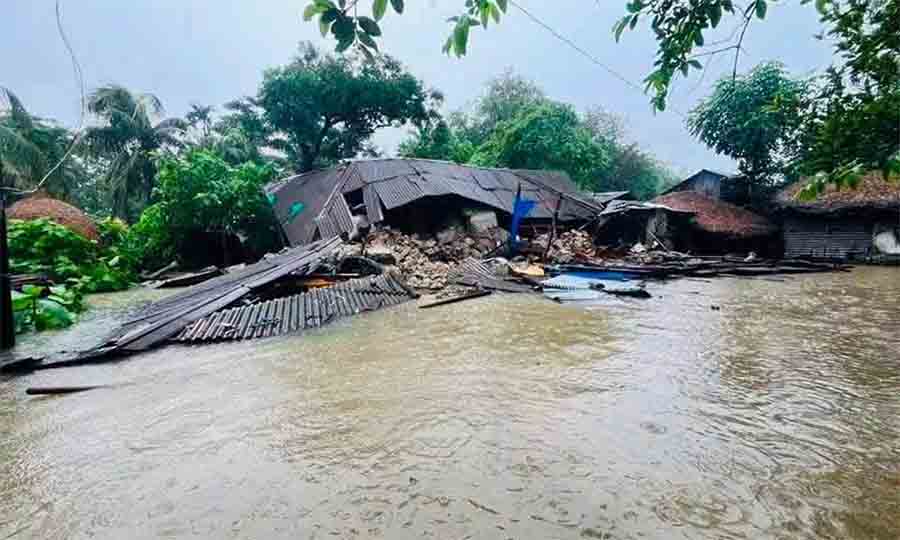
Even on the ninth day of the devastating floods, vast areas of Banshkhali, a coastal upazila of Chittagong, are still inundated with water. Although the water from the hills and rains has receded from the eastern part of the upazila, thousands of people are still living in inhuman conditions in the coastal areas of the western part.
Locals complain that the natural drainage path has been completely blocked due to the illegal construction of unplanned shrimp farms, salt cultivation lands, and fish farms by influential circles.
The unions on the western side of the 18-kilometer regional road from Pukuria to Puichhari in this 377-square-kilometer upazila are now the epicenter of the biggest suffering. Especially in the vast areas adjacent to the sea of Chnua, Shekherkhil, South Chambal, Shilkup, Gandamara, Saral, Baharchhara, Khankhanabad, Katharia and West Puichhari unions, there is still no water.
Although salt is cultivated on these lands during the winter, as soon as the monsoon season arrives, shrimp farming is started by building dams here and there in the interest of huge profits, which has now become a thorn in the side of the residents.
The Upazila Executive Officer (UNO) himself has expressed his anger over this mysterious and worrying situation of water stagnation despite being so close to the sea.
Upazila Executive Officer (UNO) Md. Ruhul Amin said, “This prolonged waterlogging after the flood in the coastal areas is very worrying. What is more surprising is that even though the water has receded quickly from all other areas, the water is still stuck in the areas right next to the sea. Taking this issue seriously, on July 13, a written instruction was issued to the chairman of each union parishad to start the work of removing illegal embankments and obstacles.”
He added that according to initial estimates, about 4,500 to 5,000 houses have been damaged. Work is underway to compile a list of actual damage.
On the other hand, in areas like Khankhanabad, Sadhanpur, Bailchhari, Chambal, and the municipality where the water has receded, there is only a cry of sorrow. Hundreds of mud houses have collapsed like a house of cards in the intense flood. Many homeless families, having lost their homes, are somehow spending the night under the rubble of their broken houses.
Local farmers have faced extreme financial losses as the summer crops of the farmlands have completely rotted and numerous ponds and enclosures have been washed away with fish.
Khankhanabad Union Parishad member Md. Didarul Alam said, “Even though the water has gradually receded in my area, the terrible damage to houses and road infrastructure is beyond words. We are providing emergency relief, including government rice,e to the affected people and are preparing a list of major victims.”
Rahul Das, a flood-affected resident of the coast, expressed his anger, saying, “Our mud houses have collapsed in the terrible floods. Even though the water has receded, many people who lost their homes are still spending their days in shelters. Even though relief has arrived, the most important thing for us now is a place to rest. And if the illegal shrimp enclosures and dams in this area are not demolished, this waterlogging will become our permanent curse in the future.”
Environmentalists and conscious circles believe that man-made canal encroachment, unplanned dams, and illegal shrimp farms are more responsible for the recent prolonged floods than the effects of climate change in disaster-prone Banshkhali. If the illegal dams are not removed quickly despite the administration’s instructions, there will be no end to the suffering of hundreds of thousands of people on the coast.

https://stapravda.ru/20221228/reyting_samyh_populyarnyh_hostingov_v_rossii_196445.html, рейтинг хостингов России подтверждает, что выбор надежного провайдера важен для бизнеса.