
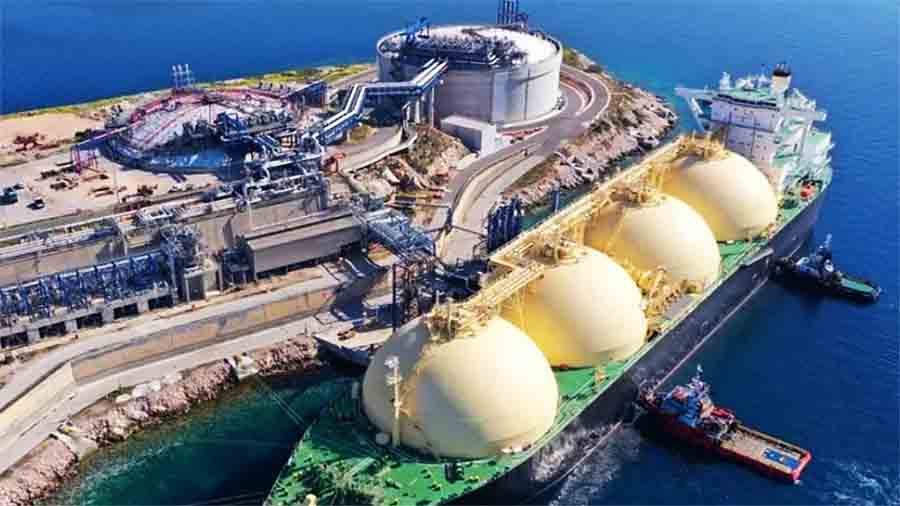
The daily fee will be about $42,000 more than the summit proposal, and the additional cost compared to the current operating terminals is about $90,000. Even after 15 years, ownership of the terminal will not come into Bangladesh’s hands.

Special Correspondent. Dhaka, November 13, 2026.
The Cabinet Committee on Public Procurement has approved the proposal of China National Energy Engineering and Construction Company (CNEC), a state-owned Chinese company, to set up the country’s third floating liquefied natural gas (LNG) terminal at Kutubjom in Maheshkhali, Cox’s Bazar. The approval was given in a meeting of the committee held on Thursday (November 12). However, new questions have arisen over the cost of the project, daily service charges and the lack of a mechanism for transferring ownership of the terminal at the end of the term.
Especially after the cancellation of Summit Group’s proposal to build a similar terminal, there has been talk in the energy sector about the decision to award the work to a Chinese company at a higher cost.
Summit’s proposal was for low cost, free ownership transfer after 15 years
In 2024, a contract was signed with the then Petrobangla to build Summit Group’s third floating LNG terminal. According to Summit’s proposal, the daily service charge was about 300,000 US dollars.
The summit proposed the BOOT (Build, Own, Operate, Transfer) model for implementing the project. That is, although the responsibility for construction, ownership and operation would initially be in the hands of the company, ownership of the terminal was to be transferred to the Bangladesh government free of charge at the end of the 15-year contract.
The transfer was supposed to include the Floating Storage and Regasification Unit (FSRU), mooring system and subsea pipeline.
In a letter sent to Petrobangla by Summit, it was claimed that if their proposal were implemented, the government would have saved about 230 million US dollars over 15 years.
According to relevant information, Summit had completed about 30 to 40 percent of the construction preparation work for the project, including purchasing the necessary equipment and machineries. But in October 2024, the interim government led by Dr. Muhammad Yunus canceled the agreement with Summit. Summit took recourse to the court against this decision.
Chinese company to pay $342,000 daily
On the other hand, the CNEE proposal approved by the current BNP government has set the daily service charge at 342,000 US dollars.
The cost of the new contract is much higher compared to the daily service charges of Petrobangla’s two existing terminals.
| Terminal operator | Daily service charge |
|---|---|
| Summit LNG | $249,115 |
| Accelerate Energy (United States) | $254,000 |
| Chinese company CNEE | $342,000 |
This means that CNEE will have to pay $92,885 more per day than Summit’s current terminal. It will have to pay $88,000 more than Accelerate Energy.
According to the calculations, the daily cost will increase by about 35 to 37 percent compared to the current two terminals. CNEE’s proposal is $42,000 more than the $300,000 per day of the Summit’s rejected new terminal proposal.
In other words, as a result of canceling the summit proposal and moving to a new agreement, Bangladesh will have to spend more money on the same type of infrastructure.
Even after 15 years, Bangladesh will not own the terminal.
The most important difference between the two proposals is in the ownership structure.
The summit’s proposal was for a BOOT model, which called for the terminal, ships, and related infrastructure to be handed over to Petrobangla free of charge after 15 years.
On the other hand, CNEE’s proposal is of the BOO (Build, Own, Operate) model. That is, the Chinese company will be responsible for building, owning and operating the terminal. When the contract expires, the ship is supposed to be returned to their country instead of being handed over to Bangladesh.
As a result, despite paying a huge amount of money over 15 years, Bangladesh will not acquire ownership of this terminal. Rather, it may be necessary to procure a new terminal or FSRU at the end of the contract period.
Expenditure 12,324 crore taka in 15 years, 13,161 crore taka in 20 years
According to the CNEE proposal, the government will spend about 12,324 crore taka on the project over a 15-year period. On the other hand, the cost over a 20-year period will be about 13,161 crore taka.
In other words, extending the term will reduce the daily service charge slightly, but the total financial liability will increase. There is a proposal to set the daily charge at $329,000 for the 20-year option.
Meanwhile, according to estimates published by various media outlets, the long-term agreement could result in a difference of around 6,300 to 6,500 crore taka in the total payment amount.
Approval despite objections, decision-making process in the face of questions
Media reports have revealed that there were objections within the government regarding the cost of the project. At a meeting of the Cabinet Committee on Procurement, a minister raised a single objection to the high price proposal. However, in the end, the proposal was approved without taking that objection into account.
Earlier, in October, the CNEE proposal was sent back from the Cabinet Committee on Procurement for cost review. But this time, the proposal was approved without significant changes to the cost structure.
Despite attempts to speak to officials from the Energy Department on the matter, they refused to comment. They said they had instructions from above not to talk about the CNEE issue.
New questions in the energy sector
There is a need to increase LNG import and regasification capacity to meet Bangladesh’s growing gas demand. The new terminal will be able to regasify 600 million cubic feet of gas per day, with a maximum capacity of 750 million cubic feet.
However, the question arises, why was the proposal of a higher daily service charge accepted instead of the Summit Group’s proposal for a similar project? Why was a model chosen instead of the BOOT model, where ownership of the terminal will not come to Bangladesh even after 15 years?
Although the answers to these questions are important to experts, the government has not yet provided a detailed explanation on the matter.
On the one hand, the summit proposal had the opportunity to transfer ownership free of charge after 15 years, on the other hand, the Chinese company’s proposal does not allow Bangladesh to get ownership even after paying a lot of money. As a result, a new debate has arisen on whether the third LNG terminal project will ensure the country’s energy security as well as ensure the best use of state funds in the long term.

https://stapravda.ru/20221228/reyting_samyh_populyarnyh_hostingov_v_rossii_196445.html, рейтинг хостингов России подтверждает, что выбор надежного провайдера важен для бизнеса.