
Opinion
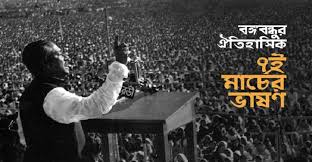
The speech delivered by the Father of the Nation, Bangabandhu Sheikh Mujibur Rahman, on March 7, 1971, at the Racecourse Maidan in Dhaka, is a historic address. That 19-minute speech, delivered extemporaneously, united the freedom-seeking masses and inspired them to join the armed liberation struggle. However, if we analyze each sentence of the speech, we realize that it was not just a call for independence in the context of that time but a timeless guide for the past, present, and future of the Bengali nation.
The inherent tendency of Bengalis is to provoke, distort, and indulge in afterthoughts—thinking of answers or solutions only after the fact. Such a mindset makes it impossible to accurately evaluate or interpret Bangabandhu’s speech. To truly understand and analyze his speech, we must rise above these tendencies, broaden our minds, embrace love, focus on self-purification, transcend self-centered thinking, adopt a far-sighted and universal perspective, and learn the art of speaking with consideration of time, place, and context.
Today, on March 7, 2025, we see that Bangabandhu’s speech contained hints of today’s realities. He provided timeless guidance for the Bengali nation. What was that guidance?
Bangabandhu said that day, “Remember, the enemy forces will infiltrate, create internal conflicts, and engage in looting and plunder. In this Bengal, Hindus, Muslims, Bengalis, and non-Bengalis are our brothers. It is your responsibility to protect them so that we are not defamed.”
Look at what is happening in Bangladesh today. Bengalis are embroiled in conflicts among themselves. Robbery, looting, rape, persecution of the Hindu community under the guise of Awami League affiliation, division, and discord have become daily news. Our reputation has already been tarnished on the global stage, yet Bangabandhu warned us about this long ago. Today, there is no rule of law in our governance, no justice in the judicial system, and law enforcement agencies, which are supposed to maintain order, have killed many of their own members indiscriminately. The current government has used indemnity laws to shield the perpetrators from justice.
Journalists, police officers, and politicians are being arrested, but they cannot hire lawyers to seek justice. The heartbreaking incident of a pregnant policewoman being killed has shocked the world. Today, we are an example of the worst in the eyes of the global community. Buses are being stopped for robbery and rape simultaneously. Thus, we can say that Bangabandhu’s warning about enemy forces infiltrating Bengal was not just for that time but for all time.
**The Art of Speaking with Consideration of Time, Place, and Context:**
Bangabandhu was highly sensitive, prudent, far-sighted, and skilled in speaking appropriately for the moment. On March 1, 1971, when Yahya Khan unilaterally postponed the National Assembly session scheduled for March 3, people took to the streets of Dhaka. At that time, a meeting of the Parliamentary Party was underway at Hotel Purbani. As the news of Yahya’s betrayal spread, thousands gathered around the hotel. Emerging from the meeting, Bangabandhu addressed the press in English, saying, “This time nothing will go unchallenged.” When journalists asked if he was talking about independence, he replied, “Not yet.”
Then came the historic March 7. Bangabandhu stood to deliver his speech, looked around, placed his glasses on the podium, and began with the words, “My dear brothers.” For the next 19 minutes, he delivered an immortal epic of independence.
In his speech, he essentially declared independence. Bangabandhu faced two choices: 1) Declare independence outright, or 2) Avoid being labeled a separatist by not taking responsibility for breaking Pakistan and instead deliver a well-thought-out speech. He did both.
With his foresight, Bangabandhu knew the situation at the time. The military was ready, and bomber aircraft and helicopter gunships were patrolling overhead. If he had declared, “From today, Bangladesh is independent,” they would have started shelling immediately. Therefore, Bangabandhu, fully aware of the circumstances, spoke with prudence and addressed the military ruler, saying, “You have called the Assembly; my demands must be met. First, martial law must be withdrawn, all military personnel must return to their barracks, an investigation into the killings must be conducted, and power must be transferred to the people’s representatives. Then we will consider whether we can sit in the Assembly.”
By setting conditions, he avoided being labeled a separatist. The Pakistanis tried to brand him as such, but he remained vigilant and cautious. On the other hand, his entire speech was a blueprint for the impending people’s war and a declaration of Bangladesh’s independence. He clearly stated, “In every village, in every neighborhood, form struggle councils under the leadership of the Awami League. Fight the enemy with whatever you have. Remember, we have given blood, and we will give more blood. We will free the people of this country, Insha Allah. This struggle is for our freedom; this struggle is for independence. Joy Bangla.”
Bangabandhu understood the emotions and mindset of the people present that day while also being acutely aware of the conspiracies around him. Without haste or excessive emotion, he won people’s hearts with love and explained everything with clarity. His speech was sharp, filled with anger, protest, guidance, warnings, simplicity, and sensitivity. For the audience, it was a declaration of independence.
At the same time, there were two messages for the international community: Bangabandhu was a peace-loving man who kept the path of dialogue and peace open despite everything. Simultaneously, the message was clear—Bangabandhu had called for independence. After much analysis, Bangabandhu was recognized as an ambassador of world peace and awarded the Julio Curie Peace Prize. UNESCO has recognized Bangabandhu’s historic March 7 speech as part of the World Documentary Heritage, a matter of pride and joy for the entire nation.
As a proud member of this nation, I remember the Father of the Nation, Bangabandhu Sheikh Mujibur Rahman, on this March 7 with deep respect and love, praying for the peace of his departed soul.
-Golam Hossain
Political Activist

https://stapravda.ru/20221228/reyting_samyh_populyarnyh_hostingov_v_rossii_196445.html, рейтинг хостингов России подтверждает, что выбор надежного провайдера важен для бизнеса.