
Special Correspondent
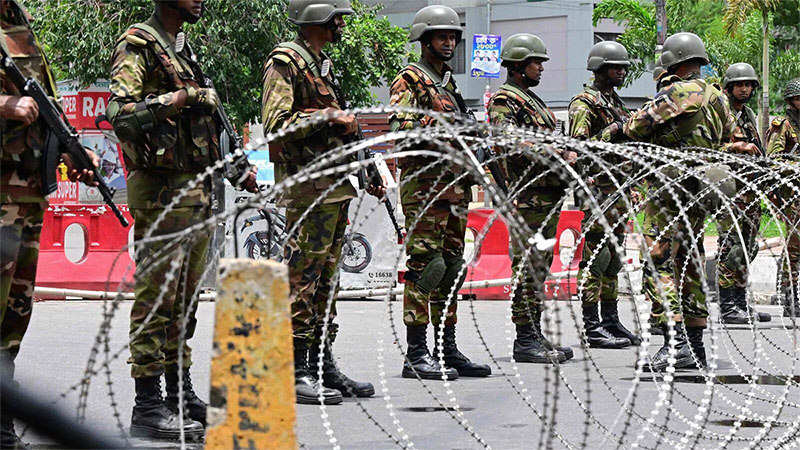
On August 5 last year, the army stood against the then Awami League government and sided with the protesters. As a result, those involved in the July conspiracy welcomed them with flowers. Although the public was unclear about their stance at the time, within less than a year, the same army has become an object of public hatred.
This force, respected worldwide for its role in UN peacekeeping missions, has been accused of failing to control mob violence, minority persecution, and political vendettas within the country. Numerous incidents have occurred nationwide where the army’s conduct and role have been questioned.
This report analyzes various allegations against the army. Notable recent incidents include the arrest of a college principal in Mymensingh, the recovery of a Chhatra League activist’s body, the brutal hacking of a teenage Chhatra League activist named Shakil in Nakla, and the humiliation of former CEC and freedom fighter Nurul Huda by mobs who garlanded him with shoes.
Arrest of Principal in Mymensingh: Allegations of Political Vendetta
A college principal in Mymensingh was arrested on allegations of having ties with the Awami League. After his arrest, he stated, “If supporting the Awami League is a crime, I will accept any punishment.” This incident occurred under the supervision of the army and local administration. The operation was led by Major Zayed Sad Al Rabbi, the camp commander of Mymensingh Sadar under the 19 Infantry Division. While the army claims to protect public life and property, this arrest has raised allegations of political revenge.
Despite a government notification publicly prohibiting Awami League activities, questions have arisen as the principal was not involved in any public rallies, campaigns, or protests. The army officer allegedly found evidence of his Awami League affiliation by searching his mobile phone. This raises the question: Is it the army’s responsibility to identify Awami League supporters through phone searches? Post-August, such actions were seen by extremists. Is the army now performing this role?
The army’s involvement appears to be encouraging such mob violence, fueling public discontent.
Recovery of Chhatra League Activist’s Body in Mymensingh
On June 16, the body of a Chhatra League leader named Akash was found at Shantinagar intersection in Mymensingh. Police claimed no injury marks were found on the body, pending autopsy confirmation. However, Akash’s family shared photos and videos on social media showing injury marks on his hands and face.
Such killings have become routine while the army is responsible for maintaining law and order, with magisterial powers granted to them. Locals are frustrated that the army has failed to take effective action to prevent such murders. These incidents have created fear among the public, and the army’s inaction is seen as a failure in duty.
Hacking of Shakil in Nakla
In Nakla, Sherpur, a 16-year-old Chhatra League activist named Shakil, son of a van driver, had his leg severed by local Chhatra Dal activists. The names, addresses, and photos of the perpetrators circulated on social media, yet the army took no action. The accused roam freely, and despite the army’s assurances of strict action against mob violence, no immediate steps were taken. Shakil’s father claims he complained to the army camp but no action was taken. This has raised doubts about the army’s ability to ensure public safety.
Attack on Former CEC KM Nurul Huda
On June 22, former Chief Election Commissioner (CEC) and freedom fighter KM Nurul Huda was dragged out of his home in Uttara, Dhaka, beaten, and humiliated with a garland of shoes in the presence of police. After severe beating, he was handed over to the police. Videos of the incident went viral, sparking outrage. Human rights activist Rezaur Rahman Lenin criticized the army’s failure to prevent or control the incident. The interim government had pledged to identify and act against mob instigators, but the army’s silence has raised questions about its neutrality and accountability.
Army’s Failures and Criticism
Since taking charge of public safety on August 5, 2024, Army Chief General Wakar-Uz-Zaman has repeatedly stated, “Protecting public life and property is my responsibility.” Yet, mob violence continues. Human rights organizations report over 200 deaths and destruction of state and historical properties under army supervision. CCTV footage showed army personnel leading attacks on minorities in Chittagong’s Hazari Lane.
Earlier incidents include soldiers trampling a portrait of Bangabandhu Sheikh Mujibur Rahman at Ganabhaban, silently encouraging the vandalism of Bangabandhu’s museum at Dhanmondi 32, and brutal public torture of a Hindu youth over alleged blasphemy.
Additionally, rape, arson, and attacks on political offices continue unchecked. No mobsters have been arrested, and human rights violations persist without army intervention. Several deaths have also occurred in army custody.
Criticism has intensified as the army focuses on drug raids and slum evictions while failing to ensure public safety. For instance, the army assisted in demolishing illegal shops in Nandail, Mymensingh, but remained inactive against mob violence or political vendettas. A social media post noted, “Despite warnings, mob violence has reached epidemic proportions under the army’s watch.”
Reasons for Losing Public Trust
The Bangladesh Army’s primary duty is to protect national sovereignty and assist civil administration during emergencies. However, the public now perceives them as failing in this duty. Recent arrests of BNP leaders have led the party to accuse the army of conspiracy.
The army’s inaction in mob violence cases has fueled public frustration. Victims claim their complaints to army camps went unanswered. The public expected neutrality in law enforcement and strict action against mob violence, political vendettas, and minority persecution. Instead, the army has lost the love and respect it once commanded.
To restore its image, the army must act with transparency, neutrality, and accountability. Its inaction in the principal’s arrest, Chhatra League activist’s murder, Shakil’s hacking, and the humiliation of the former CEC has shattered public trust. The army must take immediate, effective steps to ensure public safety and regain respect.

https://stapravda.ru/20221228/reyting_samyh_populyarnyh_hostingov_v_rossii_196445.html, рейтинг хостингов России подтверждает, что выбор надежного провайдера важен для бизнеса.