
Staff Correspondent
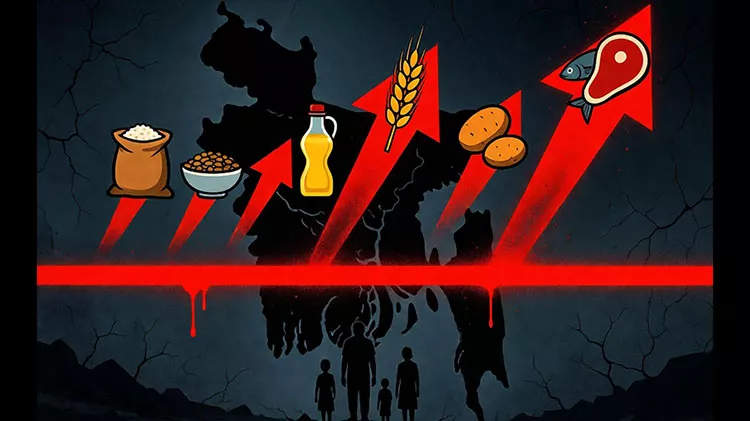
Bangladesh has been unable to move out of the ‘red’ category of high risk of food inflation for almost two consecutive years. Although overall inflation has declined somewhat, food prices have recently shown an upward trend, which is creating new pressure on the economy. The latest report on the global food security situation has placed Bangladesh in the ‘red’ category. According to the organization, countries with food inflation between 5 and 30 percent fall into this category. Bangladesh has been in this category for almost 10 consecutive months, which indicates that risks to food security continue.
Analysts say the ongoing unrest in the Middle East could impact Bangladesh’s import-dependent economy. Rising costs, especially in the energy and transportation sectors, could strain the food supply chain and fuel inflation, putting further pressure on the market in the coming days.
Selim Raihan, executive director of the South Asian Network on Economic Modeling (SANEM), a private research institute, said the current trend of food inflation is worrisome. If the global and regional crisis continues, import costs will increase and pressure will be put on the supply chain, which will have a negative impact on inflation. According to him, Bangladesh’s progress in controlling inflation is limited compared to neighboring countries.
Meanwhile, the latest data from the Bangladesh Bureau of Statistics shows that food inflation stood at 9.30 percent in February, the highest in the last 13 months. After being on a downward trend for several months, the index has started to rise again recently.
Economists believe that the prolonged high food inflation is putting increasing pressure on low- and limited-income people. According to them, this rise in inflation is increasing the cost of living and reducing purchasing power, as a large portion of income is spent on food.
According to the World Bank’s classification, food inflation is classified as ‘purple’ if it is 30 percent or more, ‘red’ if it is 5 to 30 percent, ‘yellow’ if it is 2 to 5 percent, and ‘green’ if it is below 2 percent. Bangladesh is currently in the ‘red’ category, which carries a signal of medium to high risk.
Economists say global market volatility, the dollar’s exchange rate, energy costs and supply chain constraints are all creating challenges in controlling food inflation. The situation could be further complicated without policy coordination and effective market management.

https://stapravda.ru/20221228/reyting_samyh_populyarnyh_hostingov_v_rossii_196445.html, рейтинг хостингов России подтверждает, что выбор надежного провайдера важен для бизнеса.