
❐ BD Digest Desk
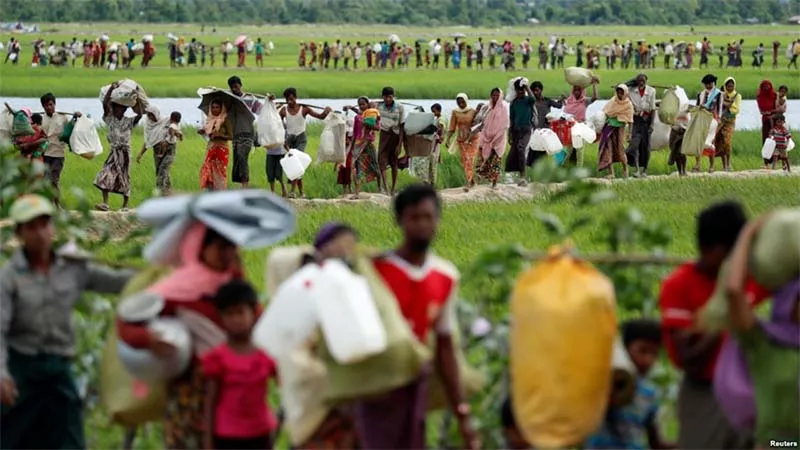
The increasing trend of Rohingya refugees displaced from Myanmar using Bangladeshi passports to illegally migrate abroad is a growing concern. Recent incidents of Rohingyas being caught trying to obtain passports in districts like Narayanganj, Chandpur and Netrokona have brought this horror to the fore.
The government of Saudi Arabia has stated that there are 69,000 Rohingya in Saudi Arabia alone. Outside the list, there are millions of Rohingya who identify as Bangladeshi in various countries around the world, including Saudi Arabia.
Due to organized brokers, dishonest local public representatives, and lack of proper verification of information, Rohingyas are easily obtaining birth registration certificates and national identity cards. This situation is not only disrupting the country’s national security, but also pushing Bangladesh’s labor market into uncertainty in the outside world.
Incident of being caught
On December 1 last year, a Rohingya youth named Aziz Khan was caught during biometric verification at the Fatullah Regional Passport Office in Narayanganj. He had resorted to fraud by introducing himself as ‘Hafez Abdul Aziz’.
This young man, who entered Bangladesh in 2018, came close to obtaining a passport through a broker using a fake birth certificate and his parents’ names.
Shamim Ahmed, the then deputy director of the Narayanganj Regional Passport Office, said, “His fraud was caught while trying to match his fingerprints using the biometric method.”
Similarly, two Rohingya women who planned to travel to Saudi Arabia disguised as Bangladeshis were caught in Chandpur. During interrogation, they admitted that brokers had prepared all their documents in exchange for a large sum of money.
On the other hand, a Rohingya named Md. Karim, who was caught in Netrokona, was also found to have a Saudi Arabian driving license. He had recently come to Netrokona by bus from Chittagong to apply for a passport. He was caught due to language difficulties.
Netrokona Police Superintendent Md. Tariqul Islam said yesterday, “After the arrest, his (Karim) speech was not understandable. Later, his speech was understood through a person in Chittagong. Later, he was sent back to the Rohingya camp.”
The workings of the broker ring
The main requirement for getting a passport is a birth registration certificate or NID. This is the place that brokers target the most. They are extorting 30 to 50 thousand taka, and in some cases several lakh taka, for each passport.
There are allegations that some local union council and municipality public representatives or related employees are issuing birth registration certificates and citizenship certificates in exchange for money without verification.
An official from the Passport Department, speaking on condition of anonymity, said that in the past, it was easy to commit fraud. After the introduction of e-passports, fraud has reduced a lot. However, the problem is with the primary documents.
If a person brings a birth registration certificate or NID from the Union Parishad, it is often difficult for the passport office to identify their true identity, unless their biometric data is already stored as Rohingya.
Negative impact on the labor market
The most negative impact of this Rohingya passport fraud is on Bangladesh’s foreign labor market.
According to experts, when Rohingyas engage in crimes abroad under the guise of Bangladeshi identity, the responsibility falls on Bangladesh.
If this situation continues, various countries around the world may impose more restrictions on issuing visas to Bangladeshi passport holders, which could have a major impact on the country’s remittance flow.
Syndicate busted, 23 arrested
Police investigations have revealed that a huge syndicate is active across the country, including Dhaka, Chittagong, and Cox’s Bazar, to help Rohingyas obtain passports. Police recently arrested 23 members of this gang.
In this syndicate, the names of some dishonest Ansar members have also emerged, along with Rohingya and Bangladeshi brokers.
According to information provided by the arrested persons, they work in several stages. One group collects Rohingyas from Teknaf or Cox’s Bazar and brings them to Dhaka. The second group creates fake birth registration certificates and NIDs using addresses from different districts. The third group completes the biometric and photo taking work with the help of Ansar members of the passport office.
They charge between one and two lakh taka for this work. Many Rohingya raise this money by selling the gold ornaments they brought with them.
Hundreds of passport delivery slips and fake documents were found on the mobile phones seized from the arrested individuals, which testifies to the horror of this syndicate.
Due to their linguistic and physical similarities with the local residents of Cox’s Bazar and surrounding areas, the Rohingya are easily integrating into local society.
Many Rohingya who arrived in the past few decades have now bought land and are trying to settle by marrying into local communities. This social mix makes passport fraud even easier.
What the lawyers say
Supreme Court lawyer Jamal Uddin Khandaker said, “Strict measures at the passport office alone are not enough to stop passport fraud; it needs to be tackled at the local level. Strict rules need to be introduced at the union parishad and ward levels for issuing birth registration certificates.”
For any new registration, it should be mandatory to verify at least 20 years of records to prove his/her lineage and permanent residence.
The Rohingya database must be automatically linked to the birth registration and NID databases. The public representatives or officials who are involved in these treasonous acts must be identified and brought to justice quickly.

https://stapravda.ru/20221228/reyting_samyh_populyarnyh_hostingov_v_rossii_196445.html, рейтинг хостингов России подтверждает, что выбор надежного провайдера важен для бизнеса.