
❐ Special Correspondent
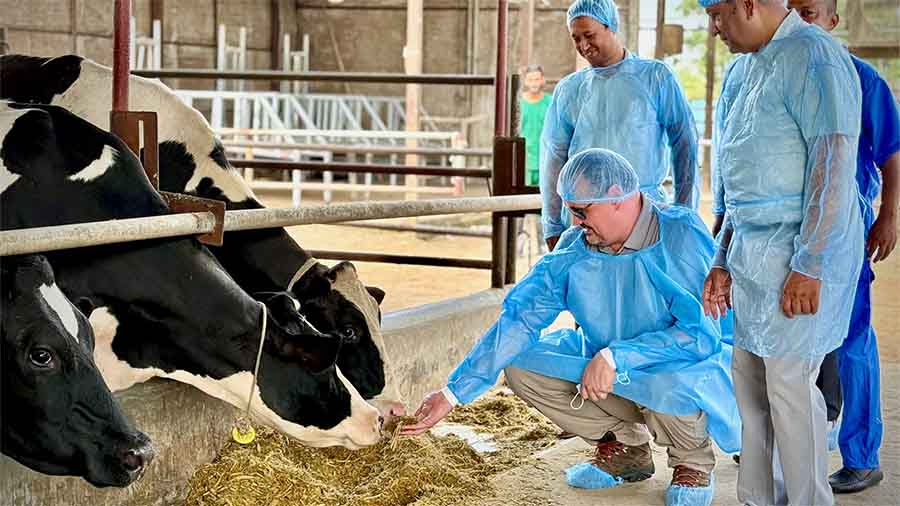
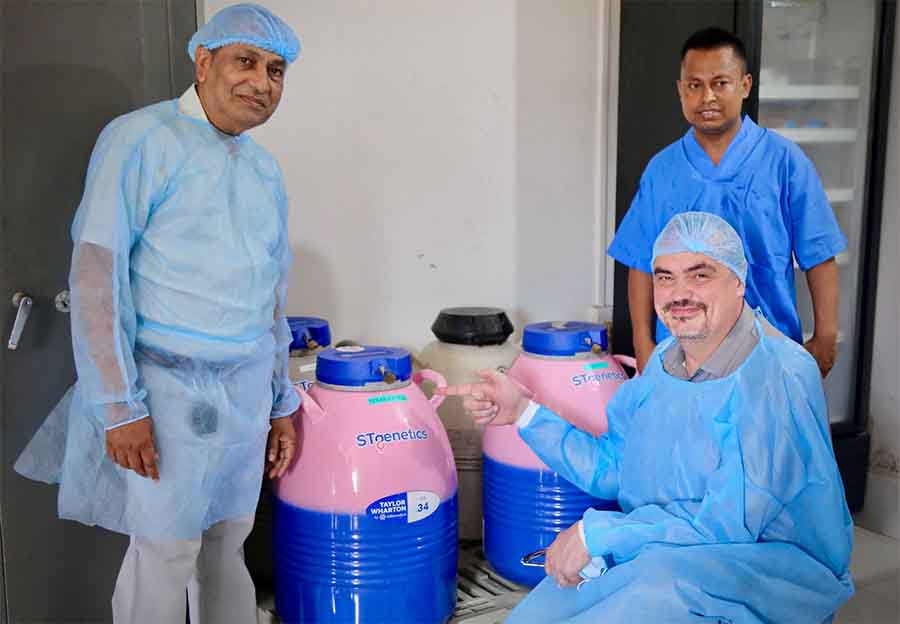
US Ambassador to Dhaka Brent T. Christensen’s visit to Paragon Dairy Farm and the promotional post on the US embassy’s Facebook page have brought to the fore an old question — what does this diplomatic move to expand the US corn and soybean market mean for Bangladesh’s own animal feed industry?
An industry already import-dependent
According to the Bangladesh Feed Industries Association (FIAB), the country meets the annual demand for about 7.5 to 8 million tons of animal and poultry feed, the main ingredients of which are corn, soybean meal, and rice husk.
According to industry insiders, about 70 percent of these raw materials have to be imported — meaning the domestic feed industry is already closely linked to the fluctuations of the international market.
Corn alone accounts for about 55 percent of poultry feed, so even small changes in global corn and soybean prices directly affect the prices of local eggs, chicken, and milk.
In this context, US agricultural export organizations — such as the US Soybean Export Council — have previously held direct meetings with leading companies in Dhaka’s poultry and soy crushing industries to expand the market.
Observers see the recent visit and campaign by the ambassador in Dhaka as an extension of that continuity.
Background to the trade agreement
Analysts are linking this animal feed campaign to a recent trade deal, rather than seeing it as an isolated incident.
On February 9, just three days before the 13th parliamentary elections, the interim government led by then Chief Advisor Yunus signed a trade agreement with the United States called the ‘Agreement on Reciprocal Trade’ (ART).
Under the terms of the agreement, US retaliatory tariffs on Bangladeshi goods have been reduced from 20 percent to 19 percent, and 1,638 Bangladeshi products are receiving duty exemptions.
But critics are mainly focused on the agreement’s agricultural provisions. Under the agreement, Bangladesh is required to provide duty-free or reduced benefits on about 6,710 US products in exchange, and is obligated to provide duty-free or reduced benefits on about 2,210 more types of products over the next few years.
According to the Center for Policy Dialogue (CPD), the government could lose about Tk 1,327 crore in customs revenue due to this agreement in the current fiscal year alone.
Certain articles of the agreement directly touch on the animal feed and livestock sector. According to Article 1.5 of the agreement, Bangladesh must accept the US Food Safety and Inspection Service (FSIS) certification as sufficient evidence for US meat and poultry (including offal), processed meat and poultry, and egg products.
Bangladesh will be obliged to approve imports of dairy products from cows, sheep, and goats only if they have a certificate from the US Department of Agriculture, and there will be no requirement for separate establishment registration.
Critics say that Bangladesh will not be able to prevent future sanitary inspections of US agricultural products unless there is a scientifically based health risk — and may even have to allow imports of products that the country produces in sufficient quantities.
The media has also raised questions about whether the terms of this agreement also allow for the import of banned pork products into the country.
Top analysts like economist Mostafizur Rahman say the deal imposes disproportionately high conditions on Bangladesh in exchange for modest tariff concessions, and that signing such a far-reaching agreement just before an interim government election is questionable.
Ambassador Christensen’s recent visit to Paragon Dairy and the embassy’s campaign around it are therefore being interpreted by many as a visible step in the implementation of this agreement – where diplomatic campaigns are creating a market for the products of an agreement that is still controversial within the country.
The country’s economy is trapped in the deal.
Earlier, the US ambassador to Dhaka, Peter Haas, had interfered in the country’s politics throughout his tenure. He remained in Bangladesh even after the change of government and took control of a large part of Bangladesh’s energy sector through a private energy company.
Experts have opined that the current ambassador is also trying to expand US dominance in the country’s agriculture and farm management through the same process.
No foreign ambassador can directly intervene in the ‘host’ state in this way – even though diplomats have repeatedly reminded them of this, Yunus’ interim government and the current BNP government have not shown any concern about it.
Potential concerns of local industry
According to analysts, such campaigns could pose challenges for the domestic industry on several levels.
First, although efforts have been made to encourage farmers to cultivate corn in the country for a long time, there has long been a fear among those involved in the agricultural sector that the increased availability of cheap and subsidized American corn and soybeans could shrink the market for local corn farmers.
Second, a large portion of US agricultural products come from genetically modified (GMO) corn and soybeans. The use, labeling, and regulatory framework for GMO animal feed in Bangladesh is not yet fully integrated, which could raise questions about food safety oversight if large-scale imports increase.
Third, domestic feed mill owners have long argued that as reliance on imported raw materials increases, the impact of exchange rates and international shipping costs on local production costs increases — ultimately putting pressure on small and medium-sized farmers, rather than large corporate entities.
Fourth, while the promotion of “American genetics” and improved cattle breeds promises to increase productivity, there is still limited clear research among livestock experts on the long-term impact of this on the conservation of indigenous dairy cattle breeds and local breeding programs.
Import-oriented economy destroying local production: Where is the risk?
Many economists are raising concerns that a contract that limits the ability to block sanitary inspections and that may force countries to import even products that are sufficiently produced domestically could shrink local manufacturing industries in the long run. Some of the potential impacts are as follows:
- Employment Loss: The dairy, poultry and feed mill industries provide direct and indirect employment to millions of people in Bangladesh. If local small and medium farms and mills cannot compete with subsidized and cheap imported products, it will have a direct impact on the rural economy.
- Pressure on foreign exchange: In a sector that already relies on 70 percent of feed raw materials for import, further increase in mandatory imports will increase the demand for dollars, which could put additional pressure on foreign exchange reserves and the exchange rate of the taka.
- Loss in revenue collection: According to CPD estimates, in addition to the loss of an estimated Tk 1,327 crore in customs revenue in the current fiscal year, the revenue loss could be even more extensive if other member countries are forced to provide the same benefits due to the WTO’s Most Favored Nation (MFN) policy.
- Obstacles to agricultural diversification: There is a fear that long-term initiatives to expand corn cultivation and develop local breeds of dairy cattle in the country will lose priority and investment incentives in the face of competition from cheap imports.
- Crippling policy sovereignty: Critics believe that provisions like Article 4.3 of the agreement — where the United States reserves the right to reimpose punitive tariffs if Bangladesh signs preferential trade agreements with countries like China or Russia — could also curtail Bangladesh’s freedom to formulate agricultural and industrial policies in the future.
Some economists fear that while some export products may benefit from tariff relief in the short term, a weakening of the domestic production base and increased import dependence in the long term could be detrimental to the structural balance of the overall economy — especially where sources of foreign exchange earnings are limited and the economy is already heavily dependent on remittances and garment exports.
The other side’s argument
However, the government is also putting forward some arguments against these concerns. According to them, through this, 1,638 Bangladeshi products are getting duty-free access to the US market and the overall retaliatory duty has been reduced from 20 to 19 percent, which is claimed to be mainly aimed at reducing the bilateral trade deficit of $6.1 billion.
The Bangladesh government’s Ministry of Agriculture has also always welcomed US agricultural technology and cooperation, saying it can accelerate the country’s agriculture-dependent economy. Improved breeds and nutritious food can increase the milk production of cows, which creates the potential to increase farmers’ income in the short term.
In addition, some traders believe that cheap imports could also help control local feed prices as corn and soybean prices occasionally decline in the global market.
Ultimately, the question comes down to the policy balance — how well Bangladesh has specific policies and oversight frameworks to protect the interests of the domestic feed industry, local corn farmers, and livestock sector while making markets for US agricultural products accessible.

https://stapravda.ru/20221228/reyting_samyh_populyarnyh_hostingov_v_rossii_196445.html, рейтинг хостингов России подтверждает, что выбор надежного провайдера важен для бизнеса.