

❐ Aynal Karigor
Article 2.6 of the US Agreement on Intellectual Property states that Bangladesh must establish a strong system of protection for intellectual property. It must also establish effective civil, criminal, and border-based mechanisms for the enforcement of intellectual property rights to prevent infringement or abuse of rights.
That is, the agreement calls for strict implementation of intellectual property laws and vigorous enforcement of patent laws.
The relationship between the country’s pharmaceutical industry and intellectual property law is complex. About 90 percent of the raw materials for generic drugs manufactured in Bangladesh come from abroad, although most of the raw materials are not patented. How can one determine which of such a large number of ingredients has an IP license, which does not, and whether any patents have been infringed?
Who is responsible for this work, and who will implement it? It is not the responsibility of the port authority or customs to make such a decision. So the question remains who will do the work.
Training has been underway for some time to enable Bangladesh Customs to identify whether the intellectual property rights of foreign companies are being infringed through imported raw materials or products.
The most worrying aspect of the agreement is the US’s keen interest in obtaining digital customs information! This is also linked to the ‘digital enforcement’ mechanism of intellectual property law.
If the port and customs information is available, the foreign side will be able to follow the labels of the raw materials imported by the manufacturers. As a result, the Japanese side will benefit from technical surveillance, the US side from decision-making, and multinational companies from commercial interests; on the other hand, Bangladeshi customs can be used to take action against the country’s manufacturers.
Intellectual property law is not just an administrative or customs issue; it is also a political question. It has long been a contentious issue between the ‘Global South’ and the ‘Global North’. Whether, where, and how strictly intellectual property rights for a product or drug are enforced are decisions that are relevant to the economic self-reliance of poor countries and the survival of local industries.
The pharmaceutical clauses in the US trade agreement could pose a serious risk to Bangladesh’s pharmaceutical industry
- Patent fees and licensing costs will increase: If the exemptions available as LDCs are limited or eliminated, domestic companies may have to pay patent fees and licenses for certain pharmaceutical raw materials or ingredients. This will increase production costs.
- Making generic drugs cheaper will be difficult: Bangladesh’s pharmaceutical industry has thrived on making generic drugs with patent exemptions under the LDC-facility. Strict intellectual property enforcement could put a strain on this production model.
- Small pharmaceutical companies may face a survival crisis: Most of the 182 companies in the country may have to withdraw from the market if it becomes difficult to pay the additional patent fees. As a result, they will be forced to increase the prices of drugs.
- Competition in the industry may decrease: If small companies are weakened, there is a risk that a large share of the market will be controlled by a handful of large or multinational companies.
- Prices of some medicines may increase: According to research, the price of insulin produced in the country could increase by up to 11 percent if patent fees are paid. The price of chemotherapy, cancer and hepatitis C medicines is also likely to increase.
- Generic drug prices are at risk of skyrocketing: Due to weak market surveillance and lack of administrative preparedness, generic drug prices could skyrocket—with the potential for a maximum increase of 1,000 percent.
- Medicines may be scarce: Some medicines may be less available on the market due to patent restrictions or high production costs; they may even be difficult to obtain, even at a higher price.
- Patients’ medical expenses will increase: If the price of medicines increases, patients will have to pay more for treatment out of their own pockets. The risk of a generic medicine costing Rs 20 becoming Rs 500 has been mentioned.
- Public health and access to medicines may be affected: If affordable medicines become scarce or out of reach, there is a risk of disruption to treatment, especially for people with long-term and serious illnesses.
- Domestic production and export capacity may come under pressure: The domestic industry meets about 97 percent of the country’s pharmaceutical needs and exports to 100 countries. This production and export capacity may be weakened if patent costs and legal barriers increase.
- Import and customs can add complexity: Determining whether a raw material is patented or not, or whether an import has infringed intellectual property rights, is complex. If customs is given this responsibility, there is a risk of misidentification, product detention, or production disruption.
- Legal uncertainty and litigation may increase: Bangladesh lacks skilled manpower and legal capacity to assess patents. Without that preparation, strict enforcement could expose domestic companies to long and costly legal battles.
- National policy freedom may be restricted: Bilateral treaty obligations may limit access to LDC benefits and the freedom to pursue public policy in the pharmaceutical sector.
Patent verification of raw materials is a difficult task even at the international level. Numerous cases related to this await resolution for years. Therefore, patent determination is also a judicial matter. After many people died in Africa due to lack of AIDS and tuberculosis drugs, a movement developed across the continent against the strict application of patent laws in the production of medicines.
Such a sensitive and controversial issue therefore needs to be considered from a political and economic perspective. It is also necessary to examine the history of legal battles over patents in different countries.
By signing the agreement, the Bangladesh government has shifted the urgent discussion on the political and economic aspects of intellectual property to a mere question of law and order or police enforcement.
This will involve surveillance from abroad, orders from the secretariat to arrest everyone, and customs to arrest them. However, each patent issue needs to be carefully reviewed separately.
The lack of technical and legal expertise in the Bangladesh Patent Office is also evident. Determining who deserves a patent for a new invention and who does not requires economic, social and judicial considerations, legal training, skilled manpower and a clear understanding of the public interest.
Bangladesh lacks these capabilities. There is also a shortage of lawyers skilled enough to handle such cases. The issue is not just technical; it is not enough to realize that there is a conflict between public interest and business profit.
In such an unprepared state, the question has also been raised as to whether receiving American or Japanese training to identify potential intellectual property infringement by domestic pharmaceutical companies is being presented as ‘technology transfer’.
There are long court battles to resolve patent and trademark disputes around the world. The question is, is Bangladesh handing over the sovereignty of its courts to the United States through the US agreement?
One advantage of being a least developed country (LDC) is that Bangladeshi companies are not required to obtain patents and licenses to manufacture generic drugs. The ingredients of generic drugs are usually the same as the ingredients of branded drugs.
As a general rule, when the patent on the original brand of medicine expires, other companies can produce the same medicine; that is, a generic medicine.
As an LDC, Bangladesh does not have to pay patent fees to international brands. Hundreds of pharmaceutical companies have been established in the country by taking advantage of this exemption from intellectual property laws.
One of the characteristics of the pharmaceutical industry in Bangladesh is that it produces large quantities and sells them at relatively low profits. Keeping the prices of medicines within the reach of the common man is also a significant achievement of the pharmaceutical policy. Generic medicines that are available for 50 taka at a local shop may cost hundreds of times more in the United States or Europe.
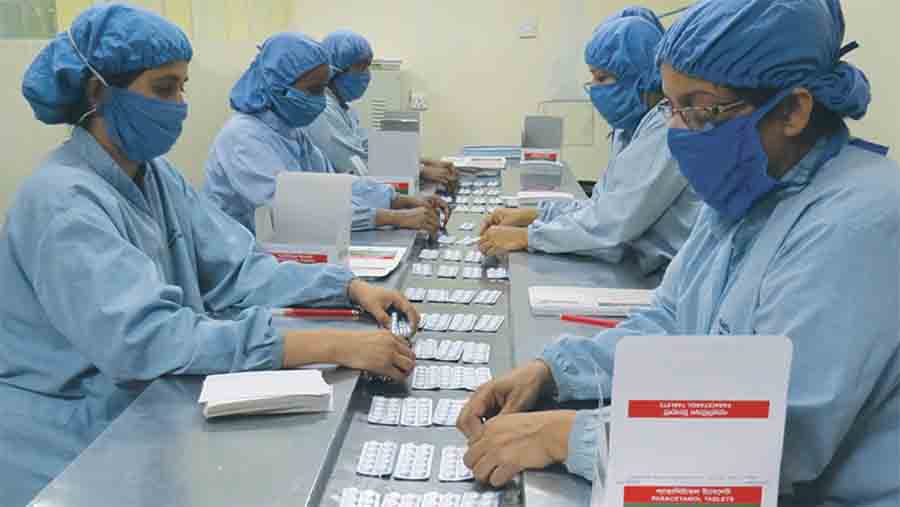
The country’s pharmaceutical industry meets about 97 percent of domestic demand and exports medicines to more than 100 countries. The exemptions granted in patent laws as an LDC have played a vital role in the development of this industry.
If Bangladesh leaves the LDC, or is forced to pay IP fees separately through a bilateral agreement, it will be difficult for hundreds of domestic companies to produce drugs at low prices at a huge cost. That aspect is clear from the terms of the US agreement.
Most of the country’s 182 pharmaceutical companies are small. If intellectual property laws are strictly enforced as in the United States, it may be difficult for these companies to continue their business by paying patent fees.
In such a situation, there is a risk that the security of medicine supply for 200 million people will fall under the control of a handful of large companies—especially multinational pharmaceutical companies.
There are many widely used medicines in the country. For example, let’s say a raw material called ‘Salt-1’ has to be imported to manufacture a medicine. Due to the LDC facility, domestic companies can import it without paying patent fees so far. But if the agreement comes into effect, if the salt used in the production of omeprazole or any similar ingredient is patented, the companies may have to pay patent fees.
New drugs, new raw materials, or new versions of old raw materials—in each case, the survival of the country’s pharmaceutical industry may be difficult if production has to overcome various patent barriers.
That’s why big pharmaceutical companies are also saying that there is no room for renegotiation of the agreement. Every clause related to intellectual property in the agreement could spell disaster for the entire pharmaceutical industry.
Many countries are now carefully implementing intellectual property laws to address patent-related complexities. They prioritize public interest, public health, and people’s right to access medicines in local drug production.
Countries like Brazil, Egypt, and Indonesia have long built up the capacity of their patent offices, taking into account national interests. As a result, their patent offices have acquired the ability to balance the public interest with the interests of companies.
Indian company Natco wanted to manufacture a spinal drug called ‘Risdiplam’. The original patent for the drug was held by Swiss company Roche. Roche sued, demanding that the Indian company pay royalties to manufacture the drug.
After a long litigation, the Indian High Court ruled in favor of Natco and granted the right to produce the drug locally.
After Natco manufactured the generic medicine, it was found that the production cost per bottle was 15 thousand rupees. Whereas the same medicine was sold by Roche for 6 lakh rupees. This means that the price of local production was reduced by 97 percent.
If the Indian court had ruled in favor of the foreign company’s patent, the public would not have been able to get the drug at such a low price. This ruling is seen as a landmark decision in the history of intellectual property law; it gave priority to the public interest over the interests of the company.
About 10 percent of Bangladesh’s population—an estimated 20 million people—is affected by diabetes.
A study by four researchers published in the ‘Asian Development Review’ says that if Bangladeshi companies are forced to pay patent fees, the price of insulin produced in the country could increase by up to 11 percent.
There is also a risk that the prices of chemotherapy drugs, oncology or cancer drugs, and hepatitis C drugs will increase.
Bangladesh’s market surveillance framework is already weak. Deficiencies in market regulation and a lack of administrative and judicial preparedness can lead to a price increase of up to 1,000 percent for generic drugs. In addition to the increase in price, some drugs may also become scarce—meaning they may not be available even at higher prices.
In Bangladesh, people have to pay a large portion of their medical expenses out of pocket. Bangladesh has the highest rate of such expenses in South Asia. If the price of a generic medicine worth 20 taka reaches 500 taka, it could have a major impact on public health.
As a result of the US agreement, Bangladesh is at risk of losing the benefits it enjoys as an LDC. The obligations of the bilateral agreement with the US amount to giving up the benefits and policy freedom that Bangladesh enjoys as an LDC under the World Trade Organization.
Fifteen new conditions have also been added.
The United States will impose conditions, sanctions, and tariffs—this is the country’s long-standing policy. But the question is, who was behind the self-imposed sacrifice of the interests of the country’s important local industries? Who campaigned secretly or openly for the agreement?
The question for the common people is who has been working systematically for a long time to implement this agreement, damaging the achievements of the domestic garment, poultry, dairy, pharmaceutical and agricultural sectors.
It is necessary to find an answer to the question of why the Ministry of Commerce, the Economic Relations Department (ERD), an influential advisor to the interim government—who is now a minister—and influential individuals who served as consultants to the ERD were so keen to make the deal.
Many of them campaigned for Bangladesh to be removed from the LDC list even during the Sheikh Hasina government. It is important to remember this.
The Sheikh Hasina government had a different calculation. Even taking into account urgent issues like livelihood, employment and public health, the country was on its way to becoming a middle-income country due to economic strength. Bangladesh had become an example to the world in indicators like maintaining the ideal GDP position, human development index, poverty alleviation, and increasing per capita income. But the devastation of July 2024 has set the country back another 50 years.
The number of unemployed people in the country has increased dramatically since the July massacre. The country has been paralyzed by production shutdowns, poverty-high unemployment, and economic collapse. According to many economists, if the country is promoted to a middle-income country in such a situation, local producers may lose trade privileges one after another.
Many people are now realizing that voluntarily accepting the obligations of bilateral agreements through an opaque process, leaving behind LDC benefits in a country of billions of poor people, is a decision that is against the national interest. Will it ever be possible to hold those involved in this unequal and anti-national agreement accountable?

https://stapravda.ru/20221228/reyting_samyh_populyarnyh_hostingov_v_rossii_196445.html, рейтинг хостингов России подтверждает, что выбор надежного провайдера важен для бизнеса.