

❐ Aynal Karigor
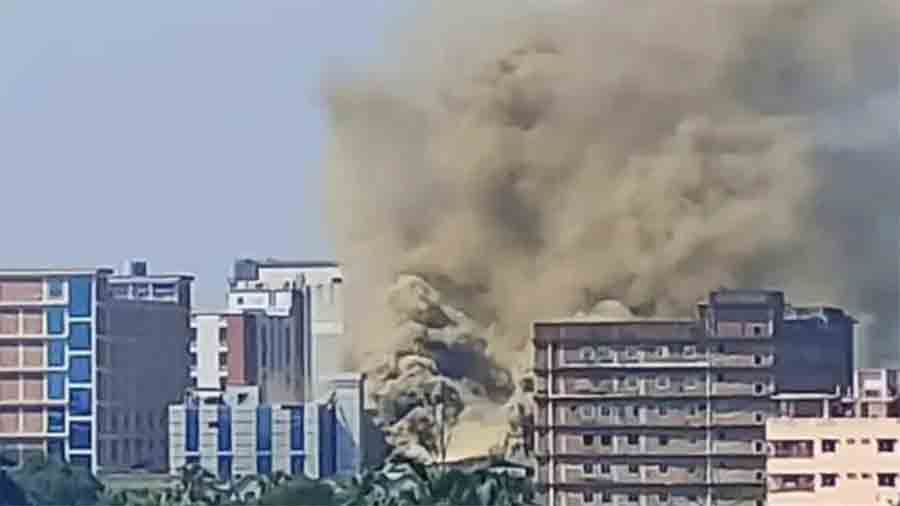
The fire service brought the fire that broke out at the pharmaceutical factory of ‘Drug International Limited’ in Cheragali, Tongi, under control after about four and a half hours of effort.
Md. Talha bin Jasim, an officer of the media cell of the Fire Service and Civil Defense Department, said they received news of a fire at the factory at 10:10 am on Wednesday. After that, 20 units of the Fire Service reached the spot in phases and joined the firefighting work. Later, the army and BGB also helped in extinguishing the fire.
The fire service said that the fire was brought under control at 1:55 pm due to the efforts of all parties. However, even then, it was not possible to completely extinguish the fire.
Many employees have claimed that this terrible fire was sabotage.
They say that Bangladesh is one of the world’s leading countries in the production of medicines, Bangladeshi medicines are exported to 140 countries, and Bangladeshi medicines are also the best in terms of quality. There is definitely a conspiracy to destroy this huge market.
Experts believe that there are some points related to medicines and medical equipment under Bangladesh’s Reciprocal Trade Agreement with the United States and recent trade policies where Bangladesh’s interests may be harmed.
The points are highlighted below.
For these reasons, the employees of the company do not consider the fire at the pharmaceutical factory of ‘Drug International Limited’ to be natural. Many employees, who do not wish to be named, claim that it is a US conspiracy.
Gazipur Industrial Area Police Superintendent Md. Amjad Hossain said that the Drug International factory is in the pharmaceuticals category. 385 workers work there.
No casualties were reported in the incident till noon. It was also not confirmed whether anyone was trapped inside the factory.
According to fire service personnel, the fire started on the fourth floor of the five-story building of the second unit of the factory. From there, the fire quickly spread to different parts of the factory. A plume of smoke could be seen rising from a distance above the factory. The intense heat of the fire and the pungent smell of chemicals made the surrounding environment uncomfortable.
The presence of chemicals and various industrial materials inside the factory made the fire difficult to extinguish. Tongi Fire Service officials believe that the fire could spread quickly because of the glass in various parts of the building, which is made of steel and aluminum.
After the fire broke out, efforts were made to bring it under control by using the water system inside the factory. But at one stage, a water crisis arose. Later, fire service personnel brought water trucks from Gazipur, Tongi, Uttara and various surrounding areas to try to put out the fire.
A fire service worker said firefighters were trying to enter the building to find the source of the fire and bring the fire under control, but their work was made difficult by the intense heat, thick smoke and smell of chemicals.
It was not immediately known how the fire broke out at the factory and the extent of the financial loss. However, it is believed that the medicines, pharmaceutical materials and equipment inside the factory were destroyed in the fire.
Attempts were made to contact the factory owner, Dr. Md. Amjad Hossain, by telephone, but his mobile phone was found to be switched off.
Members of the army, BGB, industrial police and police station are on duty at the scene.
The pharmaceutical clauses in the US trade agreement could pose a serious risk to Bangladesh’s pharmaceutical industry
- Patent fees and licensing costs will increase: If the exemptions available as LDCs are limited or eliminated, domestic companies may have to pay patent fees and licenses for certain pharmaceutical raw materials or ingredients. This will increase production costs.
- Making generic drugs cheaper will be difficult: Bangladesh’s pharmaceutical industry has thrived on making generic drugs with patent exemptions under the LDC-facility. Strict intellectual property enforcement could put a strain on this production model.
- Small pharmaceutical companies may face a survival crisis: Most of the 182 companies in the country may have to withdraw from the market if it becomes difficult to pay the additional patent fees. As a result, they will be forced to increase the prices of drugs.
- Competition in the industry may decrease: If small companies are weakened, there is a risk that a large share of the market will be controlled by a handful of large or multinational companies.
- Prices of some medicines may increase: According to research, the price of insulin produced in the country could increase by up to 11 percent if patent fees are paid. The price of chemotherapy, cancer and hepatitis C medicines is also likely to increase.
- Generic drug prices are at risk of skyrocketing: Due to weak market surveillance and lack of administrative preparedness, generic drug prices could skyrocket—with the potential for a maximum increase of 1,000 percent.
- Medicines may be scarce: Some medicines may be less available on the market due to patent restrictions or high production costs; they may even be difficult to obtain, even at a higher price.
- Patients’ medical expenses will increase: If the price of medicines increases, patients will have to pay more for treatment out of their own pockets. The risk of a generic medicine costing Rs 20 becoming Rs 500 has been mentioned.
- Public health and access to medicines may be affected: If affordable medicines become scarce or out of reach, there is a risk of disruption to treatment, especially for people with long-term and serious illnesses.
- Domestic production and export capacity may come under pressure: The domestic industry meets about 97 percent of the country’s pharmaceutical needs and exports to 100 countries. This production and export capacity may be weakened if patent costs and legal barriers increase.
- Import and customs can add complexity: Determining whether a raw material is patented or not, or whether an import has infringed intellectual property rights, is complex. If customs is given this responsibility, there is a risk of misidentification, product detention, or production disruption.
- Legal uncertainty and litigation may increase: Bangladesh lacks skilled manpower and legal capacity to assess patents. Without that preparation, strict enforcement could expose domestic companies to long and costly legal battles.
- National policy freedom may be restricted: Bilateral treaty obligations may limit access to LDC benefits and the freedom to pursue public policy in the pharmaceutical sector.

https://stapravda.ru/20221228/reyting_samyh_populyarnyh_hostingov_v_rossii_196445.html, рейтинг хостингов России подтверждает, что выбор надежного провайдера важен для бизнеса.