
International Desk
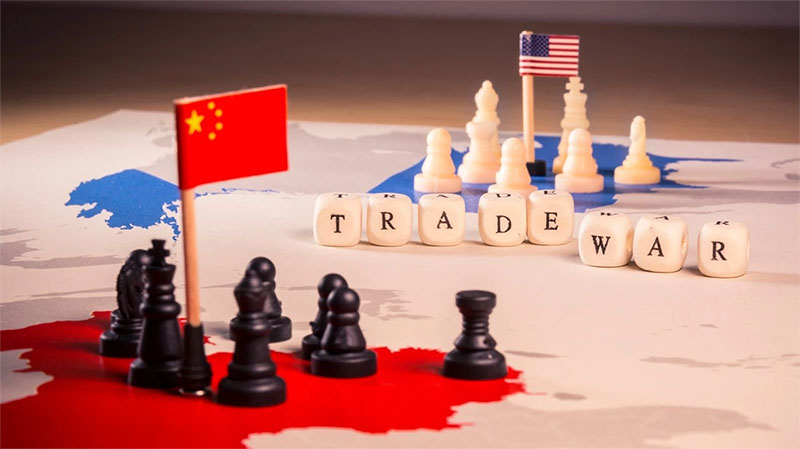
U.S. President Donald Trump has recently taken one of the most aggressive steps in the trade war against China. He imposed tariffs of up to 245% on Chinese goods, stating, “China has not acted fairly in the international market.” While some countries have been partially exempted, China has been fully targeted.
This time, however, China is not silent as before. Instead of pursuing dialogue, it has responded strongly—imposing counter-tariffs of up to 125% on U.S. goods and specifically targeting certain American industries. This marks the beginning of a direct confrontation between the world’s two largest economies.
During Trump’s first term, China attempted negotiations multiple times. But the situation is different now. China is more confident, organized, and prepared.
In 2018, the U.S. was China’s largest export destination, accounting for nearly 20% of its total exports. That figure has now dropped to 13%, significantly reducing China’s reliance on the U.S. market.
Despite slowing economic growth, China has adapted to tough realities. Both businesses and the government have become accustomed to the gradually increasing pressures. As a result, the new tariffs from the U.S. have not caused the same level of alarm as before.
However, these tariffs are not just harming China but also significantly impacting the United States. The burden of these tariffs ultimately falls on American consumers and businesses.
Estimates suggest that the new tariffs will increase annual costs by approximately $460 billion, raising the average household expense by about $3,700. This added burden could exacerbate inflation and the cost of living, posing a significant challenge for Trump politically.
Some argue that since the U.S. imports more than China, it holds a strategic advantage in imposing tariffs. The reality, however, is that higher prices for goods lead to a decline in the standard of living. Companies like Tesla and Apple, which rely on Chinese components and labor, could also face significant losses.
Meanwhile, China is responding with strategic and effective countermeasures. As the world’s largest supplier of rare earth minerals—critical for manufacturing smartphones, laptops, and military technologies—China is imposing restrictions on U.S. companies in this sector.
Additionally, China has blacklisted several U.S. defense and technology companies.
China is also targeting the agricultural sector, imposing stricter measures on imports of soybeans and poultry. This could severely affect American farmers, particularly in rural areas that are strongholds of Trump’s support.
Another critical area is intellectual property. If China ceases to protect U.S. patents, software, and film copyrights, American companies could face losses amounting to billions of dollars. In this way, China is applying pressure on the intellectual and creative dimensions of trade.
The tariff policy is not only straining U.S.-China relations but also damaging America’s ties with its allies. European leaders have expressed frustration with Trump’s policies and are seeking closer relations with China. China, in turn, is actively strengthening ties with Southeast Asian countries like Malaysia, Vietnam, and Cambodia—previously within the Biden administration’s sphere of influence.
Moreover, an upcoming EU-China summit signals a shift in global dynamics, potentially reducing U.S. geopolitical influence if Europe and China collaborate more closely.
These interconnected events have also impacted investor confidence. Political uncertainty, high debt, and tariff policies are raising questions about the stability of the U.S. economy globally.
Although Trump has stated, “A deal with China could happen within three to four weeks,” Beijing has not responded to this claim. In reality, both nations are entrenched in their positions, with neither willing to back down.
Ultimately, this is a prolonged battle of patience, strategy, and political frameworks. Trump must manage pressures from his public, markets, and media, whereas Xi Jinping faces no democratic accountability. As a result, China’s position is more advantageous in terms of time.
If Donald Trump genuinely aims to make the U.S. more self-reliant and reduce dependence on China, he must explore alternatives beyond tariffs—adopting a long-term and strategic approach. Otherwise, this decision will have serious consequences for American consumers, the economy, and foreign allies.

https://stapravda.ru/20221228/reyting_samyh_populyarnyh_hostingov_v_rossii_196445.html, рейтинг хостингов России подтверждает, что выбор надежного провайдера важен для бизнеса.