
Special Correspondent
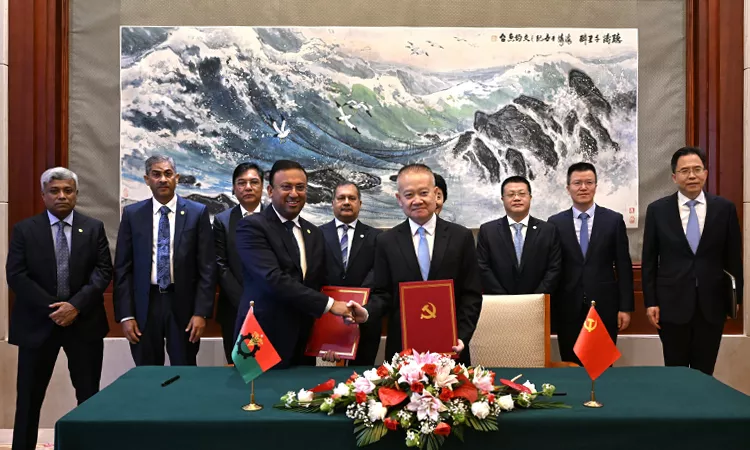
Beijing, June 25 — A Memorandum of Understanding (MoU) was signed between the Bangladesh Nationalist Party (BNP) and the Communist Party of China (CPC) at the Diaoyutai State Guesthouse in Beijing, the capital of China.
BNP Joint Secretary General for International Relations Humayun Kabir and CPC International Department Minister Liu Haixing signed the MoU on behalf of their respective parties. Bangladesh Prime Minister and BNP Chairman Tarique Rahman, CPC Central Committee International Department Minister Liu Haixing, Information and Broadcasting Minister Zahir Uddin Swapan, Water Resources Minister Md. Shahid Uddin Chowdhury Ani and State Minister for Aviation and Tourism M. Rashiduzzaman Millat were present at the ceremony. Tarique Rahman and Liu Haixing later exchanged gifts with each other. This is the first MoU between the two parties.
The formal agreement between the BNP, long known as a center-right political party, and the world’s largest Communist Party has sparked new discussions among political observers. The BNP and CPC have been increasingly close in recent months. In April this year, Chinese Vice President Han Zheng met a high-ranking delegation led by BNP Secretary General Mirza Fakhrul Islam Alamgir in Beijing, where the CPC expressed interest in strengthening exchanges and cooperation with the BNP.
Earlier, in a post-visit statement, Mirza Fakhrul Islam Alamgir said that they discussed the signing of a memorandum of understanding between the BNP and the CPC to continue political dialogue within the next two years. He also said that they were impressed by the progress achieved under Chinese leadership and that China’s economic, social and political power had reached a higher level in recent years.
Senior BNP leader Dr. Abul Moen Khan had also spoken in favor of strengthening ties with China during an earlier visit. He said that close ties with China are necessary to maintain balance with a powerful neighbor due to its geographical location, and that strengthening friendship with China will be their first step if BNP comes to power.
Two types of explanations
A section of political analysts believe that this institutional memorandum of understanding with the CPC is not a signal of any change in the ideological position of the BNP, but rather a reflection of diplomatic and geopolitical realities. They argue that almost all major political parties in the world—regardless of ideology—maintain party-to-party relations with the Communist Party of China, because China is now a center of global economy and trade. Parties of different ideologies participate in the CPC’s “Political Party Plus” program.
According to others, the series of events, including the deepening of relations with the CPC, multiple delegation exchanges, and now a formal memorandum of understanding, indicate a strategic realignment in BNP’s foreign policy, with increasing proximity to China. However, many believe that direct evidence that this means a shift in the party’s internal economic or social ideology—that is, a direct shift from center-right to left-wing—is not yet clear.
The BNP has not officially announced any change in the party’s political philosophy; they have been interpreting this relationship primarily as a diplomacy of economic development, investment, and regional balance.
Historical context
A review of the political history of the BNP shows that since its inception, the party has maintained a kind of closeness with right-wing and Islamist political forces. The influence of the Islamic nationalist trend was clear in the party’s political structure since the time of its founder Ziaur Rahman. Later, under the leadership of Khaleda Zia, the BNP formed alliances with right-wing and Islamist parties several times and governed, which political observers believe kept the party’s ideological position within the center-right and nationalist trend for a long time.
Against this long historical backdrop, the BNP’s recent rapprochement with the Communist Party of China, and now the signing of a formal memorandum of understanding, is seen by many observers as a significant shift. They argue that for a party that has historically forged political alliances with right-wing-Islamist forces to establish institutional ties with the world’s largest communist party is a significant diplomatic departure, and is interpreted by some as a possible indicator of the BNP’s center-left leanings.
However, another section interprets this change not as an ideological deviation but as a pure geopolitical reality—according to them, a party on a potential path to power has a practical diplomatic necessity for maintaining relations with a global superpower, which does not indicate any change in the party’s internal ideological position (pro-Islamist alliances, economic policies, etc.).

https://stapravda.ru/20221228/reyting_samyh_populyarnyh_hostingov_v_rossii_196445.html, рейтинг хостингов России подтверждает, что выбор надежного провайдера важен для бизнеса.