
International Desk
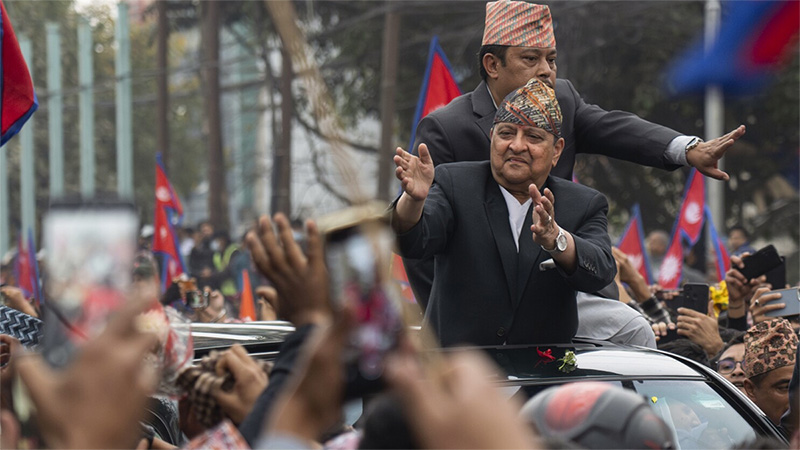
Tensions erupted in Nepal on Wednesday as thousands of people took to the streets, demanding the restoration of the monarchy. Seventeen years after the monarchy was abolished in 2008, growing frustration over corruption, economic crises, and political instability has rejuvenated the pro-monarchy movement.
On Sunday, more than 10,000 protesters marched through the streets of Kathmandu, holding portraits of former King Gyanendra Shah and calling for his return. Organizers, including the National Republican Party and other monarchist groups, claim that reinstating the monarchy is the only path to Nepal’s stability.
“Democracy has not delivered what we hoped for. Corruption, unemployment, and rising inflation have made life unbearable,” said Sunita Thapa, one of the protesters.
Nepal transitioned to a federal democracy in 2008 following a decade-long Maoist insurgency that claimed 16,000 lives and led to the end of the 239-year-old monarchy. However, the promised development under democracy remains unfulfilled. Successive governments have failed to bring political stability.
Current Prime Minister KP Sharma Oli, in office since 2024, is facing criticism for stalled development projects and allegations of corruption, further fueling the monarchists’ momentum.
Former King Gyanendra Shah, now 77, has not formally commented on the movement but has been seen occasionally appearing in public to wave at supporters, sparking renewed speculation about his return. His tacit support for a similar movement in 2020 was interpreted by many as a sign of his political aspirations.
“This movement reflects public frustration with political mismanagement, but whether the monarchy will fully return remains uncertain,” said political analyst Bimala Rai Paudel.
The government has dismissed the protests as insignificant. “This is nothing more than the unrealistic aspirations of a few,” said government spokesperson Pradeep Gyawali on Wednesday. However, the protests have spread beyond Kathmandu to eastern Nepal, including Prime Minister Oli’s political stronghold.
Nepal is also grappling with natural disasters. A 6.1 magnitude earthquake near Kathmandu and two powerful tremors in the Baglung and Myagdi regions have caused significant destruction. The government is under pressure to manage relief and reconstruction efforts, further aggravating public dissatisfaction.
Internationally, India is closely monitoring the situation. Nepal is seen as a key geopolitical bridge between India and China. China’s significant investments in Nepal’s infrastructure projects have added complexity to the crisis.
Nepal’s political future remains uncertain as the monarchy’s flag flies once more on the streets, signaling a potential shift in the country’s trajectory.

https://stapravda.ru/20221228/reyting_samyh_populyarnyh_hostingov_v_rossii_196445.html, рейтинг хостингов России подтверждает, что выбор надежного провайдера важен для бизнеса.