
Special Correspondent
A landslide in the Himalayas has triggered flash floods along the Tibetan border between Nepal and China, killing at least 500 people and leaving nearly 1,500 people missing in both countries, including at least 800 foreigners.
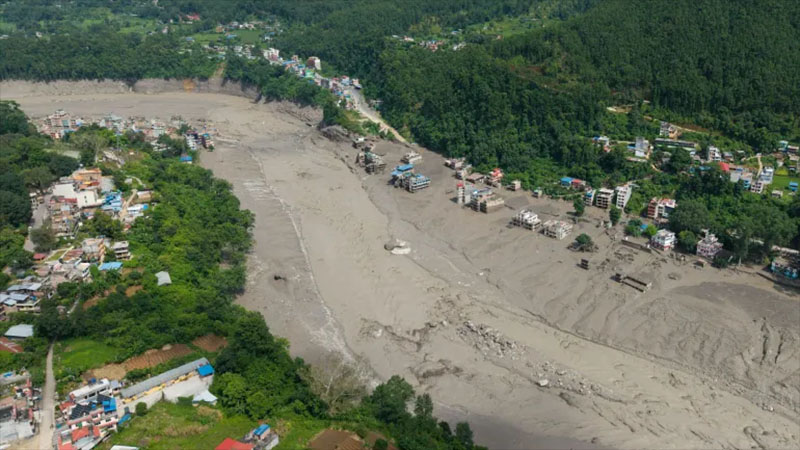
Flash floods and landslides hit the mountainous region along the Nepal-Tibet border at around 8:30 am local time on Wednesday. At least 157 people have died in Nepal and at least three in Tibet. The torrential rains, mud and rocks swept through the open Lend River valley, engulfing villages and destroying homes and other important infrastructure. At least 19 bridges and about 40 km of roads were washed away.
How the disaster began
Authorities were initially taken aback by the suddenness of the situation, as there was no rain on the day of the disaster. According to initial observations by scientists, the lower part of a glacier deep in the Himalayas at an altitude of about 5,200 meters broke off and plunged into a valley about 1,200 meters below. As it fell, it collected rocks and silt, forming a powerful snow-rock avalanche that hit the Lende River in Tibet—about 20 kilometers northeast of the Nepal-China border crossing. The debris temporarily blocked the river’s course, forming a natural dam, which then broke and caused severe flooding.
Initially, a magnitude 4.4 earthquake was thought to have caused the landslide. However, the United States Geological Survey (USGS) later revised its assessment to state that the seismic signal was not an earthquake, but rather a landslide. The landslide was eventually recorded as a magnitude 5.2 seismic event.
Where has the flood hit?
The worst affected district was Rasua in Nepal, which is located directly south of the Chinese border. The initial floodwaters entered the Lend Khola, passed through the Koshi and entered the Trishuli River, flowing south through Nepal. The Trishuli River was reported to have risen by about 9 meters in just 30 minutes.
The Timure and Sapru basins of Rasua district were the worst affected. The floodwaters then reached Nuwakot and Dhading districts, damaging homes and infrastructure. Across the border, mud and debris also hit the port of Geirong in the Shigatse region of Tibet. The Trishuli River eventually joins the Narayani River in the Indian state of Bihar, where it is known as the Gandak River.
Casualties and missing persons statistics
Nepal police have recovered at least 157 bodies so far. At least three deaths were reported in Tibet’s Gyirong County, where 558 people are missing, 260 of them foreigners.
According to police and tourism officials in Nepal, a total of 826 people are missing, including about 600 foreigners. The missing tourists are from more than two dozen countries. So far, the missing include 177 Indians, 63 Americans, 34 Australians, 33 British and 25 Canadians. However, authorities have not yet released a complete list of all the missing foreigners by nationality.
A large portion of those missing were pilgrims traveling to Kailash Mansarovar in Tibet. Tourism officials are trying to verify information about groups traveling through the region at the time of the disaster.
Local businessman Raju Vadel told Al Jazeera that he received a tearful phone call on the morning of the disaster saying his relative’s entire house had been swept away. Teacher Manoj Mishra said he saw at least nine trucks carrying people being swept away by the floodwaters.
At least 65 of the injured are being treated in Kathmandu and local hospitals. More than 5,000 Nepali army and police personnel are involved in the rescue operation, with food, tents and emergency supplies being airlifted to isolated areas by helicopter.
International response
Several countries and international organizations have extended their support to Nepal in the face of the disaster. India has sent a rescue plane carrying nearly 10 tons of emergency relief supplies—temporary shelters, blankets, medical supplies, solar lamps, and medicines—to Nepal. Indian Prime Minister Narendra Modi spoke to Nepalese Prime Minister Balendra Shah and pledged assistance.
The International Federation of Red Cross and Red Crescent Societies (IFRC) has released one million Swiss francs (approximately $1.2 million) as emergency funding for the Nepal Red Cross Society’s relief efforts and damage assessment.
The United Nations has deployed staff to support government-led relief efforts in Nepal, while its office in China has said it is ready to assist with rescue operations in Tibet. UN Secretary-General Antonio Guterres expressed his condolences to the victims. The European Union has activated its Copernicus Emergency Management Service to help with disaster mapping.
South Korea has formed a government task force and is planning to send a rapid response team to Nepal after several citizens working at a hydroelectric project went missing. The United States has announced a disaster management advisor and $500,000 in aid. Canadian Prime Minister Mark Carney has called the situation “extremely dire.”
Chinese President Xi Jinping has ordered an all-out rescue operation to search for missing people in Tibet and take measures to prevent future disasters.
Impact of climate change
The exact role of climate change in this particular avalanche is still unknown, and scientists are investigating. However, the disaster occurred against a backdrop of rapid warming and glacier loss in the Himalayan region. Glaciers in the Hindu Kush Himalayas, which spans Afghanistan, Bangladesh, Bhutan, China, India, Myanmar, Nepal and Pakistan, lost ice 65 percent faster between 2011 and 2020 than in the previous decade. Glaciers in Nepal have lost about a third of their ice volume in the past three decades.
Satellite observations show that the glacier was unusually warm before the collapse, and that the snowpack had significantly reduced, exposing more of the ice. Researchers are investigating whether the melting destabilized the glacier, although a direct link to climate change and this week’s collapse has not yet been established.
Current situation
More than 5,000 Nepali soldiers and police are still searching for survivors and recovering bodies. Officials have warned that the death toll could rise as rescuers reach areas still inaccessible due to damaged roads, high water levels and thick mud.
In Tibet, Chinese authorities are monitoring a lake still dammed by a dam in Geirong, upstream of the disaster site, which could complicate rescue efforts and pose a risk of new flooding.

https://stapravda.ru/20221228/reyting_samyh_populyarnyh_hostingov_v_rossii_196445.html, рейтинг хостингов России подтверждает, что выбор надежного провайдера важен для бизнеса.