
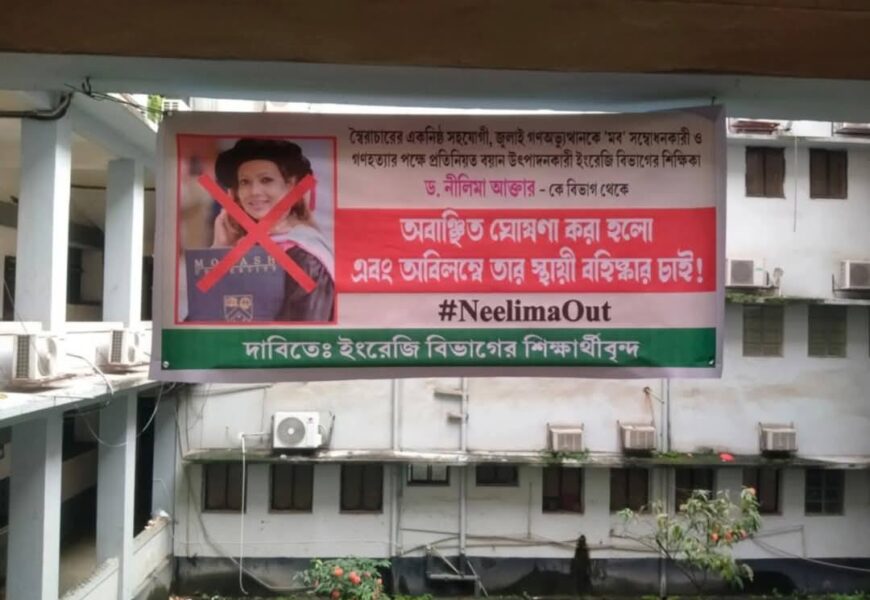
Staff Correspondent. Dhaka, July 30, 2025.
Dr. Neelima Akhtar, an associate professor of the English department of Dhaka University, has been dismissed from her job for publicly protesting against the misrule of the interim government led by Dr. Muhammad Yunus. Through her Facebook post on social media, she had raised questions about the Gopalganj massacre, the killings that took place after August 5, and the killing of 1,300 soldiers during the Ziaur Rahman era. In addition, after giving a written statement against mob-terrorism in the university, she faced the wrath of groups supported by Jamaat-BNP and Chhatra Shibir. Despite this, the university administration has exempted her from all academic and administrative activities as she continued to protest.
Dr. Neelima Akhtar, who is known as a pro-Awami League teacher and won the Dhaka University Teachers’ Association elections in 2022 as a Blue Party candidate, recently criticized the Dr. Yunus-led government in several posts on Facebook. She questioned the recent killings in Gopalganj, the violence that has taken place since August 5, and the killing of 1,300 soldiers during Ziaur Rahman’s rule in 1975, and demanded accountability from the government.
In addition, she issued a written statement against the mob-terror by Jamaat-Shibir-supported groups at the university, which went viral on social media. A post published on X Platform claimed that due to Neelima Akhtar’s protest, members of Jamaat-Shibir and the student organization planned to create a mob against her. One post said, “Dr. Neelima Akhtar, an associate professor in the English department of Dhaka University, is facing danger for speaking the truth with a strong voice. Anti-independence militant activists of the Shibir and the student organization are trying to create a mob against her.”
As Dr. Neelima’s protests continued, the university administration, which some have called pro-Jamaat, relieved her of all academic and administrative duties. The incident is being compared to the dismissal of Lalmonirhat magistrate Urmi Roy, who was removed from office for similar political reasons. No official statement has been received from the university administration on this matter, but the decision is being criticized on social media as “vindictive”.
Neelima Akhtar’s location
After August 5, when many teachers remained silent for their own safety, Dr. Neelima Akhtar was vocal in favor of Bangabandhu Sheikh Mujibur Rahman’s ideals, the spirit of the Liberation War, and the safety of students. She has been constantly speaking out against the influence of Jamaat-Shibir and terrorist activities in the university, which is believed to be one of the reasons for her dismissal. Her supporters on social media say, “Despite knowing the danger, she did not remain silent. She was punished today for speaking out in favor of the Liberation War and for the ideological students.”
Dr. Neelima’s dismissal has sparked a strong reaction among teachers and students of Dhaka University. Pro-Awami League teachers and student organizations have strongly condemned the decision. A Chhatra League leader said, “This is part of the anti-liberation war agenda of Dr. Yunus’ government. Honest and brave teachers like Neelima ma’am are being targeted.” Meanwhile, BNP and Jamaat-backed groups have denied the allegations, saying that the university administration has taken a neutral decision. However, the incident has raised questions about political influence and freedom of expression in the university.
The incident has drawn widespread support and criticism on social media. Supporters have demanded Dr. Neelima’s reinstatement and a transparent investigation into the action taken against her. Analysts say the incident has thrown a new light on political influence in universities and the freedom of expression of teachers. The next steps by the government and university authorities will influence public opinion on the issue.

https://stapravda.ru/20221228/reyting_samyh_populyarnyh_hostingov_v_rossii_196445.html, рейтинг хостингов России подтверждает, что выбор надежного провайдера важен для бизнеса.