
Preset71
Behind them, villages burn fiercely. Armed soldiers stand on the roads. In front, several children run. The middle child is completely naked—clothes burned off. The expression on her face reveals severe burns. The nine-year-old girl’s name is Phan Thi Kim Phúc. The blazing village is Trang Bang, Vietnam, January 8, 1972. This harrowing image of American napalm brutality was captured by Associated Press photographer Nick Ut. Titled “The Terror of War,” it later became a powerful anti-war symbol.
The burned child became globally known as “Napalm Girl.”
Is napalm a gas or a bomb? Napalm is a chemical compound—a mixture of gelling agents and gasoline—dropped from warplanes or helicopters. Upon contact, it ignites fires at 1,500–2,200°F, instantly incinerating infrastructure. The gel sticks to human skin, melting flesh to the bone. Water offers no escape; napalm burns underwater. The U.S. extensively used it in Korea and Vietnam.
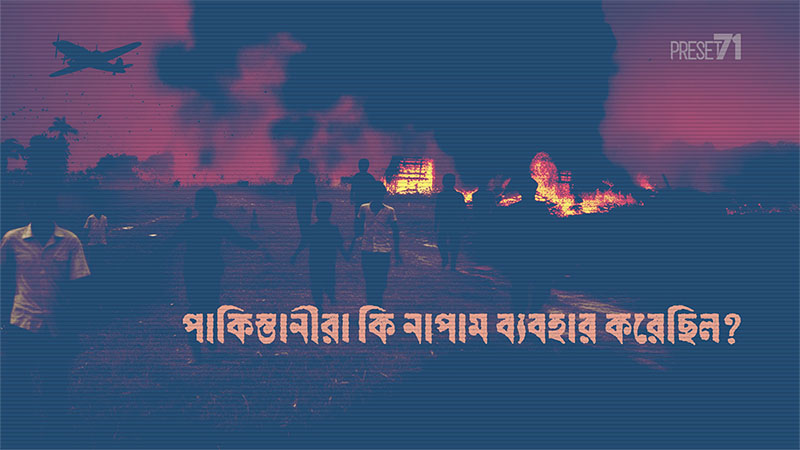
Did Pakistan use napalm in their genocide against Bengalis?
The first confirmed case occurred in Chuadanga on April 3. Led by Dr. Ashabul Haq MP and Major Abu Osman Chowdhury, the *”South Western Command”* of freedom fighters and 5,000 civilians defeated Pakistani forces in Kushtia on March 30, capturing officer Atullah alive. They seized 24 military jeeps/trucks, 58 machine guns, 89 automatic rifles, and over 100,000 bullets.
Chuadanga served as a tactical HQ. On April 3, a French TV crew led by Philippe Alfonsi arrived and interviewed Major Osman and POW Atullah. While filming captured weapons, Pakistani Sabre jets attacked, dropping napalm—the first on Bengali soil—targeting the EPR headquarters and civilian homes. The crew documented the assault from trenches and trees.
In Habiganj’s Halderpur village, near Major General M.A. Rob’s home, a wedding celebration was underway on April 25. A helicopter flew overhead, ignored by villagers. The next morning, two jets circled Haji Abdus Samad’s house. One descended, releasing a black smoke-like substance. Instantly, the homestead erupted in flames. Thirteen died, including women and children. Survivors testified that jumping into ponds didn’t stop the burning—a hallmark of napalm. Many still suffer respiratory issues decades later.
Beyond Chuadanga and Halderpur, evidence suggests Pakistan used napalm repeatedly during the nine-month war. Countless perished in agonizing pain—a history we’ve inadequately documented.
Sources:
1. Testimony of Lt. Col. M.A. Osman Chowdhury, Documents of the Liberation War, Vol. 9
2. Accounts from Halderpur villagers

https://stapravda.ru/20221228/reyting_samyh_populyarnyh_hostingov_v_rossii_196445.html, рейтинг хостингов России подтверждает, что выбор надежного провайдера важен для бизнеса.