

Dr. Mamunur Rashid
The two biggest issues exploited in the July-August deception were genocide and selling Bangladesh’s independence to Delhi. While we’re yet to see any legal action against the occupying oppressors regarding genocide, it’s now clear that Sheikh Hasina never made any anti-state agreements with India. Much of this became evident when India began withdrawing various privileges previously granted to Bangladesh.
Did Sheikh Hasina really sell out Bangladesh? What was the state of our economic and political independence? Let’s examine the data.
The Heritage Foundation (heritage.org) has long published the Index of Economic Freedom. Though termed “economic freedom,” this index analyzes 12 factors, many of which include political, judicial, and institutional independence. Chart 1 displays these 12 factors.

The accompanying video shows a comparative heatmap of total freedom indices for Asian countries, using data from 1995 to February 2025. Green indicates good, red indicates bad. Bangladesh and most Asian countries are orange (slightly better than red), meaning these nations aren’t fully “free” by Western standards. However, the video illustrates Bangladesh’s freedom trajectory from 1995 to 2025.
Two key differences emerge from this heatmap:
1) During Sheikh Hasina’s tenures (1996-2001 and 2009-2024), Bangladesh’s overall freedom index outperformed many Asian nations. By 2024, Bangladesh’s score (54.4) surpassed China (48.5), Russia (52), and even India (52.9).
2) COVID-19 and the Russia-Ukraine war impacted labor, judicial, and trade freedoms. All Asian nations suffered during conflicts.
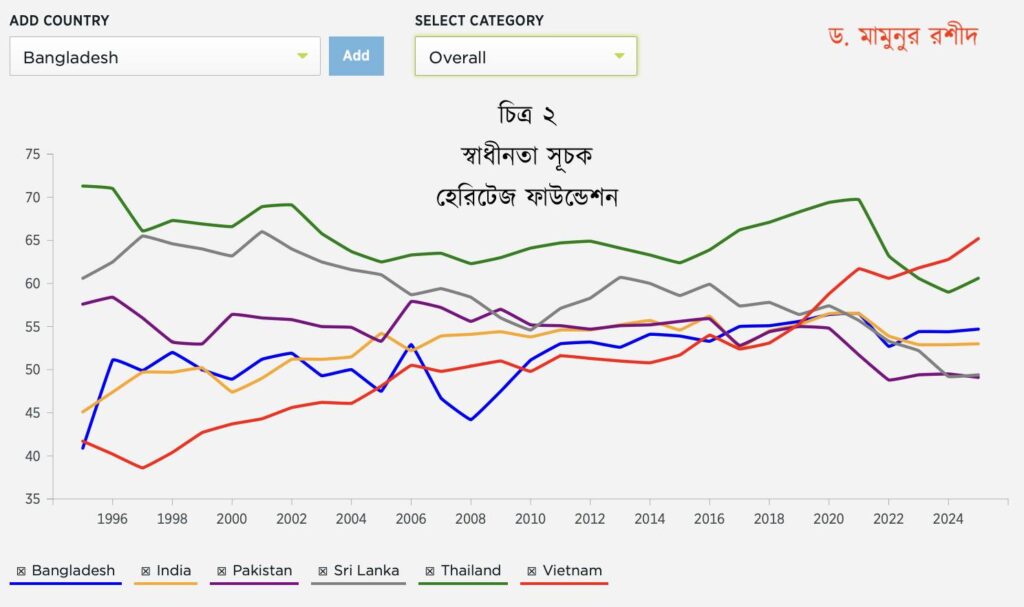
For deeper analysis, observe Chart 2’s blue line tracking Bangladesh. This line chart compares freedom indices of six selected Asian countries from 1995 to 2024.
The chart clearly shows Bangladesh at the bottom in 1995 before Hasina took office. The score rose from 40.9 in 1995 to 51.1 in 1996, peaking at 51.2 in 2001. Under BNP-Jamaat-Ershad (2002-2008), the index plummeted from 51.9 to 44.2.
When Hasina returned in 2009, she elevated the score from 44.2 (2008) to 54.4 (2024). In 2008, Bangladesh ranked last among the six nations; by 2024, it climbed to third. While COVID and the Ukraine war caused temporary declines (2021-22), Bangladesh rebounded within a year (2022-23)—unlike Thailand, Sri Lanka, and India, whose scores kept falling.

Chart 3 zooms into 2017-2025 scores. Though challenges remain, the hallmark of Hasina’s governance was consistent annual improvement. Global crises caused temporary dips, but recovery followed each time. The weakest areas were judicial independence, government integrity, and property rights—all domestic issues unrelated to India.
Yet despite these gains, baseless claims about “selling independence” persist. Ironically, Bangladesh outperformed India—the very country allegedly controlling it.
This means you’ve enjoyed far greater freedom over the past 16 years than propaganda suggests—more than many nations.
Despite this progress, systematic disinformation has destroyed a progressive nation. And many of us, unknowingly, fueled the fire.

https://stapravda.ru/20221228/reyting_samyh_populyarnyh_hostingov_v_rossii_196445.html, рейтинг хостингов России подтверждает, что выбор надежного провайдера важен для бизнеса.