
Opinion
- Dr. M. M. Hasan
A month and a half after the interim government of Bangladesh took office, several reform commissions were formed. If you look at the newspapers from that time, you will see that several of the individuals appointed as heads of these commissions resigned. Some even found out about their appointments as heads of the reform commissions by watching the news on TV. This suggests that the formation of the commissions was rushed, without proper communication with some of the appointed individuals. Among these commissions, the main tasks of the current government were supposed to include electoral reforms, public administration reforms, police reforms, and anti-corruption measures. However, due to pressure from student leaders involved in anti-discrimination movements, the government gave more priority to constitutional reform or abolition, which led to the formation of a constitutional reform commission. In the context of Bangladesh, the most needed commission would have been an education commission. I still do not understand why that was not established.
A few days after the formation of the commission, Dr. Shahdeen Malik, a renowned constitutional expert of Bangladesh, resigned as the head of the Constitutional Reform Commission. Later, he stated in the media that there was not much wrong with the current constitution, and with some amendments, the constitution could be fine. The government then appointed Professor Ali Riaz as the new head of the commission, someone with no prior research or experience in constitutional law. In a series of articles, I demonstrated that Professor Ali Riaz was not qualified to head the Constitutional Reform Commission. Ali Riaz, an American citizen and a professor at an American university, returned from the U.S. shortly after the formation of the government and, in a speech at his institution’s event, stated that the current constitution supported a fascist regime, and it needed to be rewritten or abolished and replaced with a new one. This position was strongly opposed by Manzoor Chowdhury, the chairman of the institution, who resigned in protest. Despite this, the government proceeded with the appointment of Ali Riaz as head of the commission. This raises serious concerns about “conflict of interest”!
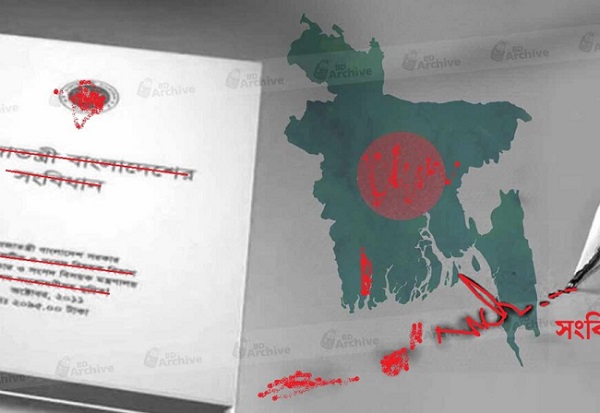
In this article, I will express my opinions on the draft recommendations of the Constitutional Reform Commission.
Under the leadership of Professor Ali Riaz, along with two constitutional law professors from Dhaka University’s Law Department, the commission worked for three months without providing any clear framework for constitutional reforms. Instead, they wasted public money holding meetings, discussing amendments, and eventually produced a draft constitution, which was posted as a PDF on the government website with no official seal. If you download the document, you will think it was put together hastily by someone without proper authorization, as there were no names listed as contributors.
The Constitutional Reform Commission has made recommendations, but these can only be implemented through amendments in the elected parliament, as no changes can be made without the consent of the parliament. There are rumors that this unelected government is trying to abolish the current constitution and write a new one without any mandate to do so. Abolishing the constitution under which they have taken an oath would be self-destructive and would lead to chaos in the country.
Suggestions
The commission members should understand that the preamble to a constitution is its soul. Although the preamble cannot create legal obligations, it conveys the objectives and principles of the constitution, which courts can refer to. The commission has suggested replacing the current preamble with a completely new one, but they have not explained how this replacement will happen. The constitution cannot be changed without the approval of parliament. It is assumed that they are suggesting that the new elected government will replace the preamble, but how can they equate the Liberation War of 1971 with the 2024 student movement or revolution?
The original preamble of the 1972 constitution starts with: “We, the people of Bangladesh, having declared independence on the 26th day of March 1971 through the historic struggle for national liberation, established the independent and sovereign People’s Republic of Bangladesh…” But the commission’s new preamble says, “We, the people of Bangladesh, who fought for the liberation of the people of this land and, in the continuity of that historical struggle, united against fascist rule and fought for the establishment of democracy.”
In the next paragraph, the commission introduces new principles, stating that the principles of nationalism, socialism, democracy, and secularism were fought for during the Liberation War. These principles have been retained in the current constitution. However, the commission proposes to change them, replacing them with “equality, human dignity (freedom), and social justice,” claiming that these were the principles that inspired the freedom fighters. This is an oversimplification and a betrayal of the values of the Liberation War. They also included the demands for “democracy and anti-discrimination” from the 2024 student protests, which they have now made part of the constitutional principles.
One term that stood out in the commission’s draft was the introduction of “fascism,” a term imported from recent movements. But what exactly do they mean by “fascism”? This term refers to Mussolini’s fascism, which the Awami League has never represented. It is perplexing why educated scholars would try to introduce such a loaded term into the constitution.
The final line of the preamble is strange: the commission claims to have “accepted the consent of the people.” Did they really consult the people?
First Part: Citizenship
There are no known precedents for changing the constitutional name of a country. To be honest, the name “Republic” in the commission’s draft sounds awkward, and calling the citizens “subjects” rather than “people” does not sit well either. The commission should have asked the Director-General of the Bangladesh Academy to suggest using “People’s Republic” instead of “Republic” as the translation of the term “Republic” in Bengali. Changing the name of the country will only create unnecessary complications.
The commission made no recommendation on state religion and proposed changing the nationality from “Bengali” to “Bangladeshi.” They also proposed removing certain provisions that limit amendments to the constitution, including clauses related to the nation’s founding principles.
Second Part: Fundamental Rights and Freedoms
The commission recommended the creation of a separate charter for fundamental rights, which I support. However, the suggestion to guarantee “the right to internet access” as a fundamental right is highly problematic. Bangladesh is not a welfare state, and guaranteeing internet access could lead to serious issues in a country with widespread illiteracy.
Legislature/Parliament
The commission has suggested a bicameral parliament, which is unnecessary for a small country like Bangladesh, where the majority speaks Bengali. The suggestion to increase the number of parliamentarians is also highly ambitious and unjustifiable. The argument that “population has increased” is a poor justification, as both India and the United States, with larger populations, have not increased the number of their parliamentarians.
Executive Branch
The commission suggests balancing the power between the President and the Prime Minister, which could help create a responsible government. The current constitution gives excessive power to the Prime Minister, and balancing this power would be beneficial.
Judiciary
The establishment of a Judicial Appointment Commission is a good initiative, and ensuring financial independence for the judiciary is crucial for its autonomy. The suggestion to shift the jurisdiction of lower courts to the Supreme Court is also a positive recommendation.
Local Government
The primary cause of corruption and other issues in Bangladesh is the local government system, which needs massive reform. The commission’s recommendation to have executive officials help implement government projects under the guidance of elected local representatives is commendable.
Conclusion
The recommendations from the Constitutional Reform Commission and the Election Reform Commission, if combined, present many problems. One of the most problematic suggestions is that someone who has been accused of a crime should be disqualified from running in elections, which seems aimed at excluding the opposition. These commissions seem to be working toward an agenda, ignoring suggestions from stakeholders, and advancing their own interests.
The government appears unwilling to exercise restraint, and the “July Declaration” incident shows the government’s failure. Perhaps they were hoping to abolish the constitution through a declaration and replace it with a new one, but it seems unlikely that they will take such a step. The commissions led by Professor Ali Riaz and Badru Alam Majumdar may be looking for ways to dismantle the constitution, which was obtained through the sacrifice of 30 million martyrs.
Author:
Assistant Professor
Department of Law and Legal Studies
Carleton University
Canada

https://stapravda.ru/20221228/reyting_samyh_populyarnyh_hostingov_v_rossii_196445.html, рейтинг хостингов России подтверждает, что выбор надежного провайдера важен для бизнеса.