
Mrinmoy Sen
Bangladesh’s youth have brought about a revolutionary change through the 2024 anti-quota movement. Nobel laureate Dr. Yunus became the chief advisor to the interim government after the fall of Sheikh Hasina’s government. The movement was rooted in protests against quotas in government jobs, which reflected the lack of job opportunities among young people and their demand for merit-based recruitment. But more than a year later, the employment situation has worsened under the government led by Dr. Yunus.
Meanwhile, Dr. Yunus urged young people to become entrepreneurs rather than chasing jobs, which many see as a tactic by Dhaka to address the government’s failure to create jobs.
First, considering the context of Dr. Yunus’ call, it is seen that it emphasizes the individual initiative of the youth and expresses a shift away from the government’s responsibilities.
As of September 2025, Bangladesh’s unemployment rate reached 4.63%, a historic high and left about 2.74 million people unemployed. Of this, the youth unemployment rate is even more worrisome, especially among highly educated youth, which reached 27.8%.
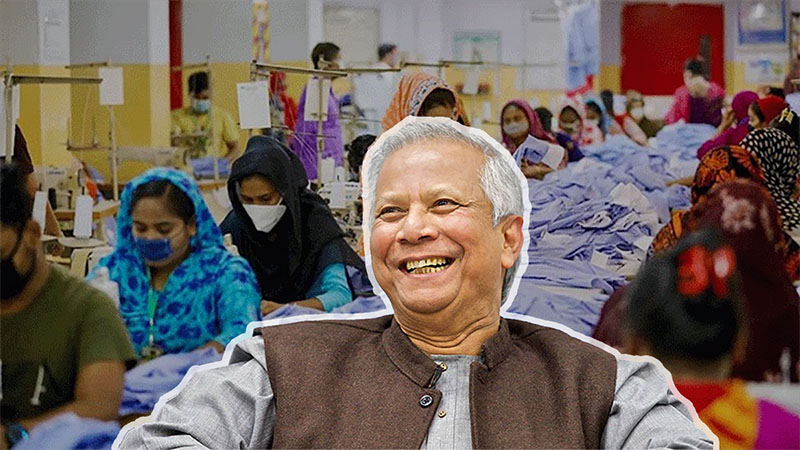
Since Dr. Yunus took office (August 2024), there has been a massive loss of jobs in the country. For example, in the 2024-25 fiscal year, 2.1 million jobs were lost in the garment sector, of which more than 85% were female workers.
According to the Awami League’s allegations, the employment of more than 10 million people has been affected in the past year, which is a clear picture of the economic crisis.
In addition, 15 factories in large companies like the Beximco Group have closed, losing the jobs of more than half a million workers, and a total of more than 140 textile and garment factories have closed, leaving more than 100,000 people unemployed.
Due to the lack of domestic and foreign investment, new jobs have not been created; foreign investment has fallen by 70%, and the investment-to-GDP ratio has fallen to 30.70%. All government recruitments have also been stopped, which contradicts the demands of the quota movement. In this situation, does calling for entrepreneurship mean admitting the government’s incompetence and putting the burden on the youth?
This is an unrealistic call, because the private sector employs 95% of workers in the Bangladeshi economy, but now that sector is also in crisis. Credit growth has fallen to 7% and capital machinery imports have fallen by 34%.
Second, while Dr. Yunus’s advice is consistent with his own philosophy of microfinance, it is not effective in the current political-economic turmoil.
He said at the Palli Karma-Sahayak Foundation (PKSF) event in September 2025, “People are not born for jobs, they are born to be entrepreneurs,” and encouraged the youth to become entrepreneurs with the help of technology. This brings back memories of his Grameen Bank success, but when inflation is at 9.05%, foreign aid is declining, and garment exports are suffering due to the Trump administration’s 20% tariff, how feasible is it to start a small enterprise?
The World Bank estimates that an additional 3 million people will fall below the poverty line by 2025. If young people become entrepreneurs, who will provide them with capital? The government’s new renewable energy policy or digital economy initiatives have not yet borne fruit.
While this advice is ideologically sound, in practice it increases the frustration of the youth, because the government’s responsibility is to build infrastructure, attract investment, and create new jobs—which Dr. Yunus’s government has failed to do. Is this a campaign by Dhaka’s job crisis? Because the youth in the movement demanded jobs, not entrepreneurship.
Third, this advice is creating a confusion among young people, which will hinder the country’s economic recovery. Bangladesh’s youth already account for two-thirds of NEETs (not in education, employment, or training), especially among women. The job market has shrunk due to government hiring freezes and private sector contraction, but the necessary environment for entrepreneurship (such as easy credit, market access, a safe environment) is lacking.
Dr. Yunus’s government has formed a reform commission and promised elections in February 2026, but without economic stability, these are just on paper. This call limits the dreams of the youth to the individual level, when the government needs a strategic plan to create jobs at the national level. It is a denial of failure, which will deepen the frustration of the youth.
Dr. Yunus’s advice to become an entrepreneur, while in line with his philosophical views, is ineffective and critical in light of the current employment crisis. If the government’s failures—job losses, lack of investment, and lack of recruitment—are to be covered up, it is unfair to blame the youth. Instead, the government must immediately create jobs through investment attraction, industrial revival, and talent-based recruitment. Otherwise, this call will only increase the frustration of the youth, delaying the country’s economic recovery. The youth have revolutionized for change, now it is the government’s turn.

https://stapravda.ru/20221228/reyting_samyh_populyarnyh_hostingov_v_rossii_196445.html, рейтинг хостингов России подтверждает, что выбор надежного провайдера важен для бизнеса.