
Staff Correspondent. Dhaka, August 17, 2025:
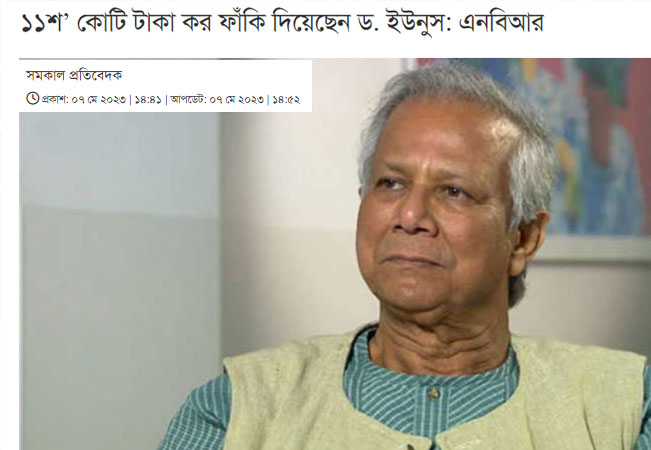
There is widespread debate and criticism over the allegations of tax evasion by Nobel laureate economist Dr. Muhammad Yunus and the tax policies he enacted after coming to power. A case filed by the National Board of Revenue (NBR) in the High Court on May 7, 2023, revealed that Dr. Yunus and the institutions he founded evaded taxes worth Tk 1,100 crore in five years from 2012 to 2017. Of this, Grameen Kalyan owed the government Tk 576 crore 94 lakh 57 thousand 823, another Grameen Kalyan institution Tk 354 crore 79 lakh 89 thousand 547, and Grameen Telecom owed the government Tk 215 crore.
On March 11, 2024, the Appellate Division ordered the High Court to settle the case of Grameen Kalyan’s tax claim of Tk 666 crore within 3 months.
After this, on August 4 last year, a High Court bench of Justice Mohammad Khurshid Alam Sarkar and Justice Sardar Md. Rashed Jahangir dismissed the writ petition filed by Grameen Kalyan challenging the validity of the NBR’s tax claim of Tk 666 crore. As a result, Dr. Yunus was ordered to pay Tk 666 crore to the government.
After taking office in 2024, Dr. Yunus overturned the Appellate Division’s verdict of paying 666 crore taka in taxes. He declared all his income legitimate and cleared himself of all tax evasion cases. This move has sparked intense public anger and dissatisfaction. Because, even though he was acquitted of his own tax evasion charges, he has increased the tax rate on ordinary citizens, further increasing their cost of living.
Under the new tax policy formulated under the leadership of Dr. Yunus, the advance income tax of employees has been increased from 10 percent to 15 percent. Penalties have been introduced for those who file zero returns. In addition, the advance income tax of those who do not have a Tax Identification Number (TIN) has been increased from 15 percent to 22 percent. This policy is creating additional financial pressure on the common citizens, especially the middle and lower-middle classes.
On the other hand, as per the Finance Ordinance 2025, the personal tax-free income limit has been kept unchanged at Rs 3,50,000. However, it is proposed to increase this limit to Rs 3,75,000 for the assessment years 2026-27 and 2027-28. The maximum tax rate for high-income earners has been reinstated at 30 per cent, which will put additional pressure on the high-income group. In addition, the minimum tax for new taxpayers has been fixed at Rs 1,000, as part of an effort to bring new taxpayers into the tax net.
Public reaction and criticism
This discriminatory policy has led to widespread public discontent. Critics say that while Dr. Yunus has been cleared of allegations of massive tax evasion by himself and his organization, he has increased the cost of living for ordinary citizens by raising taxes. A middle-class employee said, “The person who cleared himself of allegations of tax evasion of hundreds of crores of taka is now imposing 15 percent or 22 percent tax on us. What kind of justice is this?”
Economist Zahid Hossain believes that raising the tax rate, along with increasing the tax-free threshold, will have a “mixed” impact on the middle class. “The upper-income group will feel more pressure from this policy, but it will also become an additional burden for the middle class,” he said.
Other tax reforms and impacts
The Finance Ordinance 2025 has proposed several reforms. For example, changes have been made to the VAT (Value Added Tax) policy, where VAT on services provided by construction companies has been increased from 7.5 percent to 10 percent and VAT on commissions on online sales platforms has been increased from 5 percent to 15 percent. In addition, VAT exemptions have been proposed on environmentally friendly products and essential goods, such as liquid milk, diapers and liquefied natural gas (LNG).
However, these reforms are seen as creating more pressure than relief for the general public. In particular, the advance income tax on commercial imports has been increased from 5 percent to 7.5 percent, which could lead to an increase in the price of goods.
The controversy over Dr. Yunus’ tax policy is intensifying. Although he has been cleared of tax evasion charges against himself and his organization, there is growing public frustration and anger over the increased tax burden on ordinary citizens. The NBR and ACC have not yet made any official comments on the matter. However, everyone is watching the public’s reaction and possible legal action against this discriminatory policy in the coming days. The demand for a tax policy based on transparency, justice, and equality is growing stronger.

https://stapravda.ru/20221228/reyting_samyh_populyarnyh_hostingov_v_rossii_196445.html, рейтинг хостингов России подтверждает, что выбор надежного провайдера важен для бизнеса.