
Staff Correspondent
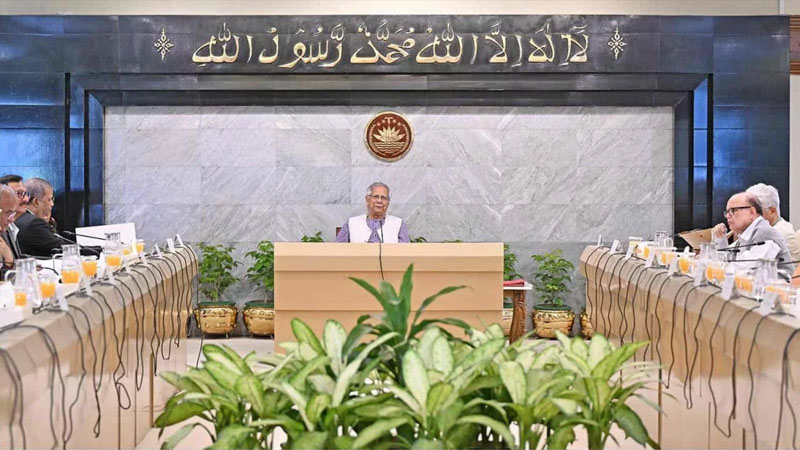
The draft of the ‘Foreign Donations (Voluntary Activities) Control (Amendment) Ordinance, 2025’ was given final approval in the recent meeting of the Advisory Council chaired by Chief Advisor Dr. Yunus.
The amendment has simplified the rules for NGOs, including private development organizations, to receive and use foreign donations. The NGO registration process has been simplified, conditions for releasing donations have been relaxed, and the requirement for approval for donations up to Tk 50 lakh per year has been abolished. The government claims that this will make NGOs more participatory and stakeholder-friendly.
But in light of this simplification, concerns have arisen about the influence of foreign donations on the country’s politics and sovereignty. These concerns are especially evident when looking at the funding history of international organizations such as USAID and the Open Society Foundations.
Analysts believe that this law could lead to increased invisible interference by foreign powers, which could affect the country’s internal politics and lead to the erosion of sovereignty. Below is a detailed picture of these fears.
USAID funding: Allegations of political instability and regime change
USAID, the United States development assistance agency, has channeled massive amounts of money through NGOs to Bangladesh. The highest amount of $1.89 billion in South Asia entered Bangladesh in 2021-2024, with most of it being distributed to NGOs and civil society groups. The money supports projects on governance, democracy promotion, and civic education, but critics have called them tools for political interference.
Role of the International Republican Institute (IRI) and the National Democratic Institute (NDI): These two organizations operate with funding from USAID and the National Endowment for Democracy (NED).
They have begun youth leadership training, NGO collaboration, and election observation in Bangladesh ahead of the 2026 elections. In 2019-20, there were allegations that an IRI plan was used to bring the BNP to power. In addition, USAID-funded rap groups were used to create provocative protest songs to incite protests.
Role in the political unrest of 2024
Awami League Minister Mohibul Hasan Chowdhury has alleged that USAID and IRI funding has been used to destabilize the Awami League government since 2018. It has been claimed that this money was used to activate NGOs in the 2024 riots and to bring about the downfall of Sheikh Hasina.
According to former US State Department official Mike Benz, USAID has used US taxpayer money to create political instability.
Even Donald Trump’s administration has canceled $29 million in USAID funds, which were allegedly being used to strengthen the political landscape.
This funding allows NGOs to influence political parties, civil society, and the media to advance foreign interests (such as competing against China’s Belt and Road Initiative). This is seen as a threat to national sovereignty, as NGOs can be used as ‘soft power’ to control domestic politics.
Funding of Open Society Foundations (OSF): Political agenda under the guise of human rights
The George Soros-founded Open Society Foundations is the world’s largest private philanthropic organization, spending $1.7 billion in 2023. It has been working on human rights, education, and the Rohingya crisis in Bangladesh since 2004.
For example, in 2017, $10 million was given to aid Rohingya refugees through the NGO BRAC. But critics accuse the Open Society Foundations of pursuing an “ideologically specific agenda.”
Political influence
The Open Society Foundation funds NGOs and incites political movements in the name of democracy promotion, governance, and minority rights.
In Bangladesh, it influences the media narrative and the opposition through NGO networks. According to Trump’s allegations, the Open Society Foundations received $260 million through USAID, which was used to create instability in countries including Bangladesh.
Sovereignty risks
Open Society Foundation funding challenges local culture and political stability by empowering ‘fringe groups’ and advocacy networks. It has been banned in Hungary, Russia and India. In Bangladesh it can turn NGOs into ‘foreign agents’, subordinating national decisions to foreign agendas.
The harmful potential of this law in the future
The previous law (Foreign Donations Regulation Act, 2016) imposed strict controls on foreign funding, which kept NGOs government-controlled. But the current relaxation (such as exemption of up to Tk 50 lakh) allows NGOs to have unlimited foreign funding flows, which can pose the following risks:
| Risk type | Possible harm | Examples |
| Political interference | NGOs can influence elections or movements by pursuing foreign agendas (such as democracy promotion), which undermines domestic stability. | IRI/NDI’s youth training project could increase polarization in the 2026 elections. |
| Loss of sovereignty | Foreign donors (such as USAID/OSF) can use NGOs as ‘proxies’ to influence national policy (such as opposition to BRI). | Soros’ network through OSF can create neo-colonialism by challenging local culture. |
| Economic and social instability | Opaque funding can increase corruption, and hinder local development by making NGOs biased towards foreign interests. | USAID’s $270 million EWMI used for political outcome engineering. |
| The decline of NGO independence | Indirect control may increase in the name of relaxation, which could turn NGOs into ‘fronts’ for foreign funders. | Like previous laws, it could be used to suppress anti-government voices. |
Experts recommend that this risk be addressed by increasing transparency in donations, regular audits, and imposing restrictions on political activities. If this law is not properly implemented, it could cause long-term damage to Bangladesh’s sovereignty. It is essential to address this challenge through dialogue between civil society and the government.

https://stapravda.ru/20221228/reyting_samyh_populyarnyh_hostingov_v_rossii_196445.html, рейтинг хостингов России подтверждает, что выбор надежного провайдера важен для бизнеса.