
Economic Desk
The country’s small and medium enterprise (SME) sector is currently going through a difficult time due to economic pressures, market uncertainty and funding shortages. A large section of entrepreneurs have reported that their sales have declined significantly in recent months. For many, it is no longer possible to keep showrooms or physical stores open.
TBS spoke to about 40 entrepreneurs who participated in the National SME Product Fair held in Dhaka. Almost all of the entrepreneurs said that their businesses have shrunk due to the economic recession, market instability and severe financial crisis. In this situation, they are not very optimistic about 2025; instead, many see 2026 as a possible time for a turnaround.
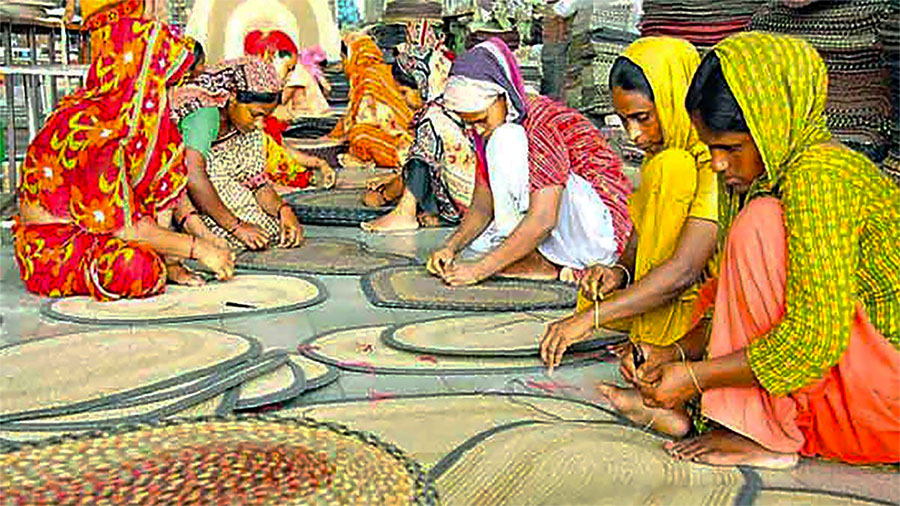
Organized by the SME Foundation, the fair, which began on December 7 at the Bangladesh-China Friendship Conference Center in Agargaon, Dhaka, will continue until December 14. More than 350 SME organizations have participated in it, about 60 percent of which are women entrepreneurs.
AM Fashion founder Mahmuda Akhter said that after running the business for nine years, he was forced to close his showroom in Uttara in early 2024. Although the business turned around somewhat in the post-Covid period, it was no longer possible to sustain it as ancillary costs including showroom rent, employee salaries and other expenses increased.
He said, “My business has decreased by more than half. I have also reduced my purchases now.” He sees the main reason for this situation as the cost of living rising despite people’s income not increasing. He also said that the emigration of a section of the high-spending population due to political unrest has had a negative impact on the sales of expensive and luxury goods.
Mahmuda also mentioned the narrowing of financing opportunities as a major challenge. He had previously repaid bank loans, but now he has been unsuccessful in trying for a loan of Tk 1.5 million for several months.
Other entrepreneurs also shared similar experiences. Elora Parveen, owner of Bahari Rang, said, “There is very little shopping now. Many people I know have closed their businesses. Some are somehow surviving online. Even at the fairs, there is almost no sales.”
Shahina Akhter, the owner of Egis Shield from Chittagong, said, “People have reduced their spending now. Even if they have money in hand, they are not leaving it in the market. Maybe business can turn around again if the political situation stabilizes.”
Rubina Akhter Munni, owner of Design by Rubina, highlighted the complexities related to VAT, compliance and trade licenses. She said that after shifting the factory to Gazipur, she had to go from office to office for two months to get a trade license. “Those who issue licenses do not understand the reality of SMEs,” she said.
Several entrepreneurs, including Shahina Akhter, believe that the country’s SME ecosystem is too Dhaka-centric. As a result, entrepreneurs outside the capital have to spend extra time and money on training, procurement of raw materials, and office work.
Zuena Ferdous Mitul, owner of Ahlad Fashions and this year’s winner of the Best Entrepreneur Award in the Micro Category, emphasizes the importance of advanced training for international product development. She also cited the complexity of documentation as a major obstacle in exporting.
Jannatul Mawa, an entrepreneur working on women’s economic empowerment, said the main problems of women entrepreneurs are lack of family support, capital shortages, and licensing-related complications.
Anwar Hossain Chowdhury, Managing Director of SME Foundation, acknowledged the financing crisis as one of the biggest challenges for the sector. He said that grassroots entrepreneurs—especially rural women and new entrepreneurs—are deprived of necessary credit facilities due to documentation problems, lack of skills, and reluctance of bankers.
He further said that the SME Foundation, which started its journey with Tk 200 crore in 2007, has limited funds of its own. Although interest subsidies are provided in partnership with banks, the real marginal entrepreneurs rarely benefit from it.
He also highlighted the weakness of product quality improvement and backward linkages. Small entrepreneurs do not get the benefits that big industries get, and as a result, many are becoming dependent on foreign raw materials, said Anwar Hossain.
According to the Bangladesh Economic Survey 2024, the contribution of the SME sector to the national GDP is about 30 percent and that of the industrial sector is 37.95 percent. However, this rate is still low compared to neighboring countries—the contribution of the SME sector in India is about 45 percent and in Vietnam 40 percent.
The Foundation believes that the contribution of the SME sector can be significantly increased if appropriate financing, technical assistance, and policy reforms are ensured.
Amidst the current crisis, there is a kind of cautious optimism among entrepreneurs. Hasina Mukta of Noontwa Boutique and Handicrafts said that the positive impact of some of the interim government’s steps may gradually become visible after the next election.
According to Rubina Akhter Munni of Design by Rubina, 2026 could be a year of new possibilities for the SME sector, including the leather, jute, and ceramic industries.

https://stapravda.ru/20221228/reyting_samyh_populyarnyh_hostingov_v_rossii_196445.html, рейтинг хостингов России подтверждает, что выбор надежного провайдера важен для бизнеса.