
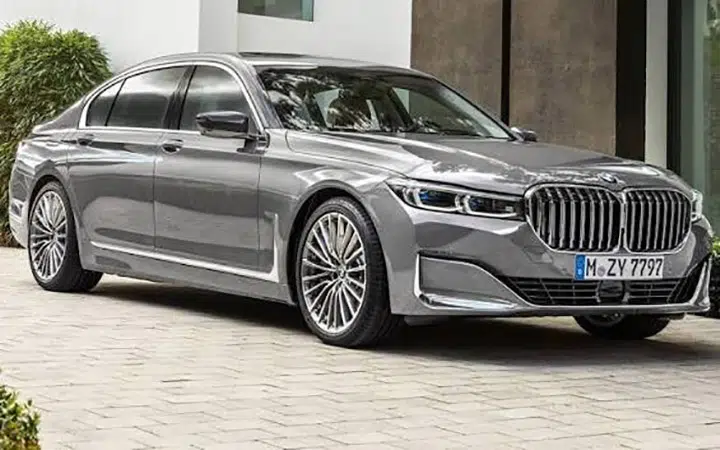

Sports car, BMW 740i and 5 half-cut trucks arrive at Chittagong Port in used parts announcement
Staff Correspondent
At a time when economic growth is close to three percent, people’s living costs are rising, and business investment is uncertain—a shipment of used car parts arriving at the Chittagong port has raised a new question: Who in the country is buying luxury cars worth billions of taka?
The consignment seized by customs detectives at Chittagong port contained a BMW two-seater sports car, the front half of a BMW 740i and five half-cut Isuzu trucks. The import declaration was for used differential assemblies, power steering assemblies and other used motor vehicle parts.
The incident not only raises allegations of discrepancies in customs declarations, but also raises new questions about the luxury car market in Bangladesh and the financial capacity of buyers.
Who has the market for luxury cars even in the midst of the economic crisis?
Customs is still verifying the actual model, age, chassis number, VIN and eligibility for import into Bangladesh of the seized BMW sports car. As a result, the specific market value of the car has not yet been finalized. However, according to the model number, the estimated market value of this sports car is 2.5 crore taka.
As a result, the question arises – in an economy where a large segment of the general public is under pressure over the price of essential goods, income, and employment, who are the buyers of such expensive cars?
Is this just a private consumption market for a small number of wealthy individuals, or has there been a level of wealth and income inequality in the country that is hidden from overall economic statistics?
Sports car named after parts
The importer of the consignment is M/S Ayaz Auto International . The exporter is Arab Japan Used Cars and Spare Parts Co of the United Arab Emirates and the C&F agent is Amin (C&F) Pvt Ltd.
Where the import paperwork mentions used car parts, a physical examination found a BMW two-seater sports car in a completely dismembered state.
Customs initially identified the vehicle as a BMW S Drive 23i . The engine capacity is believed to be around 2,500 cc.
The front part of a 2016 model BMW 740i of approximately 3,000 cc was also found in the same shipment.
As a result, customs is now not only determining the actual value and duty of the cars; but is also investigating why a complete or partial luxury car was declared as used parts .
Where is the other half of BMW?
One of the most intriguing questions concerns the BMW 740i. Initial customs information has identified the car as a 2016 model BMW 740i. But only the front half was found.
So where is the other half of the car?
Authorities are investigating whether the remaining parts had already arrived in the country in another shipment, or whether they were trying to bring them in separately. If different parts of the same vehicle were brought in in separate shipments and then assembled in the country, whether there was any intention to circumvent import policies and customs structures could also be important in the investigation.
Parts inside the half-cut truck too
The consignment not only contained luxury cars, but also five half-cut Isuzu trucks. Various vehicle parts were packed inside the cabins of these trucks. Apart from this, various used motor vehicle parts were also recovered from other parts of the consignment.
In other words, customs found differences on multiple levels between the declaration and the actual goods received.
After this incident came to light, the discussion is not limited to the question of whether duty evasion occurred or not.
While the Bangladeshi economy is facing pressure on foreign exchange, import controls, high inflation, and sluggish investment, the existence of a market for luxury cars worth crores of taka in the same country also shows a different reality.
Pressure on the income and purchasing power of the common man on the one hand, and buyers of high-priced luxury goods on the other – do these two realities indicate a large disparity in the country’s income and wealth distribution?
Who is buying these cars, what is their source of income, and how much luxury cars are entering the country every year—shouldn’t this information also be made public now?
Car seized, buyer still unknown
However, the current customs investigation has not revealed the specific buyer or ultimate owner of the BMW cars in this shipment. Even the model, VIN, import eligibility and actual value of the seized BMW sports car have not yet been finally determined.
Customs authorities are verifying the chassis and VIN numbers, engine information, actual value and applicable import policies and duties and taxes. If evidence of irregularities is found during the investigation, action will be taken under the Customs Act, 2023 and other relevant laws, the National Board of Revenue said.
But in addition to the investigation surrounding this shipment, a major economic question also remains:
When the economy is under so much pressure, who is creating a market for BMW worth billions of taka?
The answer to this question may not only identify the owner of a car; it may also reveal an important picture of the inequality of wealth, income, and consumption in the Bangladeshi economy.

https://stapravda.ru/20221228/reyting_samyh_populyarnyh_hostingov_v_rossii_196445.html, рейтинг хостингов России подтверждает, что выбор надежного провайдера важен для бизнеса.