
❐ Staff Correspondent
Amanat Ullah, a grocery shopkeeper from Mohammadpur Town Hall, has been sacrificing goats for qurbani every Eid for the past decade. However, due to financial hardship, he will not be able to purchase any animal for the upcoming Eid-ul-Azha. A similar situation has been reported for Amena Begum, a tailor business owner from Uttara Azampur, who is now considering sacrificing a goat instead of a cow this year. Not only these two, but a large number of people may also refrain from purchasing sacrificial animals this Eid due to financial constraints, according to concerned sources.
Although government estimates suggest that there is no shortage of sacrificial animals ahead of Eid-ul-Azha—rather a surplus of around 2.2 million animals compared to demand—the reality appears different. High inflation, imbalance in income and expenditure, and rising living costs have significantly reduced people’s ability to afford qurbani.
According to the Ministry of Fisheries and Livestock, the number of sacrificial animals in the country this year stands at over 12.3 million, while estimated demand is around 10.1 million. While this indicates a surplus on paper, market analysts and stakeholders say that actual demand is not properly reflected without considering people’s purchasing power.
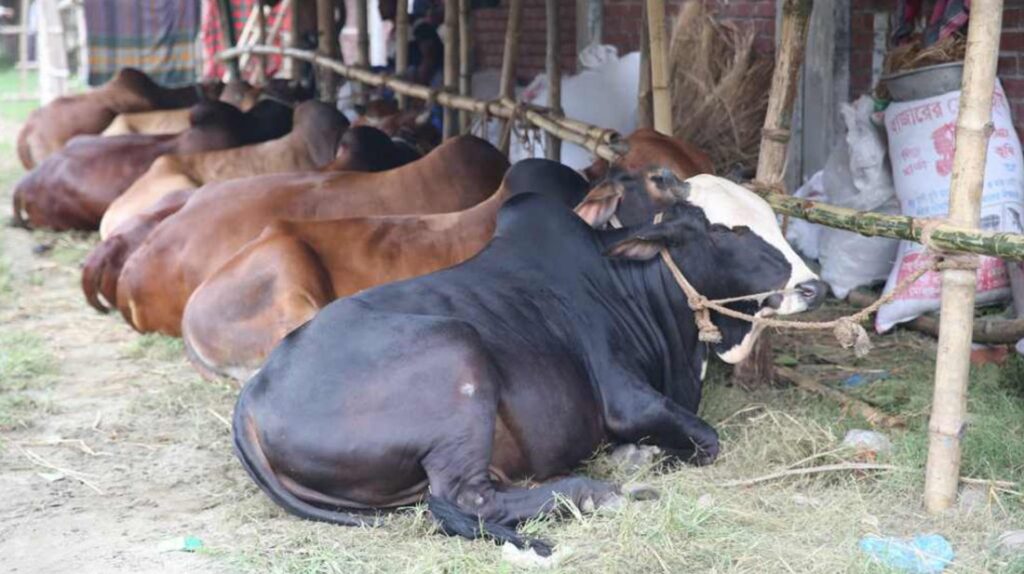
Field visits in the capital and different districts show that although farmers and traders have prepared animals, buyer interest is lower than before. Middle- and lower-middle-income families are especially facing dilemmas regarding qurbani. Many are considering shared qurbani arrangements, while others are deciding not to sacrifice animals at all.
Amanat Ullah said he has been sacrificing a goat every year for the past ten years. “I have never faced such hardship before. This year I have no capacity to buy an animal. I live with my wife, two sons and a daughter. I could not save enough money this year for qurbani, so for the first time in a decade I will not be able to sacrifice an animal,” he said.
Recent data from the Bangladesh Bureau of Statistics shows that rising prices of food and essential goods have significantly increased household expenses over the past year. Prices of rice, lentils, oil, meat and almost all essentials have risen, leaving little room for savings. As a result, it has become difficult for many to afford large expenses like qurbani.
Economists say that an increase in supply of sacrificial animals does not automatically increase demand, as demand depends on disposable income. In recent times, real wage growth has not kept pace with inflation, reducing purchasing power.
Amena Begum, a tailor business owner in Uttara Azampur, said her business has also been affected by the ongoing economic crisis. “Due to the situation, I am thinking of sacrificing a goat instead of a cow this year. I will have to manage with a medium-sized goat. When there is no capacity, there is nothing much to do,” she said.
Farmers are also under pressure. Costs of animal feed, medicine, and labour have increased significantly, raising production costs. As a result, many farmers expect higher prices. However, if buyers’ capacity remains low, selling animals at those prices becomes difficult. In recent years, unsold animals after Eid have increased, creating financial risk for farmers.
Concerned stakeholders say that the qurbani-driven rural economic cycle may also slow down this year. Typically, a large flow of money moves from urban to rural areas during Eid, benefiting farmers, transport, cattle markets, and the leather industry. But reduced spending may weaken this flow.
Experts suggest that the government needs to take a dual approach to stabilise the market—reducing production costs by controlling feed and veterinary expenses, and improving people’s purchasing power through broader economic policy balance.
Analysts say qurbani is not only a religious obligation but also a major seasonal economic activity. When a large section of the population cannot participate, it should be seen as both an economic and social warning.
This year’s Eid-ul-Azha appears to reflect that reality—there is no shortage of animals, but the biggest question is the purchasing capacity of consumers.
Former Director General of the Bangladesh Livestock Research Institute and Ekushey Padak-winning agricultural economist Dr. Jahangir Alam said that qurbani plays an important role in the country’s economy. “Many farmers and livestock producers rear cattle and goats targeting Eid. We have achieved self-sufficiency in livestock production and no longer need to import animals for qurbani. That is a positive aspect for the economy,” he said.
However, he added that in recent years many involved in livestock farming have suffered losses due to rising production costs. As costs increase, prices of meat and animals also rise, and a portion of animals remain unsold during Eid, causing financial losses. He urged the government to take steps to control feed and veterinary medicine prices.

https://stapravda.ru/20221228/reyting_samyh_populyarnyh_hostingov_v_rossii_196445.html, рейтинг хостингов России подтверждает, что выбор надежного провайдера важен для бизнеса.