
Staff Correspondent
A massive explosion took place in the single-storey building of Ummal Qura International Madrasa in Hasnabad, South Keraniganj, near the capital, on Friday afternoon. The madrasa director Sheikh Al Amin (32), his wife Acia Begum (28) and their two sons Umayet (10) and Abdullah (7) were injured. Several others in the neighboring building were also reported to have been injured.
The intensity of the explosion caused the walls of some rooms in the madrasa building to collapse and the roof to crack. Police recovered cocktails, flammable chemicals and bomb-making equipment from the scene. Initial investigations have ruled out a gas leak, as the gas cylinder was found intact.
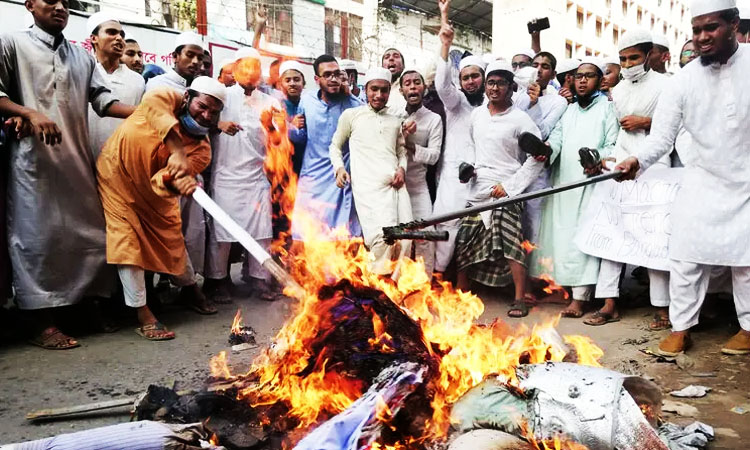
This incident is not just an accident, but also indicates a deep crisis in the country’s security situation. Although the madrasas expanded during the Awami League government, they were under control. Although madrasa students took to the streets in various movements, there was no evidence of armed activity. In addition to French President Macron or Indian Prime Minister Modi, thousands of madrasa students took to the streets to protest against the “anti-sculpture” protests of Hefazat-e-Islam, but none of the protests lasted long due to the strict and vigilant stance of the law enforcement agencies.
But the situation has changed in the 17 months of the interim government. Incidents such as storing or making explosives in madrasas have reached the highest level of concern. Starting from the attack and arson on the Prothom Alo office, the presence of madrasa students has been highly visible in all kinds of violence and protests in the last 17 months.
After Dr. Yunus seized power, the madrasa students were the most empowered. Although the students of various public and private universities returned to their respective fields of study or activities after the formation of the interim government, the students from the madrasas in various educational institutions are still carrying out violence and mob terrorism. They are consolidating their position by showing the stick of Indian hegemony.
Students from madrasas have led the attacks on the Indian High Commission in various parts of the country, from the Prothom Alo office to Chhayanaut, shouting the slogan “Naraye Takbir”. After the attack on Prothom Alo, the most supportive media of the interim government, the police have been forced to arrest all those involved in the attack, and the madrasas have been found to be involved.
Now, madrasa students are staging another protest in Shahbagh demanding justice for Hadi’s murder. In the past 17 months, madrasa students have always been on the streets on some issue or the other, carrying out some movement with religious fervor, and whenever their numbers have grown, there have been some violent attacks.
Specialized law enforcement agencies formed during the Sheikh Hasina government to combat terrorism and extremism, such as the Bangladesh Anti-Terrorism Unit (ATU) and the Dhaka Metropolitan Police’s Counter Terrorism and Transnational Crime (CTTC) , were tasked with preventing militant activities, gathering intelligence, and arresting and neutralizing terrorists. These squads use cutting-edge tactics, training, and equipment to combat international and domestic terrorism.
- Counterterrorism: Monitoring the activities of terrorist organizations, disrupting their plans, and working to prevent planned attacks.
- Intelligence activities: Collecting, analyzing, and sharing information related to terrorism.
- Direct operations: Arresting suspected militants or terrorists and confronting them in direct confrontation.
- Specialized Units: There are specialized departments like Bomb Squad and Cyber Crime Investigation.
Currently, these units are completely inactive. After August 5, top militants who were detained in various jails in Bangladesh have been released. Their network is fully active again and at the same time, there has been a suspicious increase in the movement of Pakistani citizens into Bangladesh. However, there is no specialized force in Bangladesh at the moment to verify all this information and thwart any possibility of attacks.
In Afghanistan, Mullah Omar’s Taliban trained and united using madrasas as bases. And one day, they came out of the madrasas armed and took over the country. Many madrasas in Pakistan are known as militant training centers. In May this year, India carried out surgical air strikes on militant training centers in Pakistan. It is known that every target mosque, where militant training centers were located, had madrasas.
Is Bangladesh walking on that path?
With relations with Pakistan warming in recent times, it is believed that some shipments of explosives and weapons have reached madrasas, as Pakistani cargo is exempt from 100% inspection requirements. Security analysts fear that some madrasas are preparing for armed conflict on the Afghan-Pakistani model.
Recently, during a security conference in India, Bangladesh’s National Security Advisor Khalilur Rahman was given information about militant training centers in several areas of Bangladesh by Indian intelligence agencies. The National Security Advisor has promised that these centers will be destroyed. But does the interim government have the will and ability to fulfill this promise?
The Keraniganj incident has shown us that the fears are not unfounded. The rise of madrasa students is not going unnoticed.
The country’s security experts believe that if strict action is not taken now, a terrible future awaits Bangladesh. Question for the government: What has it done about madrasa and militancy reforms? The attack on the Prothom Alo office was identified as an “attack by an isolated militant group” on the chief advisor’s page, what steps have been taken to deter those isolated extremists?

https://stapravda.ru/20221228/reyting_samyh_populyarnyh_hostingov_v_rossii_196445.html, рейтинг хостингов России подтверждает, что выбор надежного провайдера важен для бизнеса.