
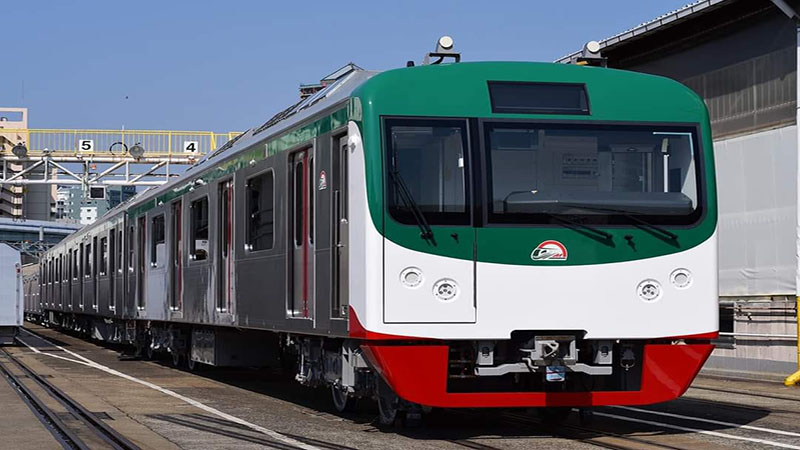
❐ BD Digest Desk
The construction cost of the capital’s two new metro rail projects has doubled compared to the estimates made during the Awami League government, causing extreme concern.
The budget for the two projects, which were initially estimated at 93,800 crore taka, has been increased in one fell swoop, resulting in a huge revised proposal of 213,985 crore taka.
This new spending proposal, which is extremely financially stressful, is currently pending in the Planning Commission awaiting final approval.
Part of this larger project is the ongoing MRT Line-1, which will extend from the airport to Kamalapur underground and from Narda to Purbachal on the flyover. On the other hand, the MRT Line-5 (North) project, which will start from Hemayetpur in Savar and extend to Bhatara via Gabtoli, Mirpur, Gulshan, is also being built with a complex mix of underground and flyover infrastructure.
According to the Dhaka Mass Transit Company Limited (DMTCL), the company responsible for the construction and operation of the metro rail, various changes in the detailed design, increase in the price of construction materials in the global market, abnormal depreciation of the taka against the dollar, delays in project implementation, and various technical changes have resulted in extreme irregularities in the cost of these two projects.
Although the development work of the depot land of the Line-1 and Line-5 (North) projects undertaken in 2019 is almost at its final stage, the process of appointing contractors is currently underway. In the meantime, DMTCL has sent the Revised Detailed Project Proposal (RDPP) to the Planning Commission, increasing the project’s unusual budget.
An evaluation meeting is being held at the Planning Commission today to rigorously scrutinize the justification for this additional cost.
The Japan International Cooperation Agency (JICA) is the main financing agency for the two metro rail projects. From the beginning, discussions were held with JICA over this additional cost during the tenure of the interim government and the current BNP government.
Later, following the interim government’s insistence on cutting costs, the BNP government formed a technical committee on May 24, led by Shamim Z. Basunia, a former professor of BUET’s Department of Civil Engineering, to reevaluate the project costs.
When the expert committee, in its report submitted in July, called this double cost completely reasonable, DMTCL quickly submitted the proposal to the Planning Commission.
Arguing for the massive increase in the project cost, Professor Shamim Z. Basunia said that the annual inflation rate of 5 percent, the 38 percent appreciation of the dollar, and the increase in the scope of work due to design changes are among the reasons for this additional cost.
Added to this is the additional burden of government VAT and taxes. He further warned that the metro rail is essential for the people of Dhaka and if the cost cannot be adjusted now, the cost will skyrocket as time goes on; if necessary, the government can also find alternative financiers.
Work is currently underway to extend the existing Uttara-Motijheel Metrorail route to Kamalapur. The total budget for the project, which was undertaken in 2012, is estimated at Tk 33,472 crore, which indicates an average cost of Tk 1,584 crore per kilometer.
But the construction cost per kilometer of the two new projects has been estimated to be many times higher than that of the old line, which has raised questions.
An analytical chart on the metro rail construction costs in various Asian countries during the tenure of the interim government shows that in India, the cost of constructing a metro rail per kilometer, excluding land acquisition and staff salaries and allowances, was only 1.5 to 4.5 billion taka.
Even though India implements projects with international loans, it is not bound by any conditions that hinder open competition in the selection of contractors, which is why they are able to build infrastructure at such low cost.
The initial outline proposed in 2019 did not include detailed designs; as a result, the scope of the project changed significantly during the preparation of the integrated design. At the same time, rising prices of fuel, steel, cement, bitumen, and transportation systems have significantly increased the cost.
While the exchange rate per dollar was estimated at 84.50 taka in 2019, it has increased to around 122 taka by 2025. With the addition of taxes, VAT, land acquisition, transfer of service company equipment, and consultancy costs, the project cost has skyrocketed.
Ever since the Awami League government started the Metrorail project, BNP-Jamaat and like-minded parties have been continuously campaigning against the project. They heated the field with various statements including ‘unnecessary’, ‘white elephant’, ‘eating ghee on loan’. But after the Metrorail was launched, it was able to bring about a radical change in the daily lives of the people of Dhaka, and also received the unwavering support of the people.
Now, after coming to power, BNP has changed its previous course. Now, highlighting the importance of the transport sector, Road, Rail and Shipping Minister Sheikh Rabiul Alam said that if Dhaka is to survive, there is no alternative except building the metro rail.
He mentioned that the complete design of the projects had been finalized before the BNP government took office, otherwise some cost cutting might have been possible. But if the work is not completed now with this increased budget, the cost will go completely out of control in the future.
The revised proposal for the MRT Line-1 project, initially approved at Tk 52,561 crore, has been requested to increase the cost to Tk 1,20,794 crore in one go. This means that the cost is increasing by about Tk 68,000 crore from the original allocation.
This huge amount makes it the second most expensive project in the country’s history, right after the Rooppur Nuclear Power Plant.
The 31-kilometer-long MRT Line-1 project will have 21 stations, including both underground and aerial. If the revised budget is approved, Bangladesh will spend a record Tk 3,866 crore per kilometer on the construction of this line.
On the other hand, the original budget of the 20-kilometer-long MRT Line-5 (North) project connecting Savar to Bhatara was Tk 41,239 crore. The current budget of this mega project, comprising 14 stations, has been revised to about Tk 93,1919 crore.
This means that the original approval is increasing by 35,000 crore taka in one go, which, if approved, will bring the construction cost per kilometer to the highest in history at 4,660 crore taka.
According to internal information from the Ministry of Road Transport, the main reason for the uncontrolled construction cost of the project is the strict conditions of the lending agency JICA and the lack of healthy competition in the market. Only Japanese companies get the opportunity to participate in the tender and they bid inflated prices, while Bangladesh has very limited room for bargaining.
Even the tender conditions include some difficult technical rules that only Japanese contractors are able to meet. As a result, competition in the entire process is eliminated and costs are increasing uncontrollably.
Shamsul Haque, a professor at the Civil Engineering Department of Bangladesh University of Engineering and Technology (Buet), gave a stern warning, saying that it is not possible to reduce these abnormal costs in any way if the tenders are not opened.
If the government can force the lending institutions to relax these exclusive conditions, then the costs will come down instantly. While it is logical to increase costs on a limited scale due to devaluation of the rupee or increase in the price of goods, there is no room for it to skyrocket.

https://stapravda.ru/20221228/reyting_samyh_populyarnyh_hostingov_v_rossii_196445.html, рейтинг хостингов России подтверждает, что выбор надежного провайдера важен для бизнеса.