
 Staff Correspondent
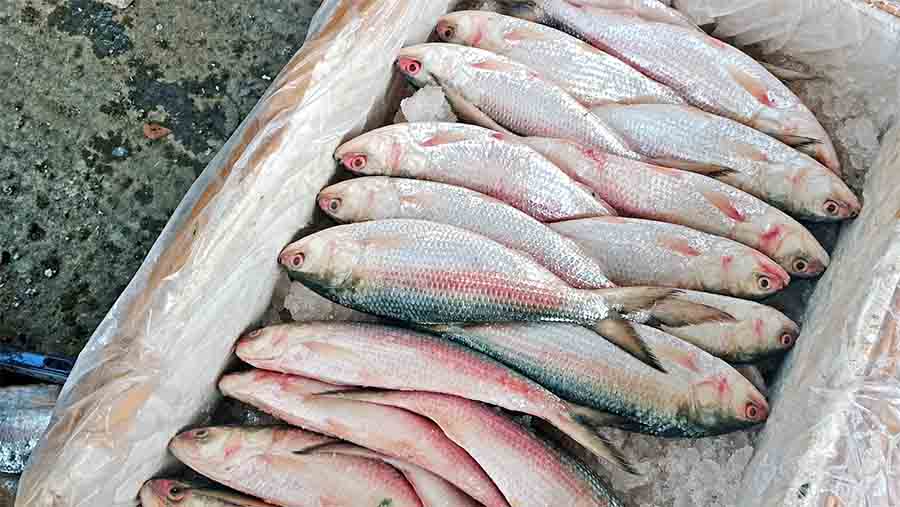
Although the supply of hilsa in the market increased slightly towards the end of the season, the crisis did not end. In the meantime, after 500 tons of hilsa entered the country from India legally for the first time and a large amount illegally, the country’s market has been flooded with foreign hilsa.
However, due to increased supply from the coastal areas of the country along with imports, the price of hilsa has dropped from Tk 200 to Tk 300 per kg in the Chandpur market in the space of two weeks.
Traders say that if the supply increases further, the price of hilsa may gradually decrease until the campaign.
Although various sources say that after paying customs duties and other expenses, the average price of imported Indian hilsa per kilogram is around 185-190 taka. Traders are selling that hilsa for 1700-1800 taka, calling it domestic hilsa.
Besides, soft, old hilsa is being cut and the eggs are being removed and sold separately for 5-6 thousand taka per kg. Salted hilsa is made from the eggs removed.
Biswas International on Khanjahan Ali Road in Khulna has imported 6,231 kg of hilsa from India through Benapole Port this year. The company has shown import prices ranging from Tk 74 to Tk 247 per kg. The company’s director, Deepta Biswas, said that the prices of the hilsa coming from Gujarat are as per the quality.
Hilsa has come to Bangladesh at even lower prices. For example, Rupa Enterprise of South Jatrabari, Dhaka, imported 7,723 kg of hilsa at a declared price of Tk 57 per kg. It paid about Tk 200 in duty and tax per kg.
Benapole’s M/s Sata Fish Feed has brought 24,700 kg of hilsa at the declared price of Tk 247 per kg. The company’s director Shahidur Rahman said that it costs about Tk 500 per kg to import hilsa. Each fish weighs 500 to 700 grams. It is being sold wholesale for Tk 500 to 600. And in the country’s retail market, hilsa weighing 500-700 grams is being sold for about Tk 1,500 per kg.
700 to 800 maunds of hilsa were landed at the Chandpur Bara Station fish landing center on Wednesday. These fish are coming from various coastal areas including Noakhali, Lakshmipur, Hatia, along with the Chandpur river. The market has regained some relief compared to before due to the increased supply.
Shabe Barat Sarkar, general secretary of Chandpur Fisheries Merchants Cooperative Association, said that the supply of hilsa has increased at the Barastuan Fisheries Landing Center in the last few days. As the supply increases, the price is also decreasing.
He said, currently, one kilogram of hilsa is being sold for 2,300 taka, 700 to 800 grams of hilsa is being sold for 1,700 to 1,900 taka, and 500 grams of hilsa is being sold for about 1,000 taka per kg. They are hoping that the supply of hilsa will not decrease before the campaign. As a result, the price may decrease slightly every day.
Badsha Malo, a businessman at Chandpur Bara Station Fisheries Landing Center, said, “A lot of hilsa is currently coming from the coastal areas. Although the size of the fish is somewhat small, the traders are happy with the increase in supply. He hopes that the supply of hilsa will continue to increase until the campaign begins.”
However, the price of good quality hilsa has not come down much yet, the trader said. According to him, one kilogram of fresh hilsa is still being sold for Tk 2,300 to Tk 2,400. And the fish with more eggs are being sold for Tk 1,600 to Tk 1,800 per kilogram.
Shah Alam, a trader at Chandpur Bara Station, said that the supply of hilsa was low throughout the season. However, due to the increase in supply over the past few days, the price of hilsa per kg has decreased to Tk 200 to Tk 300.
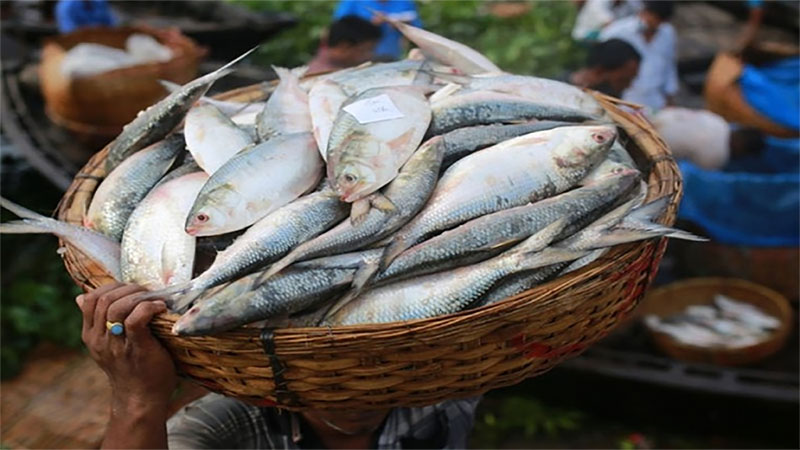
Meanwhile, amid the decline in the supply and production of hilsa in the country, the issue of importing 500 tons of hilsa from India has come under discussion.
Traders claim that the quality of hilsa imported from India is not better than that of domestic hilsa. They also claim that these fish have a lot of eggs in their stomachs.
Hilsa researcher Dr. Anisur Rahman said, “Once upon a time, hilsa was exported from Bangladesh to various places. Now there is no domestic hilsa in the country’s market, and there are reports of hilsa being imported from India. He does not see any possibility of increasing hilsa production this year either.”
He said, “The reasons for the decline in Hilsa production need to be thoroughly researched. To identify the problem and resolve it, long and medium-term plans need to be taken with experienced people in the fisheries sector. In addition, necessary steps need to be taken through inter-ministerial coordination.”
Dr. Anisur Rahman also said that the national fish Hilsa resources have decreased. Especially the large-sized Hilsa has decreased a lot. If the problem is not identified quickly and measures are not taken, not only the production of Hilsa but also other fish may be negatively affected in the next two to four years.
Fisheries officials say that Hilsa production has increased over the years due to various measures, including sanctuaries to protect mother Hilsa and Jatka, a ban on fishing during the breeding season, increased awareness among fishermen, and government incentives. However, production has declined by more than 7 percent in the last three years.
According to the District Fisheries Department, the production of Hilsa in the country was 255,839 metric tons in the fiscal year 2003-04. Although production has increased at various times in the last two decades, it reached a peak of 571,342 metric tons in the fiscal year 2022-23.
Then, production trended downward. In the 2023-24 fiscal year, Hilsa production decreased by 7.33 percent to 529,487 metric tons. In the latest 2024-25 fiscal year, production decreased further to 500,000 metric tons.
Concerned people say that the breeding and migration areas of Hilsa are being damaged due to various reasons including river pollution, unplanned sand extraction through hundreds of dredgers. As a result, the production and availability of Hilsa in the country is decreasing. As a result, on the one hand, the price of Hilsa in the market is increasing, and on the other hand, there is a need to import it to meet the demand.

https://stapravda.ru/20221228/reyting_samyh_populyarnyh_hostingov_v_rossii_196445.html, рейтинг хостингов России подтверждает, что выбор надежного провайдера важен для бизнеса.