
– Dr. Mamunur Rashid
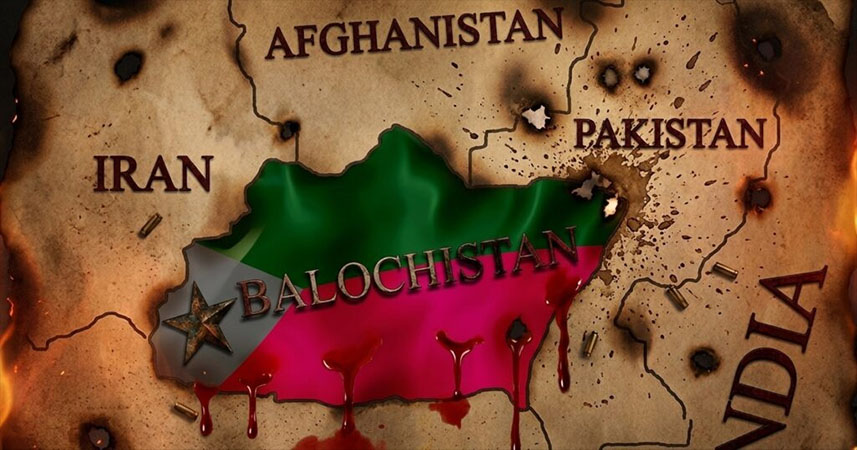
Balochistan, Pakistan’s largest province, has long harbored deep grievances against the central government. These grievances are largely rooted in a complex pattern of political, economic, and cultural marginalization. Interestingly, the nature of these grievances is similar to that of present-day Bangladesh (then East Pakistan).
The experience bears almost identical echoes to the pre-independence experience of 1971. Both regions are victims of a structural pattern in which resource-rich or majority regions have faced discriminatory treatment, increasing economic inequality, and political-cultural repression in return for their contribution to the national wealth.
This report analyzes the similarities between the current situation in Balochistan and the historical reality of East Pakistan through economic data, time series, and a detailed comparative table.
Let’s look at some data.
Economic exploitation
Balochistan is a region of Pakistan rich in natural resources, but it is also the country’s poorest province.
Natural gas: The province supplies about 18-20% of Pakistan’s total natural gas (mainly from the Sui gas field), yet Balochistan itself suffers from a gas crisis.
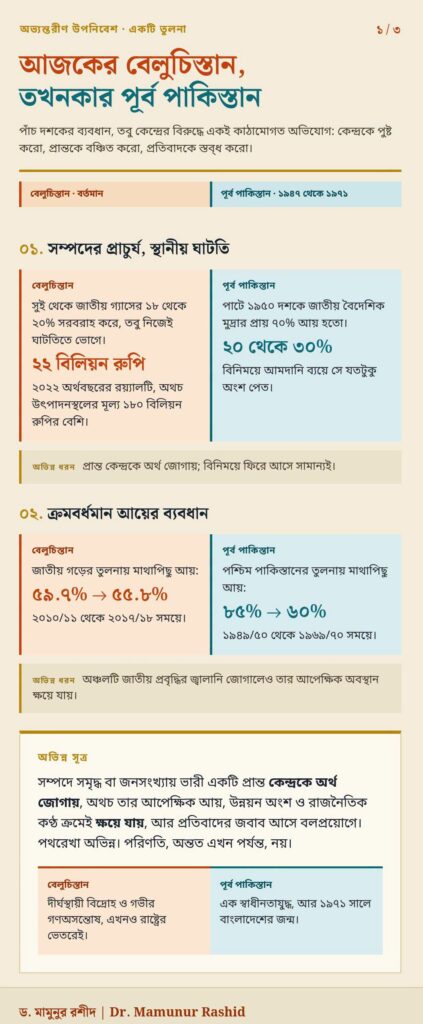
Inefficient Royalties: In FY2022, Balochistan received only 22 billion Pakistani rupees in gas royalties, while the headwell value of the extracted gas was estimated to be over 180 billion Pakistani rupees. The royalty rate allocated (12.5% of the headwell value) is considered inadequate and is often delayed. Although the amount of royalties has increased over time (from 6.3 billion in FY2009 to 22 billion in FY2022), it is insignificant compared to the extracted resources.
Per capita income gap: Balochistan’s per capita income is consistently lower than the national average and is declining. In 2010-11, it was 59.7% of the national average, which decreased to 55.8% in 2017-18 ($917 versus national $1,641). This shows that inequality is increasing over time.
Development expenditure and human development index
The province’s multidimensional poverty is much higher than the national average and has almost stagnated.
Multidimensional Poverty Index (MPI):
Balochistan’s MPI was 71.2% in 2004/05, which declined to 53.2% in 2014/15 and slightly to 53.1% in 2019-20. The national average during the same period was 38.3% (2019-20). This means that Balochistan has lagged behind the national average by about 15 percentage points for more than a decade, indicating a lag in development.
Federal Development Budget (PSDP):
The share of the federal budget allocated to Balochistan has been steadily declining. From around 10% in FY2010, it has fallen to just 6.8% (Rs. 65 billion) in FY2023-24. The deployment rate is also low—only 48% of the allocation was utilized in FY2021-22.
Education and Health:
The province’s literacy rate in 2019-20 was 54.5% (national average 62.3%), while the female literacy rate was only 42%. In the same year, the infant mortality rate (per 1,000 live births) was 70, the highest in Pakistan.
Balochistan and Bangladesh Similarities and Dissimilarities:
Every allegation in the annexes is an almost exact reflection of the experience of East Pakistan (now Bangladesh) from 1947 to 1971. Just as Balochistan supplied gas, East Pakistan exported jute, providing the bulk of Pakistan’s foreign exchange. But in both cases, the money earned went to the centre, leaving the region with poverty and neglect. Similarly, East Pakistan was stripped of its political power despite its majority in the National Assembly, an echo of Balochistan’s current minority representation.
The current crisis in Balochistan is not an isolated incident. It is a repetition of the same centralizing and exploitative state structure that once led to Pakistan’s downfall. Time continuity suggests that relative deprivation and inequality in Balochistan have not diminished over time, but rather increased.
Pakistan has not learned from history. Bangladesh has become independent.
Balochistan will also be independent.
The only thing missing is a Mujibar.
Visited 28 times, 1 visit(s) today

https://stapravda.ru/20221228/reyting_samyh_populyarnyh_hostingov_v_rossii_196445.html, рейтинг хостингов России подтверждает, что выбор надежного провайдера важен для бизнеса.