

Special Correspondent
July 22, 2026.
New tensions have emerged in the internal politics of Bangladesh Jamaat-e-Islami. A strange decision taken at the recent session of the party’s central Majlish-e-Shura and executive meeting has sparked intense discontent among its leaders and activists.
Jamaat-e-Islami’s ban and letter
As per the decision taken in that meeting on June 22, 2026, a letter signed by the party’s Secretary General Mia Golam Parwar was sent to the district and metropolitan emirs on July 12. The attached letter has already become the focus of discussion in the party arena.
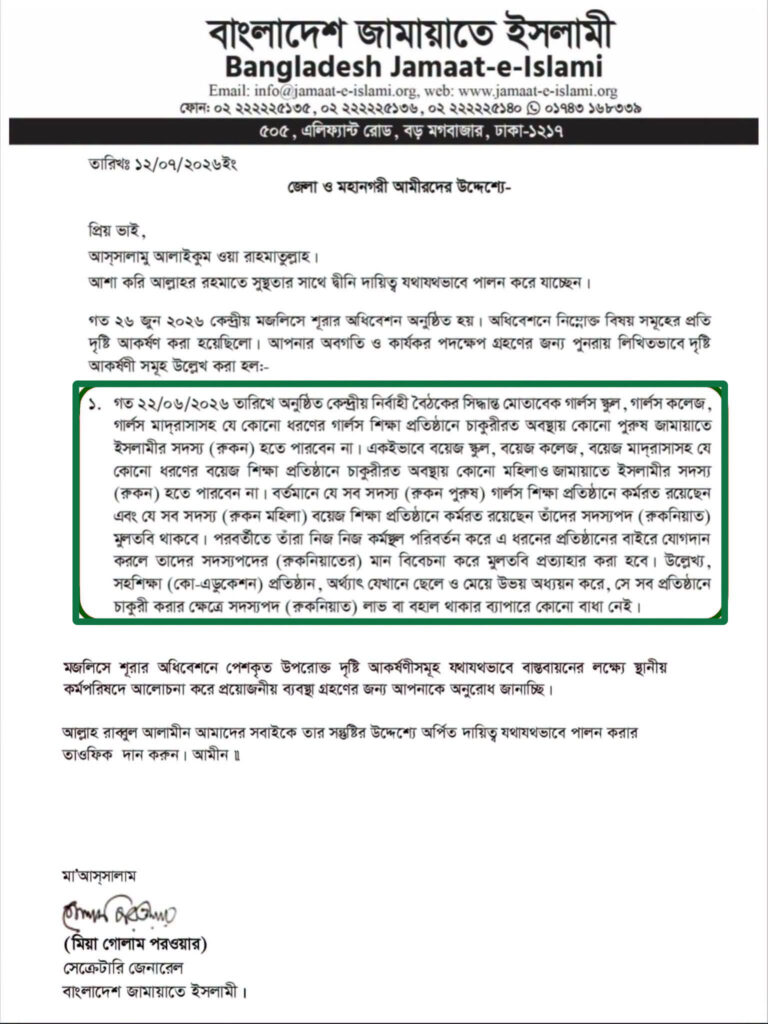
The letter prohibits female members from teaching in boys’ schools/colleges/madrasas and male members from teaching in girls’ schools/colleges/madrasas among the Jamaat-e-Islami’s Rokans. The directive also states that the membership of female members already working in boys’ schools/colleges/madrasas and male members already working in girls’ schools/colleges/madrasas will be suspended. This directive will not be effective for Jamaat-e-Islami members working in co-educational institutions.
The practical reflection of the decision has already been seen. According to media reports, Kushtia District Jamaat-e-Islami Secretary Sujauddin Joarder has been relieved of his post for teaching at a girls’ college. A notice on the Kushtia District Jamaat’s Facebook page said that no male Rokon of Bangladesh Jamaat-e-Islami can perform his duties while working at a women’s educational institution.
The incident of rape in a madrasa and its context
In recent times, several incidents of rape of girls, young women and teenagers studying in madrasas by teachers and principals of women’s madrasas have been published in various newspapers. In most cases, the rape of girls and young women is caught by the locals in the areas where these madrasas are located. The agitated locals severely beat up the accused rapists, socially harassed the villagers, and vandalized and demolished the women’s madrasas in some areas. Since then, a debate has started on social media about the reasonableness of appointing male teachers in women’s madrasas.
A few days ago, the incident of a 9-year-old madrasa girl being forcibly raped and impregnated by her madrasa teacher came to light, which created a stir across the country. In addition, the incident of the burning to death of Nusrat Jahan Rafi, an Alim examinee, with the help of the madrasa principal and students to silence the rape of a teenage girl in a madrasa in Sonagazi, still leaves a mark on the minds of the people of Bangladesh.
Latest update on this issue: Although the lower court has sentenced 16 accused involved in the Nusrat murder to death, the proceedings are stuck in the death reference hearing in the High Court.
In addition to all these incidents, many believe that Jamaat, known for its “rule by honest people,” has taken this gender-based teaching decision to protect its male members due to the growing public outrage over the increasing number of rapes of girls, young women, and adolescents in women’s madrasas.
Socially conscious individuals, social workers, and online activists protesting against rape in madrasas believe that the reason why Jamaat-e-Islami has imposed this obligation on teaching members is that incidents of rape of young girls, young women, and teenagers by teachers and principals in women’s madrasas are becoming increasingly public.
Social reaction and controversy
Kishwar Lochan, an online activist who is vocal in demanding the rights of women and children, said about Jamaat’s decision,
“This is very ridiculous. The female members of Jamaat are not involved in any adultery or rape, so why did Jamaat impose this decision on them?”
Explaining the reasons for Jamaat-e-Islami’s decision, he said,
“There is only one reason for this – so that no one understands that Jamaat-e-Islami has taken this decision to prevent rape in women’s madrasas, so to hide that, this ban has been issued for both male and female members. An attempt has been made to give the issue a gender-neutral cover.”
Dr. Nowrin said that Jamaat is actually trying to maintain balance. To remove the doubts and questions of the countrymen about the male members accused of raping children/girls/teenagers in girls’ schools/colleges/madrasas, a ban has been imposed on female members of Jamaat as well as male members from teaching in boys’ schools/colleges/madrasas.
However, male and female members of Jamaat-e-Islami associated with the teaching profession consider imposing such an unusual decision as ‘inhuman’ behavior. Thousands of Jamaat leaders and activists across the country are currently teaching in girls’ schools, colleges and madrasas. On the other hand, many female leaders and activists teach in boys’ educational institutions. They feel that if they have to change their jobs and livelihoods just to uphold the party’s ideology and follow its instructions, then it would be completely unfair and unreasonable.
The process of suspending the membership (Rukniyat) of male members (Rokon) working in girls’ schools, girls’ colleges or women’s madrasas has already begun. In many district towns, leaders and workers are being put in a dilemma of ‘quit their jobs or leave the party’. The same situation is also faced by female members; it is learnt that those working in boys’ schools/colleges/madrasas are also facing the same crisis.
Political analysis
Political experts, however, see this decision of Jamaat as a ploy of religious politics. Many believe that Jamaat-e-Islami will first put its own house in order and then apply gender-based pressure on other educational institutions in the field of teaching. They believe that by allowing its party members to change jobs, Jamaat-e-Islami can demand gender-based recruitment of teachers in all educational institutions in the future.
In other words, according to political analysts, through this party ban, Jamaat-e-Islami is creating a context for demanding the appointment of male teachers in boys’ schools/colleges/madrasas and female teachers in girls’ schools/colleges/madrasas in the future.
However, statistics say otherwise. According to the information received, it is in boys’ madrasas that the most boys, children, and adolescents are raped by male teachers. It is known that in at least 9 out of every 10 madrasas, male teachers are responsible for rape and assault. If male members of Jamaat are engaged in the teaching profession in those boys’ schools/colleges/madrasas, then it is believed that it can greatly increase the number of rapes of boys, children, and adolescents.

https://stapravda.ru/20221228/reyting_samyh_populyarnyh_hostingov_v_rossii_196445.html, рейтинг хостингов России подтверждает, что выбор надежного провайдера важен для бизнеса.