
Opinion
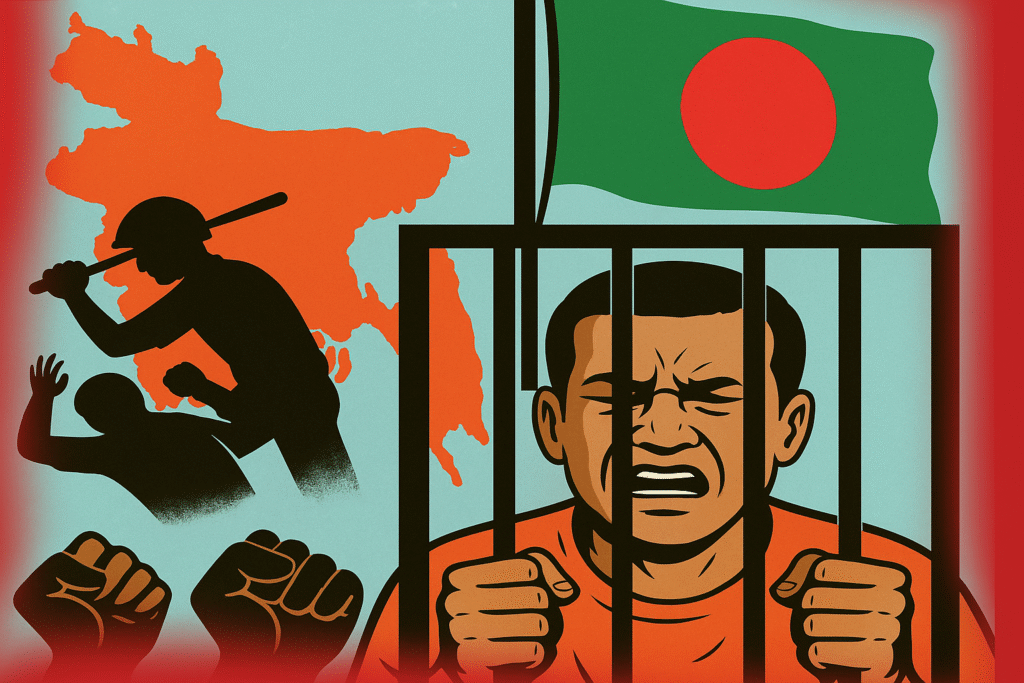
How was the human rights situation in Bangladesh on World Human Rights Day, December 10, 2025? Are human rights only applicable to religiously disguised militants, extremists, or are they equally applicable to political leaders?
Does this apply more to those opposed to the government or is it the same for everyone—are children of freedom fighters, Awami League workers, or Chhatra League members also covered by human rights?
Was it a crime against humanity to prevent the attacks on every important institution of the state, political leaders, police, Ansar BGB, planned by foreign conspirators with the help of radicalism and militants under the guise of the student movement of July-August 2024?
Or have human rights been violated in these bloody chapters – the killing, disappearance, and torture of thousands of people since August 3, 2024?
On the one hand, there is the strong condemnation of international rights organizations against the protection of state security, and on the other hand, there is the surprising silence of human rights organizations in the name of revenge and the city of corpses. In light of this duality, a reasonable question arises: Has human rights become a victim of political bias?
The student movement of July-August 2024 began with demands for quota reform, but it quickly transformed into a fight for democratic rights, then the fall of the government and a frenzied game of seizing every important position in the state and the state.
In July 2024, every organ of the state—the police, the Ansar, the Reserve Force—will use force against the organized militants and extremists behind the student abductions as a last-ditch effort to protect the state, the elected government, and the constitution. According to a fact-finding report by the United Nations Office for the Coordination of Humanitarian Affairs (OHCHR), more than 1,400 people, including law enforcement officers and Awami League leaders, were killed between July 1 and August 15, starting from the student protests and ending after the fall of the government on August 5, in this attack on the state and in the struggle to protect the security of life and property. Of these, 12-13 percent were children.
However, the UN Office for the Coordination of Humanitarian Affairs (OHCHR) fact-finding, along with the Yunus government and student coordinators’ sky-high claims of 2,000 deaths, eventually came down to 830, including both sides and opponents. However, various verifications have revealed many discrepancies in the official list of deaths.
According to Amnesty International, the police used live ammunition, rubber bullets and tear gas to attack peaceful protesters. During this time, 44 police officers were also killed in the attack on so-called peaceful protesters, which is mentioned in the report. Outside of this report, the exact number of members of the law enforcement agencies killed by so-called peaceful protesters is still not dared to reveal by the government of Nobel laureates and highly educated people from abroad.
But when the police resisted the armed extremists of Jamaat-e-Islami or Shibir during the July 24 movement, or counterattacked to suppress the attacks, the voices of the human rights hawkers were filled with lamentation. The arrest of minor protesters coming from madrasas and schools and colleges, or the deliberate killing of people who took to the streets with mysterious 7.62 bullets by third parties, these are all things that the local and foreign hawkers of humanity, the bearers of humanity, have talked about.
During this time, the concept of human rights was for everyone—human rights organizations paid equal attention to the rights of protesters, along with protecting the lives of police.
But the situation changed from August 2-3, 2024. After the fall of Sheikh Hasina, thousands of Awami League leaders and activists were killed, disappeared or tortured in the name of revenge. Mobocracy began in the name of reform. Every house of Awami League leaders and activists was looted, set on fire and if the leaders and activists were found, they were killed outright.
The preliminary report by the Global Center for Democratic Governance (GCDG) states that from August 2024 to May 2025, killing missions were carried out targeting 123 Awami League activists, of which 41 were hacked to death in Taliban style.
According to the Rights and Risks Analysis Group (RRAG), 123 Awami League members were targeted and killed between August 5 and April 2025, including children, women, and people with disabilities.
Five people were killed in the Gopalganj massacre, an average of 43 bodies floating in the river per month, and 112 people died in prison torture—along with these incidents, various incidents continue to emerge that rival any brutal mafia gang’s plan to suppress its opponents.
A mother was hacked to death while praying without finding a Chhatra League worker, a 14-year-old child was arrested under the Arms Act when a Jubo League leader was caught, the father of a 10-month-old baby’s hand was cut off, leaders and workers who had been on the run for years to save their lives were brutally murdered when they came to secretly meet their parents, wives and children, a child was murdered while buying medicine, a certificate was stolen at the university and they were victims of a mob – no human rights talk was heard anywhere.
Human Rights Watch reports that under the interim government, 10,000 Awami League members have been arrested in more than 1,000 cases, a sign of political vendetta. The actual number may be higher, as old, dilapidated prisons are being reopened as the prisons are unable to accommodate political prisoners. The fictional story of the “mirror house” that has made Sheikh Hasina a hateful and brutal character, has become a symbol of tyranny and oppression, a hundred times more so than the “Guantanamo prison of Bengal” created by Dr. Yunus.
These are just a small part of the thousands of incidents that have occurred since August 5, 2024. Where is the UN fact-finding now? Where are the international human rights organizations, where is the UN Office for the Coordination of Humanitarian Affairs (OHCHR), where is Amnesty International, where are the hundreds of deep-state agencies that have sprung up in the name of human rights?
The one-eyed policies of these human rights organizations, built on corporate funding in the name of humanity, have changed the definition of conventional human rights. Before July, when Jamaat-Shibir extremists attacked the police, international organizations were active—OHCHR, Amnesty, HRW—all protested. But after August, when targeted killings, mobs, violence, occupation, extortion, and litigation were carried out against the families of liberation fighters and millions of Awami League leaders, workers, and supporters, they maintained silence, manipulated the media to remove information or news, and turned a blind eye like a crow. The report of the Islamic Society for Human Rights says that after the movement, mob justice, torture, and fake cases increased, but there was no protest.
The Awami League itself has alleged that selected parts of the UN report have been disseminated only against them, while a large number of revenge killings and incidents of torture and killings of people of a specific ideology, belief and ideology have been ignored.
This hypocrisy of international and local human rights organizations has become clear on Human Rights Day 2025. Reforms have been promised through the enactment of the new National Human Rights Commission (NHRC) Ordinance 2025—developed with the participation of over 600 stakeholders.
But according to the Daily Star, this is only on paper—in reality, extrajudicial killings, custodial torture, and mob violence have increased.
Chief Adviser Muhammad Yunus said Bangladesh has now joined nine key UN treaties, but rights activists say, “The fascist regime has ended, but the system has not changed.”
These 15 months of bloodshed—more than 2,500 deaths—have shown that human rights are nothing more than a tool for political advantage, and that the definition of human rights includes only those who align with the objectives of these organizations.
So, isn’t it clear that human rights are a weapon of the West, which is used to manipulate third world countries in their own way, for their own interests, to achieve their own goals, and for regime change, with the involvement of various human rights peddlers?
This Human Rights Day of 2025 has taught us: ignoring justice and good governance, one can sit in power through suppression, oppression, and physical force, but that is never considered a revolution. By talking about, marketing, or using the revolution of Che or Fidel Castro, the
August 24 seizure of power is actually taking place in northern Bangladesh in the style of Idi Amin of Uganda or Robert Mugabe of Zimbabwe.
The challenge now is for the interim government to follow the democratic path it promised to take Bangladesh to, and to fulfill the rights of the people. Otherwise, history will bear witness, no matter what the surveys say, whether it is a bad ruler or a development-friendly ruler, it will not take these sons of the land long to lose their minds from the ruling class.

https://stapravda.ru/20221228/reyting_samyh_populyarnyh_hostingov_v_rossii_196445.html, рейтинг хостингов России подтверждает, что выбор надежного провайдера важен для бизнеса.