
Sophia Shahid Linu
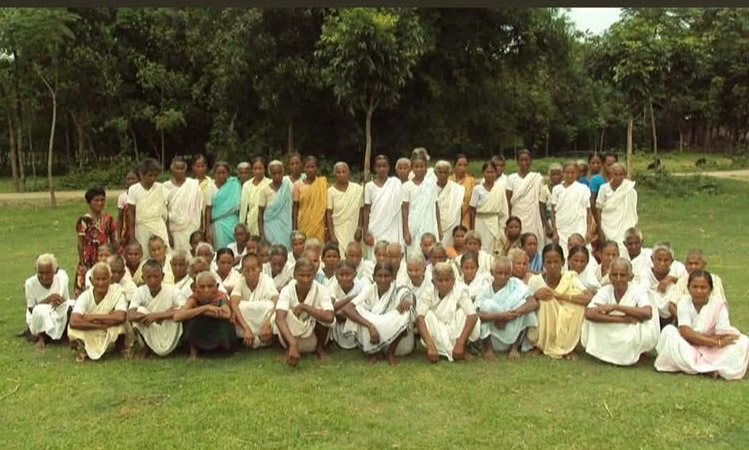
This photo was taken in 2013. All of the people in this photo were widows. All of them lost their husbands in a genocide during the Liberation War.
That demonic massacre took place on this day of the Liberation War. Only a few of the widows who lost their husbands are in this picture. Because at least 800 women lost their husbands in that one massacre. The massacre was the Thakurgaon massacre.
The largest genocide in the country’s northern region in the history of the Liberation War was the Jathibhanga genocide. The main target of the genocide was Hindus.
In the Jathibhanga massacre, Pakistani forces and Razakars killed more than 2,500 innocent Hindus in just a few hours.
This massacre was so horrific that the rapid flow of the Pathraj River near Jathibhanga was blocked after the massacre.
Shukhanpukuri is a union in the peaceful and quiet district of Thakurgaon Sadar Upazila. The bordering river Pathraj flows through the union. Jathibhanga is located on the banks of one side of the river. For centuries, the Hindu community living in Jathibhanga and the surrounding villages was the majority. Due to religious coexistence, there was no conflict among the villagers.
At the beginning of the Liberation War, ordinary people from different parts of the country started migrating to India as refugees to save their lives from the brutal genocide and torture of the Pakistani army. However, the villages of Shukhanpukuri Union were an exception in this regard.
Being a remote village, the Pakistani army and the Razakars could not enter this union at that time. Since there was no harassment from the Pakistani army and the Razakars, this route became familiar to the refugees coming to India from Debiganj Upazila of Panchagarh and Palashbari Union of Birganj Upazila of Dinajpur. As a result, the number of refugees coming from different districts along this route increased day by day.
At one stage, the Pakistani army learned about this route of refugees through the Razakars. Fearing an imminent attack by the Pakistani army and hearing news of genocide in various neighboring areas, the residents of Shukhanpukuri Union of Thakurgaon Sadar and the neighboring villages of Jagannathpur, Chakhaldi, Singiya, Chandipur, Balia, Basudebpur, Milanpur, Gauripur, and Khamar Bhopla also decided to cross the border and take refuge in India as refugees, fearing for their lives.
They set off for India on April 22. That afternoon, many of the refugees reached Jathibhanga, on the banks of the Pakhraj River. Jathibhanga had been providing overnight shelter for refugees arriving from other regions since the east.
As a result, the number of refugees there increased. At that time, the local Razakars asked them to spend the night and assured them of cooperation, requesting them to leave for the border the next morning. As the evening wore on, the refugees decided to spend the night at Jathibhanga, thinking of the women, children and the elderly and believing the Razakars’ assurances.
That night, after receiving news that the refugees had been reassured, some local Razakars informed the Thakurgaon EPR Sector Headquarters about the presence of a large number of refugees.
April 23, 1971. The day was Friday.
Since dawn, many of the refugees who arrived the previous night have started their journey towards the border. Refugees from different areas have started gathering at various places in Jathibhanga and Shukhanpukuri unions.
Since that morning, local brokers had been trying to keep the Hindu men busy by talking about repairing the broken bridge over the Patharaj River. The innocent refugees still did not realize that a demonic massacre was upon them.
As the day progressed, two trucks full of Pakistani soldiers and a group of Razakars arrived at Jathibhanga with the help of the Razakars. First, they surrounded Jathibhanga and the surrounding area. During this time, the Razakars forcibly brought out innocent villagers and refugees from various villages.
At one stage, Pakistani troops arrived with the help of the Razakars and gathered the displaced villagers and refugees on the banks of the Pathraj River in Jathibhanga. At one stage, the Pakistani forces started indiscriminate brush fire.
At this time, ordinary people started running in all directions to save their lives. During this time, countless ordinary people were martyred due to the relentless firing of the Pakistani army and Razakars. Due to the large number of people present, the ammunition stock of the invaders ran low at one stage of the massacre.
During this time, the Razakars indiscriminately hacked and killed many Hindus using indigenous sharp weapons, such as machetes, spears, and ramdas.
One of the eyewitnesses to the Jathibhanga massacre was Ram Kishore Barman, a former teacher at Jathibhanga SC High School. This is what he told me. ‘No one can believe the scene unless they see it with their own eyes. They are shooting from one side and the men are running away. They are running and getting hit again. The bullet hit them in the chest, then they could not move forward and fell down. People can kill people. After the war, many human skulls were found in the Ganges. Since people came from other districts, we never knew the names of many people.’
He said, “Before the genocide, Pakistani soldiers and brokers entered houses and looted them. After the genocide, when the Pakistani soldiers left, the Razakars looted them again and set houses on fire. As a result, the widows of the villages who had lost their husbands and relatives were left completely destitute.”
The main purpose of the Jathibhanga massacre was to kill Hindu men. Hundreds of women from Chakhaldi, Chandipur, and Shukhanpukuri villages of Thakurgaon Sadar Upazila lost their husbands in the Jathibhanga massacre. The number of widows in Chakhaldi village alone was more than 200. The number of widows in all the villages was more than 800. As a result, these villages came to be known as widow villages.
The Jathibhanga genocide was a very well-planned genocide. The main objective of this genocide was to depopulate the region with Hindu men. For this reason, they targeted the refugees and carried out this genocide.
However, many widows who lost their husbands in the Jathibhanga genocide after the war had to choose begging as a means of earning a living. Some of them worked as daily wage earners to support their families.
So many people were martyred in the Jathibhanga massacre that it was not possible to bury them. As a result, except for a few bodies, most of the bodies were thrown into the Patharaj River by the locals.
A memorial was erected on the banks of the Pathraj River, the site of the Jathibhanga massacre, a few years ago. However, the memorial now lies in a state of neglect.
Although the largest massacre in the northern region took place at this place, there is no record of any atrocities or massacres in the entire complex. There is no lock on the main gate of the boundary wall. As soon as evening falls, drug addicts sit inside the memorial and chat freely. There is no caretaker or security guard responsible for the care of the memorial and the complex.
This is a cruel irony of our history. On the day of the Jatibhanga genocide, we remember with utmost respect those martyrs whose sacrifices made this country possible.

https://stapravda.ru/20221228/reyting_samyh_populyarnyh_hostingov_v_rossii_196445.html, рейтинг хостингов России подтверждает, что выбор надежного провайдера важен для бизнеса.