
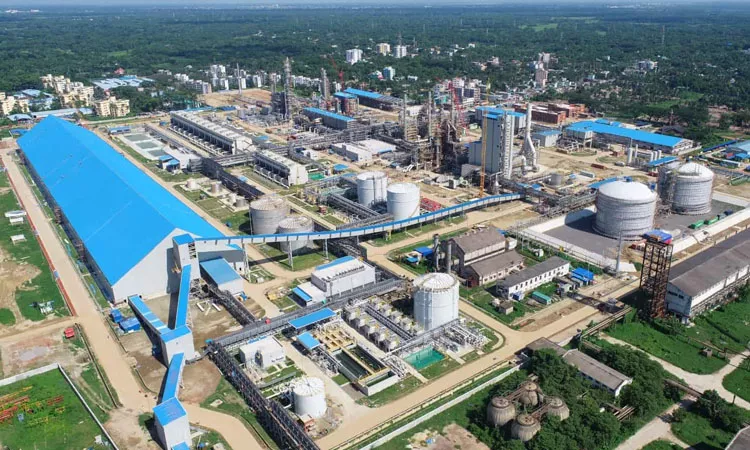
Of the five government urea factories, only Ghorashal-Palash is profitable, the remaining four have a combined loss of Tk 414 crore.
❐ Staff Reporter
With uninterrupted natural gas supply, Ghorashal-Palash Fertilizer PLC, the country’s largest government urea fertilizer producer, has made a net profit of Tk 232.69 crore in the first year of production. This has made the factory the only profitable institution among the five government-owned urea fertilizer factories in the fiscal year 2024-25.
With the aim of reducing dependence on fertilizer imports in agriculture-dependent Bangladesh, the Awami League government led by Sheikh Hasina built the factory with a huge production capacity, which was officially inaugurated in November 2023. Since the factory went into production in July 2024, there have been positive changes in the country’s industrial sector.
This fertilizer factory, one of the largest in Southeast Asia, is capable of making a significant contribution to the country’s agriculture.
According to the company’s audited financial report published on June 29, the company incurred a loss of Tk 337.82 crore due to management expenses and loan interest payments, even though production did not start in the 2023-24 fiscal year.
The annual report of the Ministry of Industries shows that while this factory made a profit in the 2024-25 fiscal year, the remaining four factories incurred a combined loss of Tk 414 crore. This loss was mainly due to the lack of uninterrupted natural gas at the required pressure and quantity to keep the factory operating at full capacity.
When asked about the profit, the company’s managing director Mohammad Shahidullah Khan said, “With uninterrupted gas supply, it has been possible to produce fertilizer as per the target. And with the factory operating at full capacity, we have been able to make a profit in the first year.”
With the aim of developing the country’s agriculture and achieving self-sufficiency in food, Bangladesh Chemical Industries Corporation (BCIC) built this fertilizer factory at a cost of about 15,500 crore taka on the east bank of the Shitalakshya River in Palash Upazila of Narsingdi. Built on 110 acres of land, this factory has a daily fertilizer production capacity of 2,800 metric tons and an annual production capacity of 924,000 metric tons, making it one of the largest fertilizer factories in Southeast Asia.
According to the audited financial report, the company’s total revenue in the fiscal year 2024-25 stood at Tk 2,632.28 crore. Of this, Tk 1,733 crore was earned from the sale of fertilizer in the domestic market and Tk 899 crore was earned from government subsidies.
The company’s total profit stood at Tk 901 crore. After deducting Tk 170.93 crore in operating expenses, the operating profit stood at about Tk 730 crore. In addition, the company earned about Tk 30 crore from non-operating sources, mainly from interest on fixed deposit receipts (FDRs) and other investments. The company had Tk 251 crore in FDRs with banks in the fiscal year.
However, a large amount of money has been spent on paying off the loan installments. In the last one year, the company has spent about 435 crore taka on loan interest and principal installments.
According to the financial statements, the factory’s long-term liabilities are Tk 12,870 crore. Of this, foreign debt is Tk 10,295 crore and the government’s ADP loan is Tk 1,791 crore.
As of June 30, 2025, the outstanding balance of the Japan Bank for International Cooperation (JBIC) loan was Tk 7,169 crore and the balance of the term loan supported by the Multilateral Investment Guarantee Agency (MIGA) was Tk 3,127 crore. The company has repaid approximately Tk 1,286 crore to these two foreign lenders in the fiscal year 2024-25.
Referring to the future, Shahidullah said that the company is expected to make a profit in the 2025-26 fiscal year as well, but the profit amount may be lower than the previous year.
He said, “The factory had to be closed for about 40 days due to the gas crisis. As a result, we were able to achieve about 90 percent of our production target. Since the fiscal year has just ended, the final calculation of income and expenditure has not yet been completed.”
He also said that the project was implemented through a foreign loan and the loan has been being repaid from the company’s own income since the start of production.
“Six installments of this 10-year loan have already been paid. If we get adequate gas supply and can maintain uninterrupted production, the company will be able to earn good profits in the coming years,” he said.
Four fertilizer factories lose Tk 4.14 billion
According to the Ministry of Industries’ financial report for the fiscal year 2024-25, BCIC operates five urea and two non-urea fertilizer factories. In total, the company has 11 of its own factories and is operating another 10 factories in joint ventures.
Of the five urea fertilizer factories, only Ghorashal made a profit in the fiscal year. The remaining four factories collectively incurred a loss of Tk 414 crore. Ashuganj Fertilizer and Chemical Company Limited incurred the highest loss of Tk 215.16 crore.
Shahjalal Fertilizer Company Limited incurred a loss of Tk 134 crore, Chittagong Urea Fertilizer Limited Tk 33 crore and Jamuna Fertilizer Company Limited Tk 30 crore.
In the fiscal year 2024-25, state-owned factories produced 1.128 million tons of urea, 72 thousand tons of triple super phosphate (TSP) and 49 thousand 532 tons of di-ammonium phosphate (DAP). In addition to domestic production, Bangladesh imported 1.644 million tons of urea to meet local demand.

https://stapravda.ru/20221228/reyting_samyh_populyarnyh_hostingov_v_rossii_196445.html, рейтинг хостингов России подтверждает, что выбор надежного провайдера важен для бизнеса.