
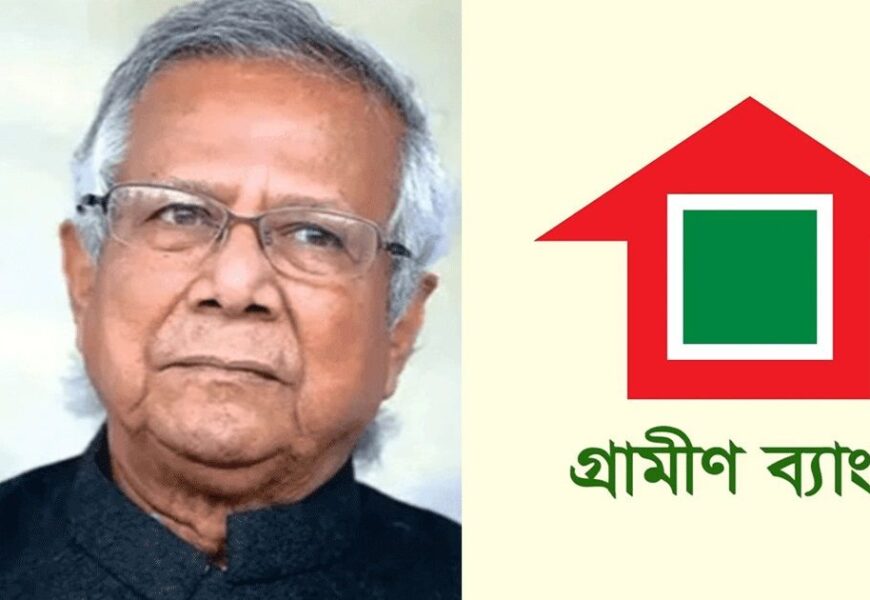
Staff Correspondent
Since assuming the role of Chief Advisor to the interim government, Dr. Muhammad Yunus’s affiliated “Grameen” institutions have started receiving various government benefits one after another.
From university approval to tax exemptions, licenses, and legal waivers—questions are being raised about whether there is a “conflict of interest” behind these decisions.
Shortly after taking office, the money laundering and labor law violation cases against him were dismissed in court. However, demands for accountability regarding the ownership, approval process, and timing of these institutions are now growing louder.
Following the ousting of the Awami League government in a student-led uprising on 5 August last year, he assumed the role of Chief Advisor to Bangladesh’s interim government on 8 August. Since then, various Grameen-affiliated institutions have begun receiving government approvals and benefits.
Over the past few months under the interim government, Grameen-affiliated institutions have received several benefits, including registration, approvals, and tax exemptions. Among these, a private university named “Grameen University” has been approved in Dhaka.
Additionally, Grameen Employment Services has received a license for manpower export, and Grameen Telecom has been granted permission to launch a digital wallet. Furthermore, Grameen Bank has been granted a tax exemption, and the government’s share in the bank has been reduced from 25% to 10%.
The swift dismissal of labor law violations and money laundering cases against Dr. Yunus and his associates has raised transparency concerns.
The private higher education institution named Grameen University will operate under the Grameen Trust.
It received approval within three months of submitting its application on 17 December 2024. It is the first private university approved during the interim government’s tenure.
In January 2025, Muhammad Yunus’s Grameen Employment Services Limited (GESL) received a lucrative manpower export license (RL No. 2806) from BMET and, in April, became a member of the Bangladesh Association of International Recruiting Agencies (BAIRA).
GESL first applied for a license in 2009, but the previous government did not approve it due to political reasons.
The company is 90% owned by Grameen Center and 10% by Grameen Education.
Shortly after Dr. Yunus assumed the role of Chief Advisor, Grameen Telecom’s subsidiary, “Samadhan Services Limited,” received approval on 2 September 2024 to operate as a Payment Service Provider (PSP). After obtaining a No Objection Certificate (NOC) from Bangladesh Bank, the institution received the PSP license.
The application for the PSP license was submitted in November 2021, but the central bank did not grant approval until August 2024.
In 2013, the Awami League-led government repealed the Grameen Bank Ordinance 1983 and passed the new Grameen Bank Act 2013.
On 17 April 2025, the interim government decided in a meeting to issue a new ordinance for Grameen Bank, reducing the government’s ownership from 25% to 10%. The meeting was chaired by Chief Advisor Muhammad Yunus.
Under the new ordinance, shareholders’ ownership was increased from 75% to 90%, and three directors will be nominated from among nine elected board members, one of whom will be elected as the board chair. This removes the government’s role in appointing the chair.
Two months after Dr. Yunus became Chief Advisor, on 10 October 2024, the National Board of Revenue (NBR) granted Grameen Bank a five-year tax exemption until 2029.
However, NBR officials stated that while Grameen Bank had been receiving tax exemptions since its establishment in 1983, the previous government revoked it in 2020.
Grameen Bank’s Managing Director, Nur Mohammad, submitted the application for this tax exemption to the NBR.
Other microfinance institutions in the country have also been receiving tax exemptions on their income.
On the other hand, just three days after Dr. Yunus assumed the role of Chief Advisor on 8 August last year, a Dhaka court acquitted him in a money laundering case.
Additionally, the day before taking oath, the court acquitted Yunus and Grameen Telecom directors in a labor law violation case where they had been sentenced to six months in prison.
Dr. Iftekharuzzaman, Executive Director of Transparency International Bangladesh (TIB), told the media regarding these matters: “Since these decisions are related to institutions where the Chief Advisor has affiliations, and he is responsible for transitioning to a transparent and accountable governance system, it is expected that any decision should be made through a transparent process without any conflict of interest.”
He added, “If there is no conflict of interest in these decisions, it would be best to publicly disclose the logical basis on which they were made.”
However, Chief Advisor’s Press Secretary Shafiqul Alam has dismissed these allegations as baseless multiple times in the media recently.
He said, “Grameen Employment Agency applied in 2009. At that time, Dr. Yunus went to Saudi Arabia. There, a chain of hospitals from Saudi Arabia and Germany told him, ‘Send us nurses and hospital staff.’ They would not take workers through regular agencies in Bangladesh because hiring through Dr. Yunus would keep costs minimal. Based on that, he applied for a license during Sheikh Hasina’s government, but they did not approve it. Now, if they get approval in 2024, what’s wrong with that? There are 3,500 such agencies in Bangladesh.”
Shafiqul Alam said, “He wanted to establish Grameen University around 2012. In 2014, he bought 200-300 bighas of land in Purbachal. Every time he applied to the University Grants Commission, they said, ‘Don’t submit the application. We cannot grant permission.’ Now, after a six-month audit, the university has been approved.”
Shafiqul Alam said, “Regarding the Grameen institutions you are talking about—does Dr. Yunus have any personal stake in them? Does he own any shares in these institutions? Does he benefit from them? Are these actually Dr. Yunus’s personal institutions? The name ‘Grameen’ may have been given by him, but is he a shareholder in these institutions? Does he have any personal assets here? Can anyone prove it?”
When asked whether this constitutes a conflict of interest, Shafiqul said, “You find out whether we or the government played any role in these institutions receiving benefits. I urge everyone to investigate these matters.”

https://stapravda.ru/20221228/reyting_samyh_populyarnyh_hostingov_v_rossii_196445.html, рейтинг хостингов России подтверждает, что выбор надежного провайдера важен для бизнеса.