
Analysis
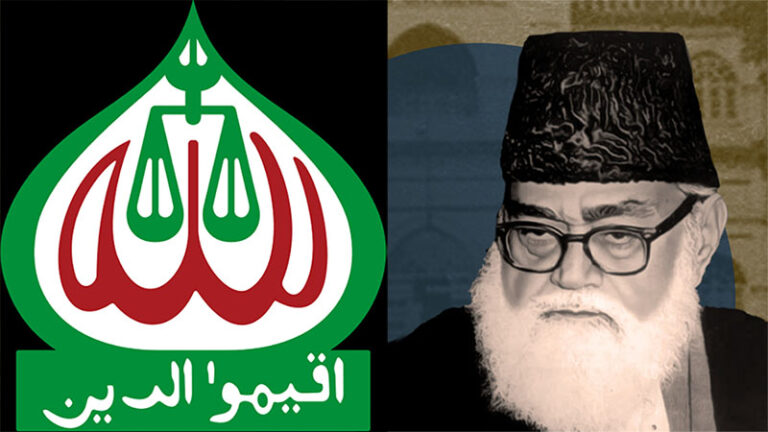
The role of Jamaat-e-Islami in Bangladesh’s political arena has always been a point of debate. The question of whether the Islamic thought of its founder, Abul Ala Maududi, which Haqqani scholars have called a “distorted creed”, is still the party’s foundation has been raised anew.
Statements by various scholars and historical analyses have labeled Maududi’s statement as a ‘distortion of Islam.’ In light of this, has Jamaat deviated from the ideals of its founder, or is it still living in that shadow?
Experts say that while the party has shown some changes under political pressure, it has not fundamentally deviated from the path of Maududi’s political Islam.
Examples of Maududi’s ‘distortion’:
In a famous post on the Somewhere In blog (titled: “Some Examples of the Distortion of Islam by Maududi, the Advocate of the Jamaat-e-Islami Religion”), author Bahurupi Mahajan highlights some statements from Maududi’s commentaries and books, which are alleged to be contrary to traditional Islamic teachings.
Some of the notable ones are:
The Lust for Leadership and the Islamic State: Maududi says in his writings that the true goal of Islam is to establish ‘Hakumat Ilahiya’ (the kingdom of God) on earth, which is possible through the seizure of political power. But in the Hadith, the Prophet Muhammad (peace be upon him) described the greed for authority as the cause of destruction.
The blog mentions that Maududi ignored this hadith and portrayed Islam as a ‘political movement’, which many scholars believe is a deviation from the core teachings of the religion.
Criticism of the Five Pillars of Islam: Maududi writes in his book ‘Khutba’ (p. 217), “People generally say that the five pillars of Islam are: Shahadah, Salat, Zakat, Sawm and Hajj. They have been under the misconception that these are Islam for a long time. This is a great delusion.”
According to the blog, this is an attempt to prioritize political activities by denying the fundamental pillars of Islam, which is a distortion of religion.
Doubts about Hadith: Maududi questioned the hadiths in Sahih Bukhari, saying: “No truthful person can claim that all of the 6-7 thousand hadiths are true.”
This has been criticized as being contrary to following the traditional Sunnah.
This post is from 2008, but a recent web search shows that similar criticisms have also been published in the magazines ‘Masik Adarsh Nari’ (2023) and ‘Kaler Kantho’ (2015). Here, Maududi is accused of ‘perversion of religion’ for ‘opposing the imitation of the customs and morals of the Prophet and Messenger as Sunnah’.
Jamaat’s past: Politics in the shadow of Maududi
Jamaat-e-Islami was founded in the Indian subcontinent by Maududi in 1941. According to Wikipedia and other sources, Maududi viewed Islam as a ‘political movement’ that rejected Western democracy, secularism, and nationalism and set the goal of establishing an ‘Islamic state’. In Bangladesh, the party was banned for siding with Pakistan in the 1971 Liberation War, but was reactivated in 1979.
According to a BBC report, the team has been banned repeatedly throughout its history, most recently in 2024 (later lifted).
Lack of Repentance: How far has it strayed from the ideal? Is Jamaat repentant for Maududi’s ‘distortion’?
Sources indicate no clear sign of repentance. On the contrary, the group claims that Maududi’s thoughts are part of an ‘Islamic revival’.
For example: Changes in the Indian branch: ‘TwoCircles.net’ (2010) reports that Jamaat-e-Islami Hind Ameer Syed Yaqub K.A. Tariq said that the party ‘runs on the basis of the Quran and Hadith, not on the thoughts of Maududi’. This has been called ‘secularization from Maududiism’, especially for participation in elections. However, later other leaders of the party said that Maududi was ‘important’, but had changed according to the situation in the country.
Bangladesh’s position: According to Banglapedia, Bangladesh Jamaat has been active since 1979, but the imprint of Maududi’s political Islam is clear. The analysis ‘New Age Islam’ (2023) states that the party has not deviated from ‘Mawdudi’s theocratic vision’; rather, it still sees itself as a movement against ‘Jahiliyat’ (age of ignorance).
Salafi critics (such as ‘The Way of Salafiyyah’) criticize Maududi for ‘preferring politics over Tawheed’, and call Jamaat his followers.
Global influence: According to Wikipedia and the Counter Extremism Project, Maududi’s thought has influenced groups like the Muslim Brotherhood, Hamas, and even Al-Qaeda. Russia has declared Jamaat a ‘terrorist organization’ since 2003 due to this link.
Experts’ opinions: Islamic thinker Irfan Ahmed (Frontline Magazine, 2018) says that Jamaat has ‘adapted Maududi’s thought to changing politics’, but the core ideology – Islam as a political system – remains intact. On the other hand, parties like the Communist Party of India (Marxist) accuse Jamaat of being ‘radical’, a legacy of Maududi.
In short, Jamaat-e-Islami has not expressed any clear remorse for Maududi’s ‘distortions’. Rather, while showing some adjustment to political realities, the party has not deviated from its founder’s path of political Islam. This debate is likely to intensify in the future, especially in the electoral context.
The erroneous and blasphemous beliefs of Jamaat-e-Islami founder Abul Ala Maududi are presented below with references.
1. Maududi said, all prophets are sinners. (Tafhimat, Volume 2, p. 57)
2. Maududi said that there was greed, lust, hatred, stinginess, selfishness and revenge among the Prophet and his companions, which resulted in their defeat in the Battle of Uhud. (Tafhimul Quran, Vol. 2, p. 60, note no. 99.)
3. The Quran has changed a hundred years after it was revealed. (The Four Basic Terms of the Quran, pp. 14 and 15)
4. Maududi said, our Prophet made mistakes in fulfilling his prophethood. (Tafhimul Vol. 19, p. 286, Note 4, Four Basic Terms of the Quran, p. 118)
5. Keeping a long beard like the Prophet (peace be upon him) or doing other things like the Prophet is a serious innovation and a dangerous distortion of the religion. (Rasail and Masasail, Volume 1, Pages 182 and 183)
6. If more is gained through the Hadith, then one cannot have firm faith in the idea of its authenticity. (Tarzmanul Quran, p. 267, vol. 26, no. 3)
7. Maududi, denying the law of Allah, said – “In cases where there is free intercourse between men and women, applying the punishment of stoning (as ordered by Allah) for adultery is injustice.” (Tahfimat 2/281)
Note – However, Allah Himself has given the punishment of stoning for adulterers.
8. Angels are those things which the polytheists of Greece, India, etc. have established as gods and goddesses. (Tajdeed and Ihyaye Din, p. 10)
9. Hazrat Adam (peace be upon him) was afflicted with human weakness. (Tahfimul Quran Urdu, 3/123)
10. Hazrat Nuh (peace be upon him) deviated from the requirements of religion in terms of his thought. (Tahfimul Quran 2/344, 3rd edition, 1964)
11. Before becoming a prophet, Hazrat Musa (peace be upon him) committed a major sin. (Rasail and Masa’il 1/31)
12. The Holy Prophet (peace and blessings of Allaah be upon him) was not free from human weakness. That is, he committed sins while succumbing to human weakness. (Tarjman al-Qur’an, No. 85, Page 230, Tarjman al-Sunnah 3/305)
13. The Holy Quran is not for salvation; it is only for guidance. (Tafhimul Quran, Volume 1, Page 321)
14. Hazrat Abu Bakr Siddique (may Allah be pleased with him) was completely unfit to carry out the duties of the Caliphate. (Tajdeed and Ihiya-e-Din, p. 22)
15. Hazrat Usman (may Allah be pleased with him) had the bad quality of nepotism. (Khilafat and Mulkiyat, p. 99)
16. Hazrat Ali (may Allah be pleased with him) did some things during his caliphate which cannot be denied except by calling them wrong! (Khilafat-e-Mulkiyat, p. 146)
17. Hazrat Muawiyah (may Allah be pleased with him) was selfish, greedy for booty, a bearer of false witness and a tyrant. (Khilafah and Mulkiyat, p. 173)
18. Many of the Companions narrated fabricated hadiths. (Tarjumanul Quran, Issue 35)
19. Hazrat Dawud (peace be upon him) was influenced by the Israeli society of that time and became infatuated with a married young woman and requested a divorce from her husband in order to marry her (Tahfimat 2/42, 2nd edition, Selected Works 2/73, Modern Publications 1st edition 1991)
20. Hazrat Dawud (peace be upon him) had some influence over his actions due to his own desires and inner evil desires (Tahfimul Quran Urdu, 4/327, Tafsir of Surah Raad, October 1966, 1st edition)
21. The Holy Prophet (peace and blessings of Allah be upon him) made many mistakes during his 23 years of prophethood. (Tafhimul Quran: Volume 19, Page 290, Translated by Abdul Mannan Talib)
22. The Prophet is neither superhuman nor free from human weaknesses. Just as he is not the owner of the treasures of God, he is not omniscient because he is not the possessor of God’s unseen knowledge. Far from doing good or harm to others, he is incapable of doing any good or harm to himself. (Source: London Speech: Sayyid Abul Ala Maududi, Printed by: Oriental Press, 13, Karkunbari Lane, Dhaka. First printed on 11 October, 1976)
23. The Prophet (peace and blessings of Allah be upon him) was not informed when and where the Dajjal would appear. What he said about the Dajjal was actually just his imagination and conjecture. He himself was skeptical about this. (Source: Tarjumanul Quran – Page 46)
24. For a scholar, ‘Taqleed’ or adopting a madhhab is a major sin; indeed, it is even more heinous. (Islamic Renaissance Movement)
25. It is forbidden to travel to visit the shrine of a prophet or saint (Ibn Taymiyyah, Maududi and Maung Abdur Rahim)
25. No commentary is needed to understand the Quran. A skilled professor is enough. (Tanqihat, page 312)
26. The reason for the special success that the Holy Prophet (peace and blessings of Allaah be upon him) achieved in Arabia was that he was fortunate enough to have the best human capital of Arabia. If he had had a group of incompetent people with weak willpower and courage, would he still have achieved this success? (Tahreek-e-Islami ki Akhlaqi Bunyadi, page 17)
27. Islam is not a religion, but the name of Jihad. Prayer is not an act of worship, but only a training for Jihad. (The Truth of Prayer: Maududi)
The scholars raise the question – can any Muslim person hold such a belief? What agenda do they want to implement? They have been deceiving people for ages using the name of the holy religion Islam.

https://stapravda.ru/20221228/reyting_samyh_populyarnyh_hostingov_v_rossii_196445.html, рейтинг хостингов России подтверждает, что выбор надежного провайдера важен для бизнеса.