
Preset71
To the northeast lies the district town of Rangpur. To the northwest is Saidpur Thana Sadar. Nearby to the west is Parbatipur. Between them, on the banks of the Jamuneshwari River, lies Badarganj. Rangpur has a strong Pakistan Army cantonment. Saidpur has another cantonment, along with a Bihari-dominated population. The neighboring Parbatipur is also Bihari-dominated.
On the night of March 31, Captain Anwar revolted with Bengali soldiers from Saidpur Cantonment. Outside the cantonment, Major Nizam, Lieutenant Mokhles, and Second Lieutenant Rafiq were stationed at different locations with their troops. All gathered at Fulbari, where the battalion was reorganized under Major Nizam’s command.
As per the security plan, Captain Anwar was assigned a company of soldiers to take position in Badarganj—their objective was to prevent the Pakistan Army from crossing the Jamuneshwari River from Rangpur. The rest prepared defenses around Fulbari to counter any attack from Saidpur.
On April 7, Captain Anwar set up defenses in Badarganj. On April 9, Pakistani forces attacked their positions. Brigadier Abdullah Khan Malek led the Pakistani offensive. The battle between the brigadier and the captain lasted from 9 AM to 4 PM. Unable to withstand the intense assault, Bengali troops began retreating. While moving from one defensive position to another, Captain Anwar was ambushed in Badarganj Bazar. His driver was martyred, but Anwar leaped from the vehicle and fled into the market. After much struggle, he reached the Badarganj railway station and then traveled two and a half miles into the village, where he found his soldiers. By then, he was bloodied and shot in the leg. The soldiers sent him to Fulbari and advanced again toward Kholahati in Ramnathpur Union near Badarganj.
On the morning of April 10, Pakistani forces attacked Kholahati. Unable to hold their ground, the Bengali soldiers retreated to Fulbari. Meanwhile, Captain Ashraf and Lieutenant Mokhles’ company also arrived there.
On April 11, Pakistani forces attacked Fulbari. A fierce battle ensued between the entire battalion and the Pakistani troops. Unable to withstand the onslaught, the battalion fell back to Charkhai.
After the Bengali soldiers withdrew, the Pakistan Army planned revenge on the civilian population. They were aided in this by Bihari leaders from Parbatipur and ATM Azhar, the president of Islami Chhatra Sangha (now Chhatra Shibir) in Rangpur district.
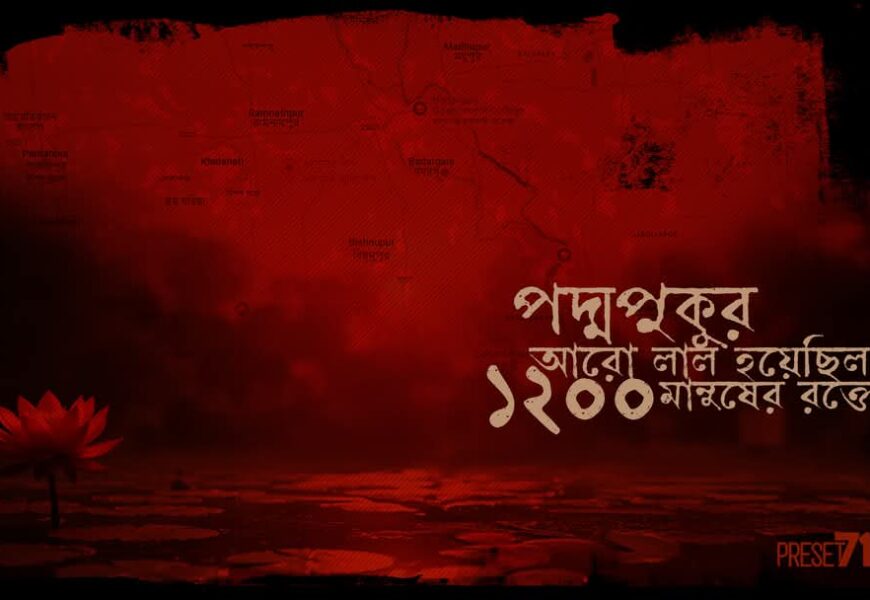
April 17. Around noon, a group of Pakistan Army soldiers arrived by train from Parbatipur under the leadership of Biharis Bachchu Khan and Kamruzzaman, heading toward Ramnathpur Union in Badarganj. Meanwhile, another group led by ATM Azhar approached from Badarganj Sadar. Surrounding the entire union from both sides, they blockaded all villages. Desperate to survive, men, women, and children fled toward the wetlands of Jharuar Bil and Padmapukur. The killers chased them down and began indiscriminate slaughter.
Before leaving, they abducted 200 young men, handpicked from the crowd. Only a few bodies were ever found—the rest disappeared.
Former acting principal of Badarganj Degree College, Meser Uddin, recalls that among the abducted was his cousin Sambaru, whose body was later recovered. Sambaru’s widow committed suicide after seeing his corpse. That same day, Meser Uddin’s other relatives—Fazlur Rahman, Azadul, Islam Uddin, Abdul Gaffar Promanik’s three sons Ohidul, Omar Ali, and Rajab Ali, and Khibir Uddin’s two sons Nur Mohammad and Khairul—were also martyred.
At the time, 17-year-old Meser Uddin had taken shelter with his family in Jharuar Bil Padmapukur. Though he survived, he witnessed countless deaths firsthand. At least 1,200 people were massacred that day.
Another eyewitness, Md. Afzal Hossain Promanik, remembers the killings of Menhajul BSc from Baniyapara and teacher Pranakrishna from Hindupara. He recalls:
“Corpses littered the roads. Blood pooled beneath lifeless bodies. Houses burned. The surroundings were terrifying. That day, the waters of Jharuar Bil and Padmapukur turned red from the atrocities of Razakars Bachchu Khan, Kamruzzaman, and Azhar.”
Sources:
1. Testimony of then-Captain Anwar Hossain. Documents of Bangladesh’s Liberation War, Volume 9.
2. Testimony of Meser Uddin. Prothom Alo, March 17, 2014.
3. Jharuar Bil Genocide. Saleq Khokon, June 10, 2013.

https://stapravda.ru/20221228/reyting_samyh_populyarnyh_hostingov_v_rossii_196445.html, рейтинг хостингов России подтверждает, что выбор надежного провайдера важен для бизнеса.