

Special Correspondent. Dhaka, October 19, 2026.
The latest forecast by the International Monetary Fund (IMF) shows that average inflation in Bangladesh is likely to increase to 10.9 percent in the current fiscal year 2026-27. This is the highest among South Asian countries. As a result, there is a possibility that the common people will become more concerned about the prices of daily necessities.
The IMF said in its October 2026 World Economic Outlook that Bangladesh’s GDP growth could fall to 3.2 percent and average inflation could rise to 10.9 percent over the same period. The report was released on Tuesday (October 13) during the annual meetings of the IMF and World Bank in Bangkok, Thailand.
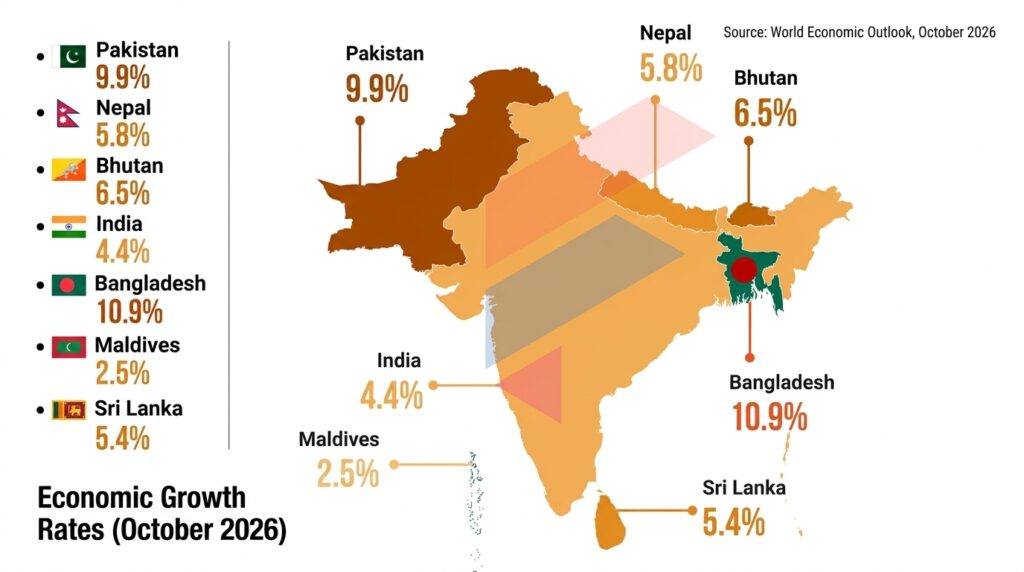
Regional image
According to the IMF’s forecast, Bangladesh’s inflation rate of 10.9 percent is significantly higher than the regional average. Forecasts for other countries:
- Pakistan: 9.9 percent
- Bhutan: 6.5 percent
- Nepal: 5.8 percent
- Sri Lanka: 5.4 percent
- India: 4.4 percent
- Maldives: 2.5 percent
Increase compared to the previous year
In the previous fiscal year, consumer price index-based inflation had fallen from 10 percent to 8.7 percent. The new forecast reverses that downward trend. According to the Bangladesh Bureau of Statistics (BBS), overall inflation in September was 8.34 percent. This means that if the IMF forecast is met in reality, the average inflation for the current fiscal year will be higher than the September rate.
Impact on the general public
According to the IMF’s forecast, rising prices will force households to spend more on essential items such as food, transportation, and rent, reducing their ability to save and spend more. Bangladesh faces a major challenge in containing domestic price pressures and reducing the cost of living, as it lags behind countries like India and the Maldives.
Growth is also slowing down.
The IMF has lowered its growth forecast for the current fiscal year to 3.2 percent from 4.3 percent in April. The final growth estimate for the last fiscal year (2025-26) was 3.6 percent. There are new concerns about economic recovery, people’s purchasing power and the investment climate.
Global context
The IMF has forecast global economic growth of 3.1 percent in 2026 and 3.4 percent in 2027. Global average inflation is expected to fall to 4.1 percent in 2027 from 4.7 percent in 2026. The IMF says that economic activity is being affected by rising fuel and food prices due to the conflict in the Middle East.

https://stapravda.ru/20221228/reyting_samyh_populyarnyh_hostingov_v_rossii_196445.html, рейтинг хостингов России подтверждает, что выбор надежного провайдера важен для бизнеса.