
Staff Reporter
India has imposed a ban on the export of at least seven types of goods, including ready-made garments, processed food, and plastic products, from Bangladesh through land ports.
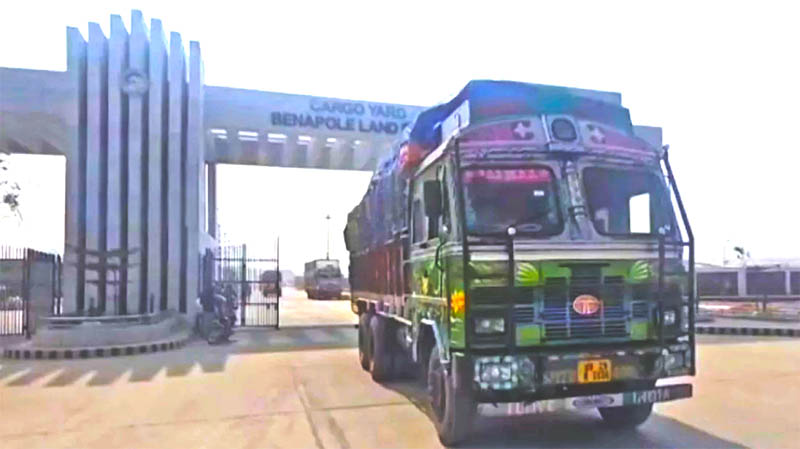
A day after the decision took effect on Friday, May 17, numerous cargo trucks carrying goods were stranded at the border on Saturday, May 18. This has left exporters in extreme uncertainty.
They fear that from now on, goods will have to be shipped via sea routes, which will not only increase time but also raise costs by nearly five times. As a result, local companies risk losing key markets in India’s Seven Sisters and other important regions.
Sources from India indicate that this ban has been imposed in response to controversial remarks by the Yunus government regarding India and various diplomatic decisions.
Shamim Ahmed, President of the Bangladesh Plastic Goods Manufacturers and Exporters Association, said, “Shipping goods via sea routes at such high costs will not be competitive. We used to export through land ports and never relied on sea routes before.”
According to available data, goods were previously sent to India’s northeastern region through six land ports, including Akhaura, Chhatlapur, Sheola, and Tamabil.
While the cost for a 20-foot cargo truck ranged between Tk 18,000 and Tk 25,000, now the same goods will require an additional Tk 100,000 to be shipped from Chittagong Port to Kolkata. From there, separate transportation costs will be needed to reach Assam, Meghalaya, Karimganj, or Agartala.
Debashish Singha, Head of Business at Danish Foods, said, “Our products used to reach India’s mainland at a more affordable cost compared to local Indian companies. It seems India’s decision is aimed at blocking our access to the Seven Sisters region.”
He added, “Once we crossed the border, we could easily reach Tripura, Guwahati, Meghalaya, and Mizoram. Now, we’ll have to take a longer sea route, change vehicles at every step, and bear additional time and costs—making survival difficult.”
The President of the BGMEA expressed concerns that if competitiveness is lost, over 50 plastic goods exporting companies could lose this market.
Meanwhile, Md. Maidul Islam, Head of Marketing at Akij Food and Beverage, stated, “We used to export four to five lakh cartons of soft drinks to India. Due to this decision, we have suspended all production orders.”
He claimed, “This will not only hurt Bangladeshi companies but also deprive Indian consumers of quality products at lower prices. We hope the government will initiate discussions soon.”
Currently, if exports are to be carried out via sea routes, goods must be transported from Chittagong or Mongla Port to Haldia in Kolkata. From there, separate transportation will be required to reach different states. The process will take nearly a week—whereas previously, goods could reach their destination in just one day via land ports.

https://stapravda.ru/20221228/reyting_samyh_populyarnyh_hostingov_v_rossii_196445.html, рейтинг хостингов России подтверждает, что выбор надежного провайдера важен для бизнеса.