
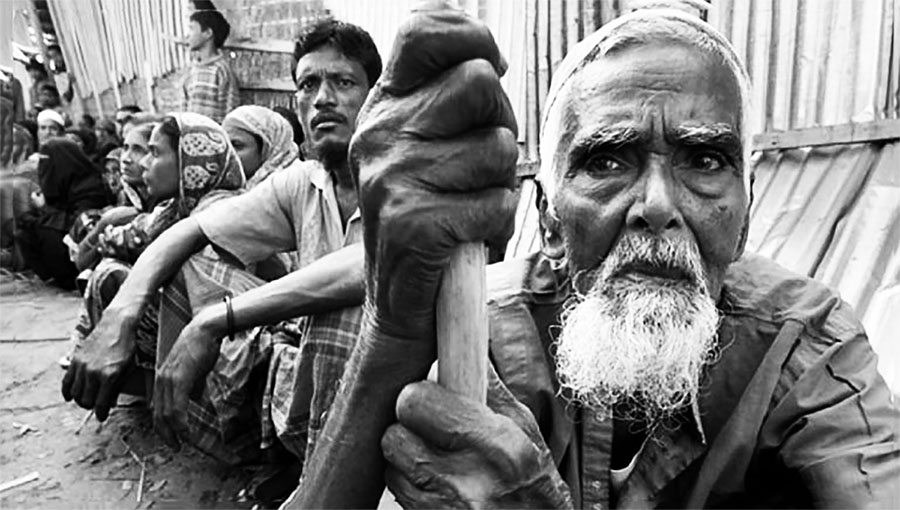

In contrast to India’s success in reducing poverty, Bangladesh’s economy is experiencing the opposite trend. While the national poverty rate fell to 18.7 percent in 2022, it is expected to rise to 21.2 percent in 2025, according to the World Bank. The rate has further increased to 21.4 percent in the latest estimate released in April 2026. The World Bank has identified inflation, employment crisis, falling real wages, and income inequality as the main reasons for this.
New figures on India’s poverty reduction highlight a significant difference in the economic progress of the two South Asian neighbours. According to the World Bank, India’s extreme poverty rate has fallen from 16.2 percent in 2011-12 to 2.3 percent in 2022-23. On the other hand, Bangladesh’s long-standing trend of poverty reduction has reversed in recent years.
The World Bank has revised the international extreme poverty line to $3 per day (2021 PPP) in 2025. The new line puts India’s rate at 5.3 percent in 2022-23. That is, it is not correct to promote 2.3 percent as the new $3 poverty line.
Bangladesh’s poverty reduction history: 37.1 to 18.7 percent
According to the World Bank’s Bangladesh Poverty and Equity Assessment 2025 report, the national poverty rate in Bangladesh decreased significantly between 2010 and 2022.
| Year | National poverty rate |
|---|---|
| 2010 | 37.1% |
| 2016 | 26.4% |
| 2022 | 18.7% |
| 2023 (estimate) | 18.9% |
| 2024 (estimate) | 20.5% |
| 2025 (estimate) | 21.2% |
Source: World Bank, Bangladesh Poverty and Equity Assessment 2025. Statistical microsimulation-based estimates for 2023-25.
National poverty rate in Bangladesh
Survey-based data for 2010-2022 and World Bank estimates for 2023-2025.

As a result of this consistent improvement, about 34 million people were lifted out of poverty between 2010 and 2022. During the same period, the extreme poverty rate fell from 12.2 percent to 5.6 percent.
Why is poverty increasing again in Bangladesh?
Several reasons have been highlighted in the World Bank’s 2025 assessment and the April 2026 Bangladesh Development Update.
1. Inflation and decline in people’s purchasing power
Rising prices of food and non-food items in Bangladesh have created a huge pressure on the lives of low-income people.
According to the World Bank’s April 2026 report, inflation was 8.5 percent in the 2025-26 fiscal year. The wages of low-income workers have not increased at that rate. As a result, their ability to meet food, rent, transportation, medical care, and other essential expenses has decreased even though their income has remained the same.
In other words, even if a worker’s salary increases slightly, if the price of daily necessities increases more than that, his real income decreases.
2. Decrease in employment creation
The World Bank’s assessment has cited the slowdown in job creation as one of the biggest weaknesses of Bangladesh’s economy.
The World Bank’s 2025 assessment stated that employment in the country had decreased by about 2 million between 2023 and 2024. The estimate at that time said that another 800,000 jobs could be lost in 2025 as well.
Women and young people in particular have been hit the hardest.
The pace of new job creation in the industrial sector has slowed. Instead of productive and well-paid jobs, many people are engaged in low-income informal work.
According to the World Bank, almost half of young people between the ages of 15 and 29 are engaged in low-paying jobs.
3. Weaknesses in the industrial and manufacturing sectors
Industrialization once played a significant role in reducing poverty in Bangladesh. Many people were lifted out of poverty, especially through increased employment in the ready-made garment industry, manufacturing sector, and rural economy.
But the World Bank’s observations show that the pace of job creation in the industrial sector has slowed down since 2016. Economic growth has not been able to create labor-intensive employment like before.
Although agricultural employment plays a role in reducing poverty in rural areas, many of these jobs are low-productive and low-paid.
4. Income inequality and weakness of social protection
According to a World Bank report, half of the poorest 20 percent of households in the country did not receive the benefits of social protection programs in 2022. In contrast, 35 percent of the richest 20 percent of households received these benefits.
That is, a large portion of those who need government assistance the most have been left out.
At the same time, a large portion of the benefits of subsidies such as electricity, fuel, and fertilizer have reached relatively well-off families and business groups.
As a result, even though there was government spending, it could not play a sufficiently effective role in reducing poverty.
5. Declining economic growth and investment crisis
According to the World Bank’s April 2026 forecast, Bangladesh’s GDP growth could drop to 3.9 percent in the 2025-26 fiscal year.
The same report cited weak private investment, a banking sector crisis, weak revenue collection, and constraints in the business environment.
According to the World Bank, the default loan rate was 30.6 percent in December 2025. On the other hand, the tax-GDP ratio fell below 7 percent for the first time in 15 years in fiscal year 2025.
In this situation, the ability to generate new investment, industrial expansion, and employment is affected.
Comparison with India: Where is the difference between the two countries?
In the case of India, new World Bank statistics show significant progress in poverty reduction.
According to the India Development Update published in April 2026, India’s extreme poverty rate declined from 27.1 percent to 2.6 percent between 2011-12 and 2023-24. During the same period, India’s poverty rate at the $4.20 per day poverty line, set for low- and middle-income countries, declined from 57.7 percent to 16.1 percent.
Poverty reduction in India
The rate based on the international poverty line was published in the World Bank’s April 2026 report.

Source: World Bank, India Development Update, April 2026. Extreme poverty line $3 per day, 2021 PPP.
Here is another important comparison. At the $4.20 per day poverty line in 2021 purchasing power parity (PPP):
-
The poverty rate in India was 16.1 percent in 2023-24.
-
In Bangladesh, the rate at the same international poverty line in 2022 was 20.5 percent.
How has India progressed, why has Bangladesh lagged behind?
Several factors are important behind India’s poverty reduction.
-
Increase in consumption expenditure: The Household Consumption Expenditure Survey of India 2023-24 found an increase in per capita monthly expenditure in rural and urban areas.
-
Macroeconomic Growth: The World Bank’s April 2026 report estimated India’s growth for the 2025-26 fiscal year at 7.6 percent.
-
Social assistance: Food assistance and other social programs have played a role in maintaining the living expenses of low-income families.
-
Economic expansion: The expansion of services, manufacturing, infrastructure, and the domestic market has impacted economic activity.
However, India’s poverty reduction statistics also reflect the impact of new survey methods and revisions to consumer spending data. Therefore, the entire reduction cannot be attributed solely to economic growth.
Big challenges ahead for Bangladesh
There is no denying Bangladesh’s past success in poverty reduction. Lifting nearly 34 million people out of poverty between 2010 and 2022 was a major achievement.
But the kind of productive employment, investment, income growth, and social protection needed to sustain those gains have become increasingly weak in recent years.
According to the World Bank, about 36 million people in Bangladesh were at risk of poverty in 2022. This means that even if they were above the poverty line at the time, they could fall into poverty again due to illness, job loss, natural disasters, or major economic shocks.
In this situation, just increasing GDP growth is not enough. The big question is whether the benefits of growth are reaching working people, women, youth, and low-income families.

https://stapravda.ru/20221228/reyting_samyh_populyarnyh_hostingov_v_rossii_196445.html, рейтинг хостингов России подтверждает, что выбор надежного провайдера важен для бизнеса.