
Dr. Mamunur Rashid
Amid widespread devastation, mob violence, failed negotiations, and rampant killings and assaults, the Yunus government is trying to survive on just one front—remittance income. The hard-earned money of expatriate Bangladeshis is being portrayed as an achievement of Yunus’s government. Yet, behind today’s success lies the result of sixteen years of policy, diplomacy, and relationship-building under the Sheikh Hasina government.
Let us look at the data to understand how Yunus is reaping the benefits of Sheikh Hasina’s efforts.
The data covers the period from 2015 to 2024. Remittance inflows are in billions of dollars and the number of migrant workers is in lakhs. Data for 2024 is estimated. Sources include Bangladesh Bank, World Bank, ILOSTAT, and Bureau of Manpower, Employment, and Training. Due to discrepancies between different sources, reliance was placed on a single dataset. Any error is the author’s own.
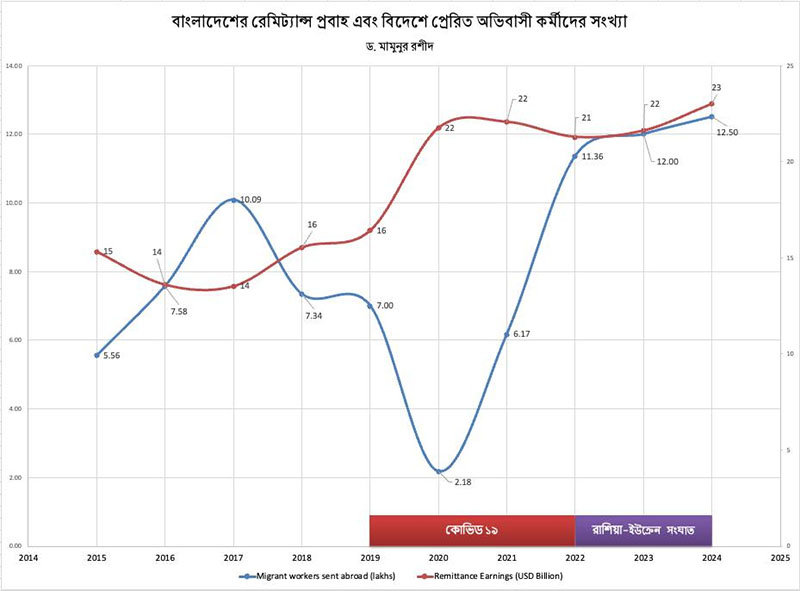
From the chart, we see that over the past decade (2015–2024), Bangladesh’s remittance inflow has increased from 15 billion to 23 billion dollars. Remittance is anti-cyclical and emotionally significant. That means when the country enters economic recession, expatriates send more money. Even in 2020, when global economic activity came to a halt due to COVID-19, our remittance flow did not stop—instead, it increased.
This rise in remittance has been made possible for several reasons. Remittance flows are primarily influenced by the number of migrant workers abroad. The more workers we send, the more remittance we receive. Government policies and diplomatic relations with host countries play a crucial role. By 2024, Bangladeshi migrant workers had reached over 150 countries.
In addition, during Sheikh Hasina’s tenure, incentives were provided for remittances, no additional taxes were imposed, and low-interest loans were made available through the Probashi Kallyan Bank.
Between 2018 and 2020, the number of outbound workers significantly dropped. While about 10.09 lakh workers went abroad in 2017, only 7.34 lakh did in 2018, 7 lakh in 2019, and 2.18 lakh in 2020.
From 2021, this number began to increase again. In 2024, Bangladesh was able to send 1.25 million workers abroad. The drop in 2018 was linked to uncertainties in the election year, while from 2019 to 2021, overseas deployment depended on the receiving countries and Bangladesh’s policies on COVID-19, including vaccination and timely test reports.
The Sheikh Hasina government successfully arranged priority vaccinations and timely COVID test results for migrant workers—quicker than many other countries. As a result, even during COVID in 2021, Bangladesh managed to send 400,000 additional workers abroad.
Therefore, the upward trend in remittances and outbound labor migration is a subtle endorsement of Sheikh Hasina’s policies and the competence of Bangladeshi workers.
If that is the case, then despite having an internationally recognized figure at the helm, the closing of doors for our workers and travelers globally suggests two things: 1) the reputation of our workers has been damaged, and 2) we have chosen the wrong leadership.
Recently, the Malaysian government arrested Bangladeshi workers, accusing them of being linked to terrorism and involved in extremist activities to overthrow the Sheikh Hasina government.
Yet, instead of addressing these issues, the Yunus government ignored the reports from foreign countries. By emotionally blackmailing the workers, remittance was used as an economic weapon to bring down Sheikh Hasina’s government in 2024.
Airport officials under the Yunus administration are reportedly extorting money from workers by falsely charging 50 taka for coffee while looting their bags. Such flawed policies will soon lead to serious economic damage for Bangladesh.
While under Sheikh Hasina, Bangladesh was known worldwide as a country of hardworking laborers, Yunus is now branding us as a nation of extremists.
The achievements Sheikh Hasina made through graceful diplomacy, Yunus not only claims credit for but is also destroying those relationships—crippling Bangladesh economically.
Inspired to write this article by Dr. Zahir Ahmed
Author’s profile: Economist and researcher

https://stapravda.ru/20221228/reyting_samyh_populyarnyh_hostingov_v_rossii_196445.html, рейтинг хостингов России подтверждает, что выбор надежного провайдера важен для бизнеса.