
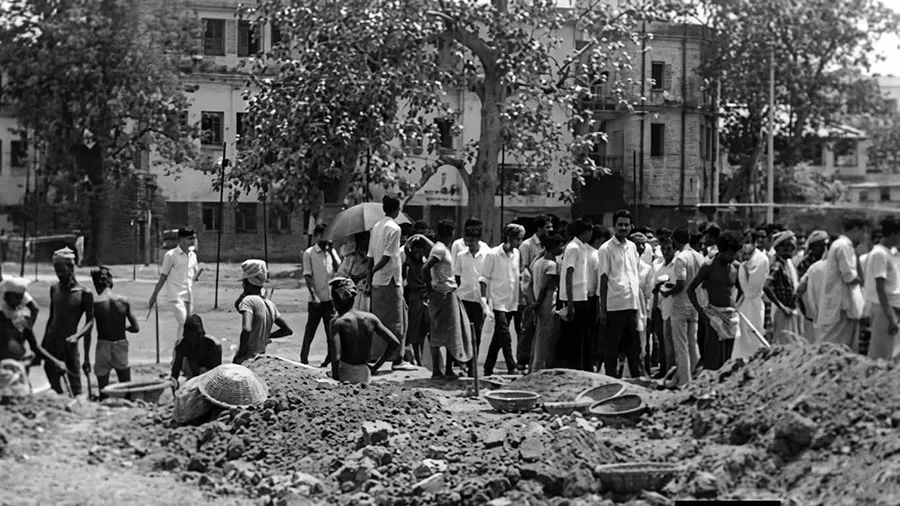
Compiled by Hossain Tawfiq from the testimony of Mr. Parimal Guha, an eyewitness to the hellish conditions after taking refuge in a manhole for 19 hours straight.
Jagannath Hall-1 under attack by attackers
Dhaka University. Jagannath Hall. Servants’ Quarter. Next to the cowshed. He defended himself by hiding in a manhole for 19 hours straight. He protected himself from the ambush of the invading forces. The manhole was stinking. Sometimes he would suffocate. His head would throb, his legs would tremble. There was no way to get out. The sound of continuous gunfire. The sounds of people’s screams and cries were all coming to his ears.
Every now and then, he somehow managed to get his throat out of the manhole and took a breath. He tried to catch a glimpse of the world outside the manhole, but the horrific killings were still going on. Mr. Parimal Guha, General Secretary of Jagannath Hall, Dhaka University, described to me the experience of the terrible night of March 25th.
He was a witness to this nightmarish night. He somehow managed to get into the manhole and miraculously escaped certain death.
He said that on the night of March 25, at around 11 pm, I returned to the hall from the house of renowned singer Rathin Roy in Laxmi Bazar. The invading military forces had not yet started the attack. People had spontaneously built barricades on the streets. Cars were moving at a fast pace. As soon as I stepped out of Rathin’s house onto the street, people asked me, where are you going? When they heard that I was going to Jagannath Hall, everyone forbade me from going. They said, the situation in the city is very tense, the military can descend at any time. The university area will be their main target.
You should not go, said Shri Parimal Guha. I got quite scared after hearing what the people said. I thought I would not return to the hall at night. There were many students in the hall at that time. I spoke to 60/70 students who were staying in the hall. Thinking of them, I decided to go to the hall. If we die, we will all die together and if we live, we will all live together. Leaving them like that, I thought it was against my life to save myself and returned to the hall.
It was 11 o’clock at night. There was silence all around. No movement of cars or horses. Silence. Occasionally, the distant chants of “Joy Bangla, Bengalis have awakened – Bengalis have awakened” could be heard. The students in the hall were standing at the gate of the hall. Everyone was terrified! No one said a word. Everyone was terrified by the unknown.
I explained the situation to them. No one believed me. Some said there was no reason to attack us. About 25 students immediately left the hall to take shelter outside in a safe place. I don’t know where they are now? Were they really safe, or were they victims of the gruesome murder of the invaders? The Pak army attacked our hall at 12:30 am. Before that, we could hear gunshots all around.
We didn’t hear any rifle fire that day. We heard machine guns, mortar shelling, and the occasional loud bang of tanks. Before the soldiers entered, some of us who were in the hall climbed onto the roof of the hall, some went to the servants’ quarters, and some tried to hide in our rooms. I went through the drain at the back towards the servants’ quarters.
The invading soldiers had entered the hall. I saw them searching every room. The sound of gunfire was reaching my ears. I went out the back. I slowly walked towards the drain of the servants’ quarters. The invading soldiers had entered the hall. I had not yet entered the manhole. I saw the soldiers searching every room.
There was no light in the hall. They had cut off the electricity before attacking the hall. Still, I watched as Vijay burst into joy after catching the students, sometimes beating them mercilessly, and sometimes taking them away. In the meantime, I heard the sound of gunshots from close by. The sound of gunshots shook my heart and soul. After that, I entered the manhole. It was around 1 am.
March 26th. The morning sun rose. I was in the manhole. I stayed in the manhole all day. All day long, only gunshots and people’s cries of self-pity were ringing in my ears. The day passed and it was evening. I couldn’t take it anymore. After 19 hours, I took my life in my hands and walked down the street, counting my steps. I climbed over the wall and went to the nearby staff quarters. There was no shelter in Professor Santosh Bhattacharya’s house.
Daily Purbadesh, February 16, 1972
Jagannath Hall-2 under attack by attackers
The surprise attack by the Pakistani invading soldiers on Jagannath Hall began at 12:30 am on March 25. The students, disoriented, tried to save their lives by taking shelter wherever they could. Some climbed to the roof in groups, some tried to hide in their rooms, and one or two went towards the servants’ quarters.
Jagannath Hall. North House. Room No. 29. Two students lived in the room. Haridhar and Sunil Das. On March 25th, a guest of Sunil’s came. Parimal said that the Pakistani invaders attacked North House and entered Room No. 29 first.
All three were present in the room at that time. They had not imagined that the Pakistani soldiers could be so violent. So in good faith they considered their room to be the safest shelter. The soldiers found the three. What joy, what joy, for these animal soldiers to catch their prey!
Parimal Guha said, the electricity supply in the hall was cut off. The soldiers had brought searchlights with them. They made the three of them stand together and brushed them. They fell down together. Then the soldiers threw a grenade into the room. In case anyone survived!
Sunil and his guest died in the brush. When he came to get news of Sunil, he himself sacrificed his life at the hands of the beasts. Haridhar was not hit by the bullet. He also fell to the floor with the other two at the sound of machine gun fire. But a grenade hit his leg. He was seriously injured.
Parimal Guha said that the invading soldiers left the room after throwing the grenades, thinking that everyone was finished. No one can survive the machine gun fire and then the grenade charge. But Haridhar miraculously survived. Blood was gushing from his legs. He wanted to hold back the flow of his own fresh, bright red blood. But he could not stop the bleeding.
Haridhar was sitting in the room guarding the bodies of his friend Sunil and his guest. There was blood in the room, there was no way out. A pack of ferocious hyenas was searching from room to room. They killed everyone they found. Haridhar was stunned. He was about to lose consciousness. He was sitting in shock. He was thinking about the pitiful fate of Haridhar, Sunil, his guest and the other students. He was thinking. He was losing his mind but still he was tearing it apart. Suddenly he remembered how many broken screws were in his room. If he tried, maybe he could get out of the city of death this way.
It was late at night. The sound of gunfire inside the hall had subsided. Haridhar tried. He went down the pipe. But where was the safe place? He slowly crawled towards the pond. Blood was still flowing from his legs. However, the speed of the blood had slowed down. Almost merging with the water, he took refuge in the grass on the bank of the pond. After that, he did not move from here. Haridhar spent his time in this state until March morning.
The curfew was lifted in the morning. A shopkeeper saw the half-dead Haridhar while passing by. He took him to Dhaka Medical Hospital. After several days of treatment, Haridhar recovered.
Dainik Purbadesh, February 23, 1972
Jagannath Hall-3 under attack by attackers
Out of the 25 students, none but one escaped their furious attack – a stream of red blood on the ceiling of the hall. They were made to stand, chest-width apart. A few lines. Three in each line. Then the sound of “Drim Drim.” Machine gun fire. Everyone fell down together. Then they moved a little and fell silent under the icy touch of great death.
I am talking about the roof of Jagannath Hall of Dhaka University. A group of invading Pakistani hyenas shot and killed several students who had taken shelter on the roof of the hall on the last night of March 25th.
Shri Parimal Guha said: Seeing the wild dance of the Pakistani menace, about twenty-five students including Satya Das, Rabin and Suresh Das took shelter on the roof of the hall for self-defense. Except for Suresh, no one else escaped their furious attacks.
He said Suresh was a little short. His chest size did not match the others. He was made to stand behind everyone. Then the machine gun roared. Everyone’s chests were riddled with machine gun bullets from the attackers. A stream of red blood flowed on the ceiling of the hall. Suresh was short, the bullet did not hit his chest. It hit his shoulder. He also fell down with everyone, just like a dead man.
Suresh is alive in the procession of the dead. Even when they tried to take shelter for self-defense, everyone surrendered to death; they could not evade death. But only he is alive. He is alive as a living witness and eyewitness to this brutal murder.
Parimal said, Suresh’s shoulder had been blown away by the powerful machine gun fire. Blood was flowing in a continuous stream. He could not stop the bleeding even after pressing hard on the wound. He was stunned by the warm blood in his own body.
The fresh, bright blood on his body was flowing in a continuous stream. His bleeding was not stopping at all, the blood flow was not slowing down. He needed to bandage it. But what would he use to bandage it? He had nothing but the lungi he was wearing and the shirt he was wearing. He tore the lungi to pieces and made bandages from the torn pieces of the lungi. The bodies of the young men were lined up on the roof. He was awake alone like a watchman.
Streams of blood. The ceiling of the hall is covered in red blood. There is silence all around. Nothing can be heard except the sound of gunshots and the cries of people. Parimal continues: He was ashamed of sitting next to the dead, and sometimes the dreams he had left behind, the colorful and sweet memories of thousands of days, floated before his eyes.
He would cry and cry out those memories. Suresh would lose himself in the procession of memories. The water tank on the roof of the hall. Suddenly, his consciousness dawned. Suresh entered the water tank without delay. On March 26, he spent the whole day and night hiding in the water tank. On the 27th, it was not possible for him to stay in the water tank. On the morning of the 27th, he took his life in his hands and came down from the roof in fear.
He moved towards the road north of Jagannath Hall. Suresh did not straighten up out of fear. He was crawling forward. Parimal Guha then came out of the staff quarters onto the road after the curfew was lifted. Suresh regained his life after meeting Parimal. Parimal Guha later took Suresh to Dhaka Medical College Hospital for treatment. Parimal heard the story of the hellish massacre on the roof from Suresh.
Dainik Purbadesh, February 25, 1972
Jagannath Hall-4 under attack by attackers
The men burst into laughter. When the three of them were almost half dead from the inhuman beating, they were lined up and shot.
March 26th at 11 am. The invading soldiers took 5 people inside the hall. They took the bodies scattered from various rooms, the roof of the hall, and the balcony and loaded them into a truck. A large hole had been dug in the middle of the hall grounds. The bodies were brought there to be buried. They also took these 5 people there. Then they made them stand right on the edge of the hole and shot them. Everyone immediately fell down.
Mr. Parimal Guha said about the morning of March 26. He was still in the manhole. He saw the hellish massacre, the horrific scene with his own eyes. He said that among these 5 people, he was able to recognize Kaliranjan Shil. He was not able to recognize anyone else. After making them stand together and brushing them off, the assailants drove away in a car.
Perhaps they went to catch more prey. Countless lifeless bodies remained on the edge of the pit in the field. Suddenly, a man ran away from this pile of dead bodies with a sigh of relief. Parimal Guha said, I clearly saw that this lucky person was Kaliranjan Sil.
The one whose image was captured on an engineer’s celluloid camera is Kaliranjan Shil. He again spoke of the morning of March 26. Early in the morning, the invading soldiers took Professor Anudvaipayan Bhattacharya to the field. Mr. Bhattacharya was a house tutor. He lived in a room in the Assembly Building. Parimal Guha saw that they took away Bidhan Roy, a student of the hall, and another man. The latter’s appearance made him look like a fourth-class employee.
Professor Bhattacharya was wearing a dhoti. The three were brought together. It was time to be beaten. They were kicking them with their boots, hitting them with rifle butts. The beating was brutal. They were screaming, Vidhan could not bear the intensity of the beating and was begging to be released. They were repeatedly praying to be released. They were bursting into laughter at Vidhan’s words. The brutal soldiers increased the intensity of the beating.
When the three of them were almost half dead as a result of the inhuman beating, they were made to stand in a line. Then the familiar sound of machine guns. The three of them fell to their deaths.
Parimal Guha said that he saw the body of Dr. Govinda Chandra Deb, the renowned philosopher and worshipper of humanity and the dean of the philosophy department of Dhaka University, in the field on March 26. His body was naked. The soldiers had laid him face down to bury him in the ground.

https://stapravda.ru/20221228/reyting_samyh_populyarnyh_hostingov_v_rossii_196445.html, рейтинг хостингов России подтверждает, что выбор надежного провайдера важен для бизнеса.