
Staff Correspondent
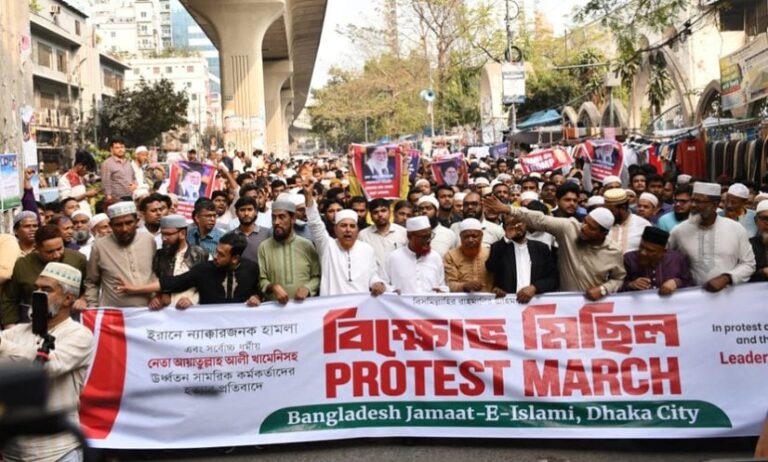
Following the killing of Iran’s supreme leader Ayatollah Ali Khamenei in a joint US-Israeli strike, leaders and activists of Bangladesh Jamaat-e-Islami and Islami Chhatra Shibir held massive demonstrations and rallies in the capital Dhaka, expressing strong protest against the US ‘aggression’. While some extremist supporters have called for joining the ‘war’ against the US, the party leadership has emphasized peaceful protests and diplomatic solutions.
A protest rally was held at the north gate of Baitul Mukarram National Mosque on Sunday (March 1) afternoon under the initiative of Jamaat-e-Islami Dhaka Metropolitan North and South. After the rally, thousands of leaders and activists marched through Bijoynagar and Kakrail to Shantinagar. Jamaat Naib-e-Ameer ATM Azharul Islam, in his speech as the chief guest, condemned the attack as a “violation of international law” and “despicable”. He called on the UN and OIC to intervene immediately and announced a larger program if the attacks did not stop.
Leaders of the Islamic Student Union also participated in the march, chanting slogans against the US and Israel and remembering Khamenei as a “martyr.” Some activists called on social media to join a “jihad” or resistance war against the US.
The protest comes amid a series of meetings between US officials and Jamaat leaders during the 18 months (2024-2026) of Dr. Muhammad Yunus’s interim government. According to a report by the Washington Post, US diplomats met with Jamaat in Dhaka, Washington, and virtually in 2025-2026. These included:
- Two former US ambassadors to visit Jamaat headquarters in March 2025.
- Discussions with Jamaat representatives at the US Embassy in Dhaka in June.
- Charge d’Affaires Tracey Ann Jacobson’s meeting with Jamaat Amir Shafiqur Rahman in July.
- Shafiqur Rahman was granted a visa to the United States in November.
- Four meetings in Washington and virtual discussions with the US Trade Representative.
In an audio recording, the US diplomat said that Bangladesh had made an ‘Islamic shift’ and that Jamaat would do well in the elections; “We want them to be our friends.” During this engagement, the Yunus government lifted the ban on Jamaat, which led to the party’s political resurgence.
Jamaat is currently the opposition party in parliament. Many see the protests against the Iran attack as a manifestation of Jamaat’s ‘internationalist Islamist’ stance, which conflicts with the US engagement during the Yunus era.

https://stapravda.ru/20221228/reyting_samyh_populyarnyh_hostingov_v_rossii_196445.html, рейтинг хостингов России подтверждает, что выбор надежного провайдера важен для бизнеса.