
Special Correspondent
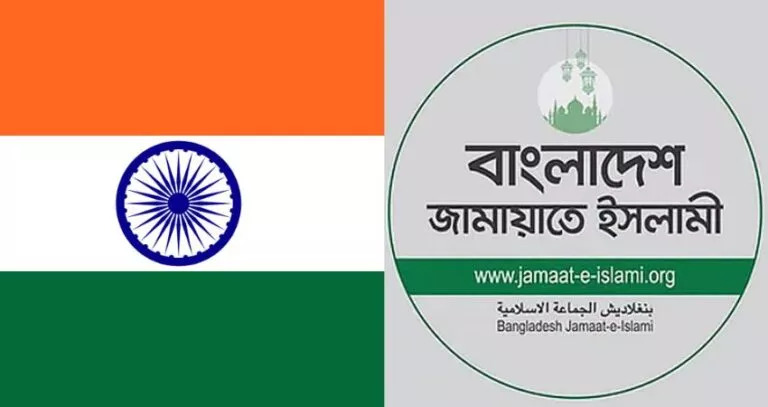
Ahead of the 13th National Assembly elections, the position of Bangladesh Jamaat-e-Islami on the India issue has come under renewed discussion. Jamaat, which has long been known as an anti-India political party, has been seen in its recent statements and election manifesto to be more restrained and flexible than before. The question has arisen in the political arena – is the party changing its ideological position, or is this just a strategic change in electoral reality?
Bangladesh Jamaat-e-Islami has announced a manifesto with 26 priorities, pledging to build a ‘safe Bangladesh’ for the upcoming elections. The manifesto was presented by party chief Dr. Shafiqur Rahman at a hotel in Banani, Dhaka, on February 4.
The manifesto emphasizes the development of foreign policy relations with South Asian countries, including India, and the Western world, emphasizing mutual respect, cooperation, and regional stability.
The party’s top leaders have also been seen to have a more restrained tone regarding India than before. After an interview given to international media outlet Reuters was recently published, Jamaat was accused of holding ‘secret meetings’ with India. Dr. Shafiqur Rahman explained this in his verified Facebook post on January 1.
In the post, he wrote that after returning home after recovering from illness, various diplomats from home and abroad paid him a courtesy call. Like diplomats from other countries, two Indian diplomats also came to meet him. However, he expressed surprise at the presentation of this as a ‘secret meeting’ and condemned such news as misleading. He also mentioned that if there is any meeting related to the interests of the two countries in the future, it will be held in public.
Many believe that the tone of Jamaat’s anti-India rhetoric has softened as the political landscape has changed over the past year. The party’s strong rhetoric against Indian aggression following the July uprising and subsequent fall of the Sheikh Hasina government has become relatively subdued in recent times. This has raised curiosity among voters as to whether this is a change of position or an election tactic.
Historically, Jamaat has been critical of India’s role. During the 1971 Liberation War, the party considered protecting Pakistan’s integrity politically important and interpreted India’s military and diplomatic role as self-serving. In the post-Liberation War, allegations of India’s military intervention, regional hegemony, and influence in Bangladesh’s internal affairs have repeatedly surfaced in its statements.
This consistent stance is reflected in recent past statements as well. In a discussion meeting organized by the South Jamaat-e-Islami in Dhaka Metropolitan City in March last year, the party’s Secretary General, Professor Mia Golam Parwar, alleged that India has been conspiring against Bangladesh since independence and is systematically trying to discredit the Bangladesh Army.
However, a different tone has been heard recently. In an interview with the Indian media outlet Times of India, Jamaat Ameer Dr. Shafiqur Rahman said that Jamaat has never engaged in anti-India politics. He also mentioned that the international policy of the party is not enmity with anyone, but friendship with everyone.
When asked about the party’s policy stance on the issue, a leader of Jamaat-e-Islami’s central propaganda department said that the party’s Ameer has already clarified his position on the issue. Efforts were made to contact Nayeb Ameer and Comilla-11 constituency candidate Dr. Syed Abdullah Mohammad Taher for details, but his statement could not be obtained. Similarly, it was not possible to contact the party’s Assistant Secretary General Maulana Hamidur Rahman Azad.
According to political analysts, it is difficult to conclude that Jamaat’s position on the India issue has completely changed. Rather, in order to adapt to the times and political realities, the party is changing the language and strategy of presentation while keeping its policy position unchanged.
Dr. KM Mohiuddin, a professor and political analyst at Jahangirnagar University’s Department of Government and Politics, said that with the upcoming elections, Jamaat is working on multiple calculations. Attracting floating voters and young voters is important.
“The party is also considering the impact that an open conflict with a neighboring country could have on the election results. In the current situation, Jamaat’s restrained stance on the India issue can be seen as an election strategy,” the professor commented.

https://stapravda.ru/20221228/reyting_samyh_populyarnyh_hostingov_v_rossii_196445.html, рейтинг хостингов России подтверждает, что выбор надежного провайдера важен для бизнеса.