

Under Yunus Government Directive, Historic Durga Temple Destroyed, Minority Community’s Anguish Fills the Air
Report | June 26, 2025
The public Shri Shri Durga Temple in Dhaka’s Khilkhet – which stood as a religious, cultural and emotional symbol for Hindu devotees – has finally been demolished by government order.
On Thursday morning, June 26, the demolition operation was led by Dhaka Divisional Railway Administration, accompanied by police, army personnel and hardline activists.
The drive was conducted based on an order issued on June 24 by Deputy Commissioner and Divisional Estate Officer of Railways Md. Nasir Uddin Mahmud.
According to Bangladesh Railways, this was implemented under Sections 5(1) and 5(2) of 1970 Ordinance No. 24 to remove illegal structures and occupants from railway land stretching from Kuril Biswa Road intersection to Khilkhet market area.
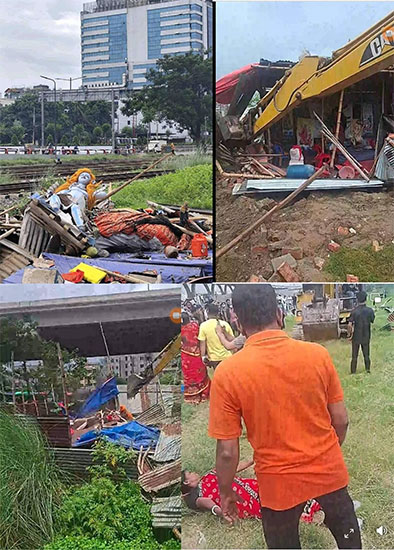 The temple demolition has brought intense grief, anger and feelings of insecurity among the Hindu minority community.
In the morning, large numbers of army personnel from Eastern Cantonment along with police forces entered the temple premises with bulldozers. Hindu men and women gathered in front of the temple in protest, tearfully begging to spare the structure. Ignoring their pleas, police forcibly removed them.
Devotees weren’t even allowed time to remove the Durga idol before demolition. Photos and videos circulating on social media show the broken idol lying by the roadside.
Many Hindus faced obstruction while trying to record videos, with allegations of mobile phones being confiscated. Several were injured during confrontations with law enforcement. Hindu women wept openly witnessing the destruction.
Though constructed with corrugated tin, the Khilkhet Durga Temple had long served as a spiritual center for the Hindu community, hosting regular worship and housing a permanent idol of Goddess Kali. During annual Durga Puja celebrations, the temple grounds would come alive with festivities.
Local residents say the temple represented not just a place of worship but stood as a cultural symbol of Hindu identity that had endured for generations.
On the night of June 24, the temple first came under attack by a mob led by Mufti Mahmudul Hasan, owner of Islamia Sweet & Live Bakery, and Abdul Quddus, president of the Jamaat-e-Islami affiliated Khilkhet Labor Welfare Federation. They attempted to vandalize the temple while hurling abuses and death threats at devotees present.
The radicals issued an ultimatum: “Remove the temple by 12 PM tomorrow or we will demolish it ourselves.”
Shyamal Chandra Das, general secretary of the temple committee, said the attackers engaged in no dialogue, simply declaring the temple could no longer remain standing. This left local residents feeling completely insecure.
The following day, various Hindu organizations including Hindu Mahajote staged protests at the temple premises, condemning the attack and demanding immediate arrest of the perpetrators. However, rather than taking action against the attackers, the administration itself proceeded with demolition, spreading anger among the public.
The incident raises serious questions about state impartiality and minority protection. While railway authorities cite “eviction procedures,” the timing – immediately following extremist threats – has led many to view this as state-sanctioned oppression of minorities to appease radical majority groups.
Minority organizations state this event will remain a dark stain on Bangladesh’s record of religious tolerance and minority rights.

https://stapravda.ru/20221228/reyting_samyh_populyarnyh_hostingov_v_rossii_196445.html, рейтинг хостингов России подтверждает, что выбор надежного провайдера важен для бизнеса.