
Staff Correspondent
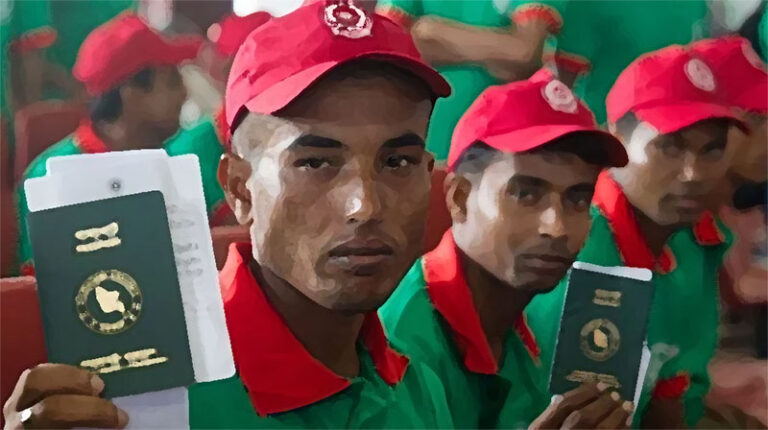
Bangladesh’s overseas employment has declined significantly due to the impact of the US and Israeli attacks on Iran, instability in the Middle East and internal irregularities. From March 1 to April 26 this year, 82,561 workers went abroad, which is 60,790 or 42.40 percent less than the same period last year. Last year, 143,351 people went abroad during this period.
Statistics show that the number of workers going abroad almost doubled to 160,014 during March-April 2024. This means that there has been a major decline in the migration flow in the space of one year.
Impact of war in the Middle East
The analysis shows that the Middle East labor market has been hit the hardest. There has been a sharp decline in the number of workers sent to major destinations such as Saudi Arabia, Qatar, and Kuwait. In the same period last year, 102,104 people went to Saudi Arabia, while this year that number has dropped to 44,876, a decrease of 56 percent.
Employment in Qatar has fallen by 69 percent, and in Kuwait by 27 percent. However, although in relatively small numbers, there has been a slight increase in the number of workers going to Jordan and the United Arab Emirates. According to experts, the military tensions surrounding Iran have affected the security and economic activities of the Gulf region, which is directly reflected in the labor market.
Saudi dependence and risk
According to the Bureau of Manpower Employment and Training, more than 66 percent of overseas workers went to Saudi Arabia in 2025. About 78 percent of the total employment in the Gulf countries depends on this region. As a result, any instability in that region has a major impact on the entire migration sector.
Stagnation in the alternative market too
There is also little progress in potential labor markets outside the Middle East. The markets of Malaysia, Oman, and Bahrain have been closed for a long time. Sending workers to Singapore has decreased, and initiatives to increase employment in high-income countries like Japan and South Korea are not being effective.
In European countries like Romania, Poland, and Croatia, the market has almost closed due to visa complications and worker irregularities. As many workers have fled to other countries in these countries, employers have become reluctant to hire Bangladeshi workers.
Visa complications and new crises
To work in Europe, one has to go to New Delhi, India, to get a visa. But due to the recent political situation, it has become difficult to get an Indian visa, so workers are not able to go there. As a result, migration to Europe has further narrowed.
At the same time, the route to Europe via Kyrgyzstan is almost closed. On the other hand, that market is also at risk due to allegations of sending workers to the war zone in Russia with the lure of work.
Internal irregularities and syndicates
The main reasons behind the closure of the Malaysian labor market are the syndicates of recruiting agencies, excessive charges and irregularities. There are allegations that the government is charging several times more than the prescribed fee. As a result, thousands of workers have not been able to go abroad despite completing all the procedures.
In addition, fake certificates, fake experience and the tendency to flee abroad without getting a job are damaging the image of Bangladesh, which is affecting new employment opportunities.
Government initiatives and optimism
The government says bilateral talks are underway to reopen closed labor markets. Communication with Middle Eastern countries is ongoing and assurances have been received that employment will increase once the situation normalizes.
In addition, initiatives have been taken to find new labor markets, develop language and skills, and simplify visa procedures. Positive progress has also been reported in reopening Malaysia and other old markets.
Overall, it can be seen that the number of workers going abroad in the first four months of this year stood at 243,287, compared to 333,642 in the same period last year. This means that there has been a major decline in foreign employment overall.
According to analysts, it’s not just the war—lack of market diversity, skills shortages, administrative complexity, and irregularities—all of which are contributing to a major decline in Bangladesh’s migration.

https://stapravda.ru/20221228/reyting_samyh_populyarnyh_hostingov_v_rossii_196445.html, рейтинг хостингов России подтверждает, что выбор надежного провайдера важен для бизнеса.