
Opinion
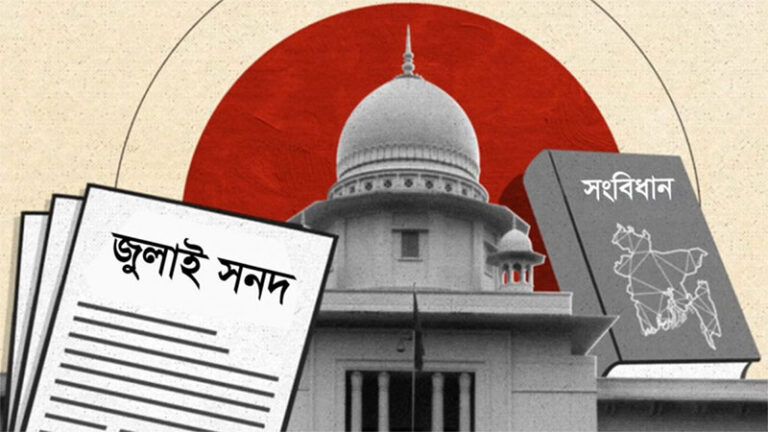
1. This so-called ‘charter’ is against the Constitution of the People’s Republic of Bangladesh. Here, the glorious history of Bangladesh’s liberation war and democratic struggle has been distorted.
2. The name of the Father of the Nation, Bangabandhu, the architect of independence, has not been mentioned anywhere, whereas an attempt has been made to glorify the unconstitutional ruler, Dr. Yunus, by mentioning his name.
3. It has been presented as the equivalent of the “supreme law” by citing the “general will of the people” as the reason for its adoption. It has been said that it has been made with the “consent” of the people as a “settlement of a new political settlement.” There is no visible criterion in Bangladesh at the moment to measure the consent of the people.
4. Out of the 52 registered political parties in Bangladesh, 16 have signed here, which is roughly half of the country’s total voters in terms of voter turnout. That is, talking about the consent of the people while excluding the remaining half of the country’s people is a fraudulent exercise.
5. Ali Riaz says that this charter is a ‘social contract’ between the state, citizens and political parties.
The question is who signed this social contract on behalf of the state, who on behalf of the people, and which parties and individuals signed this social contract on behalf of the political parties?
The legal validity of the current interim government is widely questioned. As such, whether the government’s chief advisor, Dr. Muhammad Yunus, and the members of the so-called Consensus Commission have any legal authority to sign on behalf of the state is a major legal scientific question. Agreements are signed on behalf of the state in the name of the President, and the Prime Minister (advisor) does not sign them, except in exceptional cases.
And if the chief advisor signed as the head of the consensus commission, then who signed on behalf of the state?
[I am not sure, however, whether everyone signed the same document, or whether each signed their own copy reserved for them. If the latter is the case (as is evident in various photographs), then the entire signing affair is another legal scandal, with no unity of purpose or meeting of minds between the parties.]
6. False, fabricated or distorted information has been presented here regarding the historic Six-Point Movement of 1966, the 1970 elections, the brutal assassination of Bangabandhu, etc., which is a blatant combination of Jamaat and BNP narratives.
7. During Zia’s regime (1979), the rehabilitation of Jamaat politics and war criminals in politics has been described as the introduction of ‘multi-party democracy’. However, the mass uprising of 1990 has been denied.
8. The history of turning Bangladesh into a militant state from 2001 to 2006 has been hidden (the post-election persecution of the Hindu minority in 2001, the August 21, 2004 bomb attacks, simultaneous bomb attacks in 63 districts across the country, the killing of Judges Sohel and Jagannath in bomb attacks, the killing of top Awami League leaders including Shams Kibria, etc.) has been suddenly brought up in the ‘Logi-Baitha’ incident of October 28, 2006.
9. The period from 2009 to 2024 has been presented in a one-sided, untrue, half-truthful and distorted manner.
10. The word ‘fascist’ has been used in this, citing the name of Bangabandhu’s daughter, Sheikh Hasina, out of political malice.
The past 16 years have been marked by the term ‘fascist’, and a system has been maintained to harass any government bureaucrat, government employee, or any independent person by labeling them as “fascist allies” and to cultivate hatred in society.
11. The so-called “July fighters” have been granted indemnity or immunity from liability without calling for a proper, objective and transparent investigation into the July-August killings, and it has been stated that the “legality and necessity” of this July Charter cannot be questioned in court.
This will allow Dr. Yunus and members of his government to use this charter as a shield to protect themselves.
Where provisions or amendments to the Constitution itself can be challenged in legal systems around the world, such provisions are gross violations of human rights and the rule of law and a means of perpetuating discriminatory systems.
12. The government is talking about a referendum on this, but it has no constitutional legitimacy to hold one. The “Re-Ferry-endum” idea inherently and structurally demands that those in government have already been elected by the people once.
13. The Charter states that the matters that are “immediately implementable” will be implemented by this “interim government and relevant authorities.”
It is not clear who will decide what is immediately enforceable and what is not. So how will it be legal if it is implemented before it has legal force?
And who is the relevant authority?
14. It states that the party in power in this charter will “reasonably” amend, add, subtract or modify the constitution.
The word “reasonably” has different interpretations for different political parties, so this charter leaves the door wide open for abuse.
15. Arrangements have been made to omit or strategically neutralize the contents of the Declaration of Independence, Bangabandhu’s March 26th Declaration of Independence, and the historic March 7th Speech that were included in the Schedule to Article 150.
16. It talks about the religiously based and geographical Bangladeshi nationalism unleashed by General Zia, which is incompatible with the emergence and development of the liberal concept of the unity and solidarity of the thousand-year-old Bengali culture and Bengali language and nationhood.
This does not go with indigenous ethnicity either.
17. The principle of state religion has been maintained by removing the principle of secularism, one of the rubrics of the constitution, which has led to the possibility of Bangladesh losing its balance and becoming a religiously extremist state.
Jamaat’s keenness to keep the PR system running, especially for the upper house, has further fueled this possibility.
18. It contains about 86 reform proposals, some of which are constitutional, some policy-related, and some administrative.
All these things cannot be assimilated into the constitution at the same time. There is no such system anywhere in the world.
The constitution is a static issue, administrative law is an ongoing issue.
19. There are a lot of ‘notes of dissent’ in this. So what is the consensus on?
It has been said that if political parties go to the people through manifestos with different agendas, they will be able to implement them even if they go against the July Charter.
So what has been said in the charter so far?
20. The so-called “July Warriors” (NCP) have not yet signed the July Charter.
This is also a political drama and is being used as a tool to delay, influence the upcoming elections, or use the state structure to achieve other political ends.
Out of a tendency to compare the 1971 War of Independence and its aftermath with 24, they are insisting on having the President issue a “constitutional order”, which is not only ridiculous and unconstitutional, but also amounts to extreme arrogance towards our War of Independence and reveals ignorance about the Constitution and the workings of constitutionalism.
21. Implementing most reform proposals will require consensus among the government, opposition parties, and other active institutions of society, which is not ‘politically feasible’ in a fragile or developing democratic system.
As a result, the government system will collapse very easily.
22. Various reforms have been proposed, including applying the principle of seniority only in the appointment of the Chief Justice, taking away the use of the title of judge from a former judge in ‘special cases’, making the Speaker from the opposition party, the plan to introduce an upper house of parliament, the long and incomprehensible provisions of the caretaker government, and unfairly curtailing the President’s royal prerogative of pardon, which are controversial, risky and contrary to established parliamentary traditions in many ways. These need to be debated on a wider scale and in a timely manner.
The July 23rd Charter is conceptually unbalanced, intellectually unattractive, historically misleading, legally unsustainable, unprecedented in comparative constitutional terms, and nauseating in drafting skills and language.
24. This is a travesty of the historical tradition of our constitution-making (1971-1972).
25. Finally, since no reputable constitutional jurist was involved in the drafting, this July Charter is actually a “fake charter.”
Professor Dr. Masum Billah
Legal Expert, Teacher, Law Department, Jagannath University

https://stapravda.ru/20221228/reyting_samyh_populyarnyh_hostingov_v_rossii_196445.html, рейтинг хостингов России подтверждает, что выбор надежного провайдера важен для бизнеса.