
Chittagong Correspondent
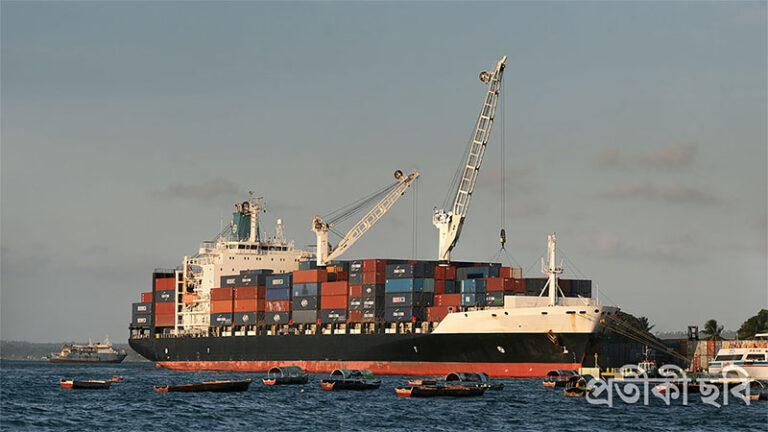
Export operations have been severely disrupted due to a strike by C&F (Clearing and Forwarding) agents and a strike by transport owners at Chittagong Port. As a result, six ships left the port without loading nearly 1,000 single containers of export goods.
The ships left the jetty at various times from Saturday to Sunday morning. Exporters fear that the strike could cause losses of hundreds of crores of taka.
According to the new decision of the port authority, the entry fee for vehicles and individuals has been increased fourfold. In protest against this decision, transport owners started an indefinite strike from Thursday. As a result, trailers carrying containers could not enter the port, and the loading of export goods was completely stopped. C&F agents also joined the strike with the same demand.
As a result, on Saturday and Sunday morning, six ships—including the large ship Soul Resilience —left the port with empty containers without export goods.
The port authority said that 3,000 to 4,000 TEU (twenty-foot container) of cargo has been stranded every day due to the strike. The Soul Resilience ship alone could not load 170 export containers. Overall, about 1,000 containers are stuck in the port’s depot, for which exporters will have to pay additional storage and demurrage fees.
“The port authority has increased the fee four times, which is completely unreasonable for us. We cannot afford this additional cost,” said Salim Khan, president of the Chittagong District Prime Mover Trailer Workers Union.
Although the strike was called off on Sunday afternoon, it is feared that it will take several more days for the port’s operations to fully return to normal. Currently, the port’s container deliveries have decreased by about 45 percent, and an additional 3,300 containers are stuck at the port.
Syed Mohammad Arif, chairman of the Bangladesh Shipping Agents Association, said, “The turnaround time of ships has increased due to the strike. This is severely affecting not only exports but also imports.”
Inaction and inefficiency under the Yunus administration
The interim government led by Dr. Yunus, which came to power in August 2024, has not been able to bring about the desired stability in the country’s economic sector. Continuous inefficiency and instability, especially in the port and transport sectors, are destroying business confidence. Chittagong Port controls more than 90 percent of the country’s total trade—where such stagnation is directly affecting the national economy.
A study by the Bangladesh Institute of Development Studies (BIDS) says that logistics inefficiency and customs-related corruption cost the country about 1 to 1.5 percent of its GDP every year, reducing export competitiveness and hindering foreign investment.
According to analysts, four factors are particularly responsible for the weakness of the Yunus administration.
First , political instability and election uncertainty. Army Chief General Waqar-uz-Zaman recently said that the failure to announce election dates and delays in strategic issues like ports “pose a risk to national sovereignty.”
Second , the government’s focus is more on attracting foreign investment than on economic reforms. There is growing anger among workers over the plan to hand over the New Mooring Container Terminal in Chittagong to foreign company DP World.
Third , macroeconomic indicators are on the decline. Private sector credit growth fell to 7.15 percent in January 2025, the lowest in a decade. Buyers in the export sector are also canceling orders as costs rise due to strikes, power shortages, and customs complications.
Fourth , the government’s delay in decision-making. Although measures such as fee hikes had already signaled worker dissatisfaction, the government did not take timely remedial measures, making strikes inevitable.
Economists say the slow pace of reforms and lack of administrative coordination are making the path to economic recovery difficult. If effective steps are not taken quickly, Bangladesh’s goal of becoming a ‘trillion dollar economy’ will become even more distant.
The Chittagong Port Authority is currently trying to restore operations, but exporters and traders say government financial support and policy support are essential to offset the losses caused by the strike.

https://stapravda.ru/20221228/reyting_samyh_populyarnyh_hostingov_v_rossii_196445.html, рейтинг хостингов России подтверждает, что выбор надежного провайдера важен для бизнеса.