
Staff Reporter
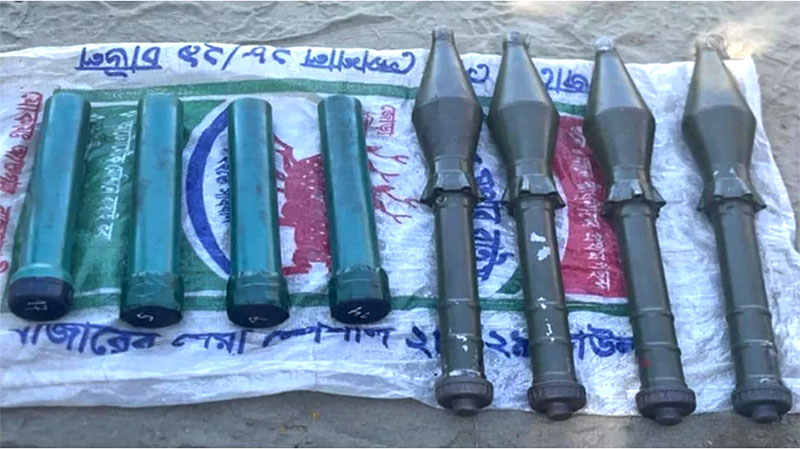
On November 22 at 1:30 AM, Rapid Action Battalion (RAB)-15 conducted an operation in the Sabrang area of Teknaf, recovering four live 40mm tank-busting rockets and four fin assemblies from an abandoned location.
The recovery of such deadly military equipment has been flagged as a significant security threat to the country by RAB’s senior assistant director in the Cox’s Bazar branch, Md. Kamruzzaman. The destruction of the rockets and fin assemblies is to be carried out by the bomb disposal team of the Ramu Cantonment. However, since the weapon recovery, no further details have been released to the media, and no information has been provided about those responsible or the origins of the weapons.

News Published in Dhaka Tribune
RAB reported that they had received intelligence about a group of illicit arms dealers stationed in the Northpara Majher Dail area, attempting to sell a shipment of advanced weaponry. When RAB’s team arrived at the location, two or three individuals fled, but despite chasing them, RAB was unable to apprehend anyone.
This raised a crucial question: why would ordinary arms dealers be attempting to sell military-grade weapons? Tank-busting rockets are not typically used by common criminals; using such weapons requires advanced military training. Additionally, large terrorist organizations are known to use such weapons.
Following the news published in the Dhaka Tribune, a thorough investigation was conducted by a firm named True Gazette, which uncovered startling information. The company revealed that the tank-busting rockets were manufactured at Pakistan’s state-run Pakistan Machine Tool Factory (PMTF) in Karachi. The technology behind the rockets was originally developed by the Soviet Union in 1961. The weapons recovered in Cox’s Bazar were made in Pakistan.
According to the U.S. Air Force Museum, these weapons are only manufactured in Pakistan within South Asia.
A significant question remains unanswered: how did the rockets end up in Teknaf, Bangladesh? Despite two months passing, no conclusive answers have been provided.
Direct Shipment from Karachi to Chittagong
It is worth noting that just five days before the rocket recovery in Teknaf, on November 16, a ship arrived directly from Karachi Port in Pakistan to Chittagong Port. While the ship was said to be carrying industrial raw materials and consumer goods, the cargo was unloaded without any physical inspection, maintaining strict confidentiality.
The cargo manifest claimed that the containers contained chemicals for industrial use, such as sodium carbonate, dolomite, limestone, along with fabrics, onions, and other products.
Chittagong port officials confirmed that the ship brought products such as refined sugar, mineral dolomite, soda ash, rolls of fabric, old scrap iron, and sugarcane molasses. Furthermore, according to reports from The Daily Prothom Alo, one container contained whiskey, vodka, and wine.
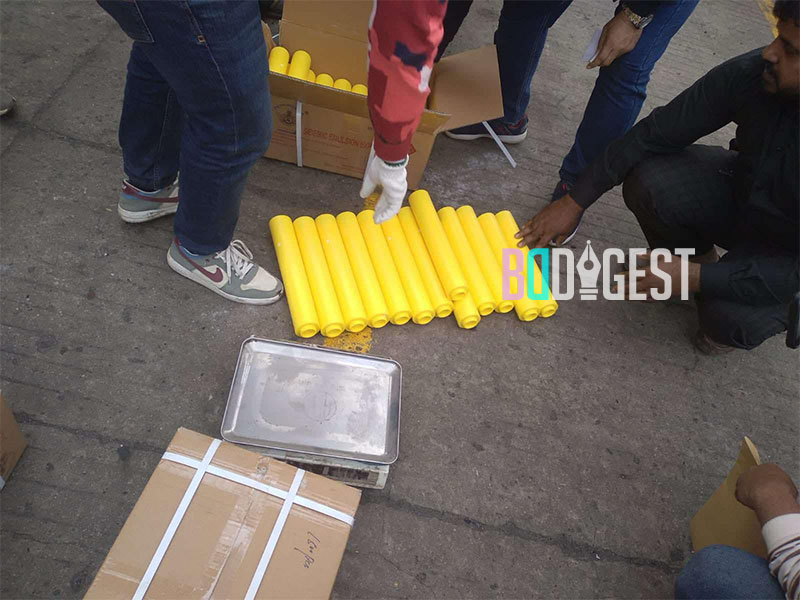
However, BD Digest obtained information and images that revealed that two containers from the Pakistani ship contained dangerous explosive materials. One container had a red square label marked with “EXPLOSIVE.” The type of explosive material resembled the rockets recovered in Teknaf.
Explosives Discharged from the Containers
Images of one container, marked as WHLEU-42617942G1, showed a red square label with the word “EXPLOSIVE” written on it. When the container was opened at Chittagong port, Navy officers noticed the explosives and held the shipment for an hour, but under instructions from senior authorities, the cargo was unloaded.
The container was found to contain seismic emulsion explosives produced by a Cambodian company, which experts stated are used for destroying large structures.
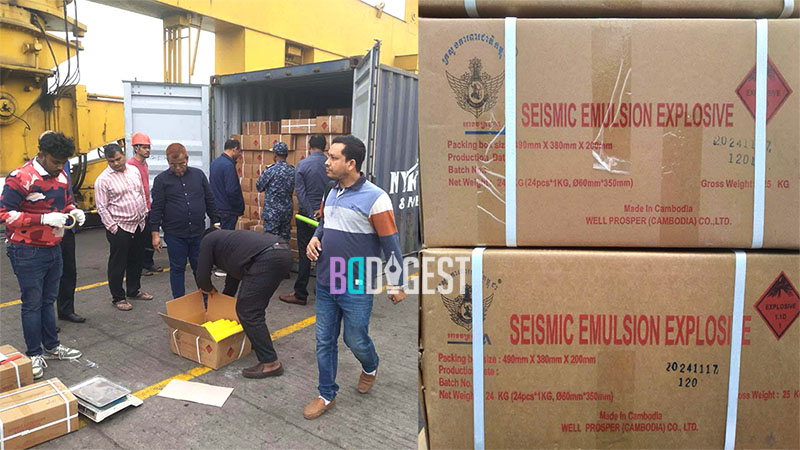
According to sources, a part of this explosive material was sent to Sylhet, and another part to Keraniganj.
Security Concerns and Rising Terrorism
‘Arges Grenade’ recovered from crop field in Jhenaidah
On Wednesday, January 8, at noon, Jhenaidah RAB-6 recovered an M36 model Arges grenade from Charpara field in Baribathan village of Jhenaidah Sadar upazila. The company commander of the organization, Major Naeem Ahmed, said that RAB recovered it after receiving information that a grenade was lying in Charpara field. Later, RAB’s Bomb Disposal Unit destroyed the grenade inside the field.
However, it could not be said who or what had left the grenade here. Members of RAB, police and army were present in the operation. Incidentally, several boxes of Arges grenades produced in that country were brought from Pakistan in the grenade attack of August 21, 2004.
Security analysts have raised concerns over the inevitable rise of terrorism in Bangladesh. Following the events of August 5, several dangerous terrorists escaped from various prisons in the country, and many cases were dismissed, enabling their release. Additionally, several terrorists expelled from the military for their involvement in terrorism are seeking to have all charges dropped. This has prompted international organizations and media outlets to identify Bangladesh as a breeding ground for terrorism.

https://stapravda.ru/20221228/reyting_samyh_populyarnyh_hostingov_v_rossii_196445.html, рейтинг хостингов России подтверждает, что выбор надежного провайдера важен для бизнеса.