

❐ Staff Reporter
The government has become a virtual hostage to traders over the cooking fuel liquefied petroleum gas (LPG). Due to their pressure, the price of this essential fuel has increased by 35 percent in the seven and a half months of the current government’s rule. Even then, buyers are having to pay Tk 250 to 400 more than the government-set price to buy cylinders.
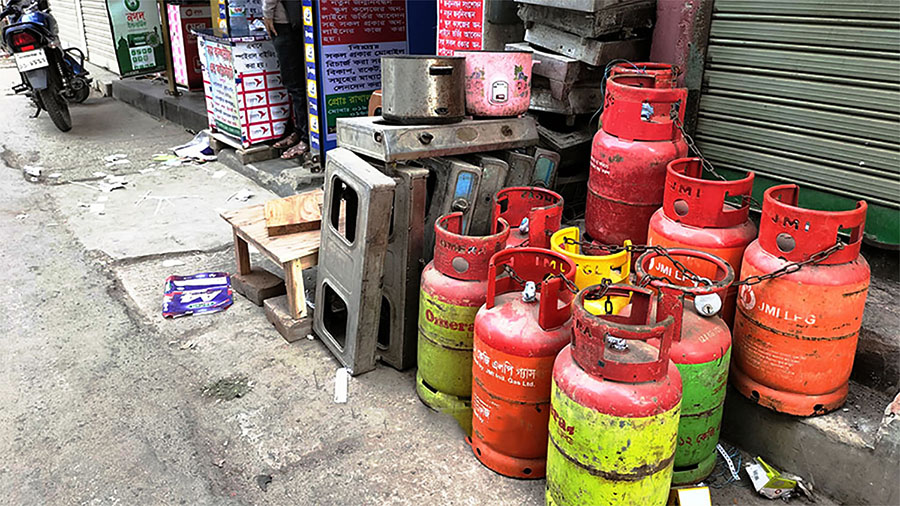
Although the price of a 12-kg cylinder has been fixed at Tk 1,837 in stages, gas is not available anywhere in the country at this price. Taking advantage of the weakness of government institutions, unscrupulous traders are selling Tk 1,837 cylinders for Tk 2,200 to 2,300. As a result, consumer costs are increasing every day.
And that is why the consumers, whose frustration has reached its peak, complain that a section of the government is taking extra money from the people’s pockets through agreements with LPG companies. Otherwise, far from breaking this syndicate, the government is not even acknowledging the existence of the syndicate.
This is the reaction of ordinary consumers who visited the market.
There are more than 10 million LPG consumers in the country. Due to the shortage of gas supply through pipelines, many are forced to rely on LPG. Therefore, they are the ones who have to bear the pressure of the increased price.
Experts say that in addition to taking swift action against the syndicate, it is important to increase the capacity of government institutions. This is because the relevant agencies are not able to play an effective role in regulating the market.
There are also allegations that Bangladesh Petroleum Corporation (BPC) is not able to show its capacity in importing LPG. While private importers are importing LPG for around $200, BPC is asking for $270.
After visiting several markets in the capital on Thursday and talking to buyers and sellers at various levels, it was found that LPG is not available anywhere in the country at the price set by the government.
Retailers say they are unable to buy gas as per demand because the companies are not supplying it properly. So, they are buying cylinders at higher prices through alternative channels and selling them at higher prices, making a small profit.
Wholesalers are not accepting the retailers’ complaints. They say that since retailers already have gas in stock, they are not interested in purchasing new gas from pillar points.
Dealers and distributors complain that operators are not supplying cylinders as per demand. Although there are conflicting complaints among operators, distributors and dealers, no one is willing to speak out publicly.
Retailers explain the reason, saying that if they speak out against the big players, the current supply will also be cut off. They complain that despite imports and stocks, supply from plants is being limited. As a result, distributors are not getting the necessary products, and the impact is being felt in the retail market.
Operators claim that there is enough LPG in the country. According to them, taking advantage of the reduced supply, some distributors, dealers and retailers are hoarding cylinders and selling them at higher prices. The problem may also be caused by retailers.
Bangladesh LPG Operators Association (LOAB) President Mohammad Amirul Haque said that action will be taken if there is evidence that any operator is selling at a higher price.
To manage the situation, energy experts have advised that relevant agencies including the Bangladesh Energy Regulatory Commission (BERC), Competition Commission, Department of Consumer Rights Protection, and BSTI should conduct effective surveillance.
Energy expert M Shamsul Alam claims that BERC is providing opportunities to businessmen.
He said that before 2021, traders used to sell LPG at whatever price they wanted. BERC got the power to fix the price by court order. But under pressure from traders, they set the price higher than that of neighboring countries, but still they cannot enforce it.
Prices have increased by 35 percent in seven months
When the current government of Tarique Rahman took office in February this year, the price of LPG was Tk 113 per kg, and the price of a 12-kg cylinder was Tk 1,356. Seven and a half months later, on October 4, the price was fixed at Tk 153 per kg, bringing the price of a 12-kg cylinder to Tk 1,837.
Despite a couple of price cuts in between, overall LPG prices have increased by 35 percent in the seven and a half months of this government. There has been widespread public anger as consumers are unable to buy LPG even at the increased price.
BERC had first set the price of a 12-kg cylinder at Tk 975 in April 2021. During Tarique Rahman’s rule, the price was increased in two phases by a total of Tk 599 in April this year, to Tk 1,940. It was reduced by Tk 55 in June and Tk 357 in July.
In August, the price was increased by another 70 taka to 1,598 taka. In September, it was reduced by another 13 taka to 1,585 taka.
Highest price in South Asia
According to the information available, the price of LPG is now the highest in South Asia in Bangladesh. Although the price per kg in the country is fixed at 153 taka, in India its subsidized price is 87 taka in Bangladeshi taka, and 108 taka without subsidy. The price in Pakistan is 124.16 taka, in Nepal 115.35 taka and in Sri Lanka 116 taka.
According to the Indian media outlet The Hindu, even excluding subsidies, the price of a 12-kg cylinder in the country is around 1,300 rupees. In Colombo, the capital of Sri Lanka, the price of a 12.5-kg cylinder is 4,965 rupees, or 1,400 rupees.
In Pakistan, the price per kg is Rs 279. In Bangladeshi currency, the price of a 12 kg cylinder there is a little less than 1,500 taka. Although there are allegations of LP gas being sold at a slightly higher price than the fixed price in Pakistan, it is reported that it is sold at a price roughly set by the government in India, Sri Lanka and Nepal.
68% of the market is controlled by a few specific companies, intelligence information found evidence of manipulation
According to BERC data, at least 150,000 tons of LPG is used annually in the country. 80 percent of this goes to cooking, 12 percent to industry, and 8 percent as autogas for vehicles. 98-99 percent of the LPG market is occupied by private entrepreneurs.
In August, the country imported 157,760 tons of LPG. In September, more than 150,000 tons arrived. Although there are a total of 29 LPG companies operating in the country, only 10 imported in September. Of these, United IGas imported the most.
A recent report by the government’s energy department said that just four companies—Omera, Petromex, Meghna, and Jamuna—control 68 percent of the country’s total LPG market.
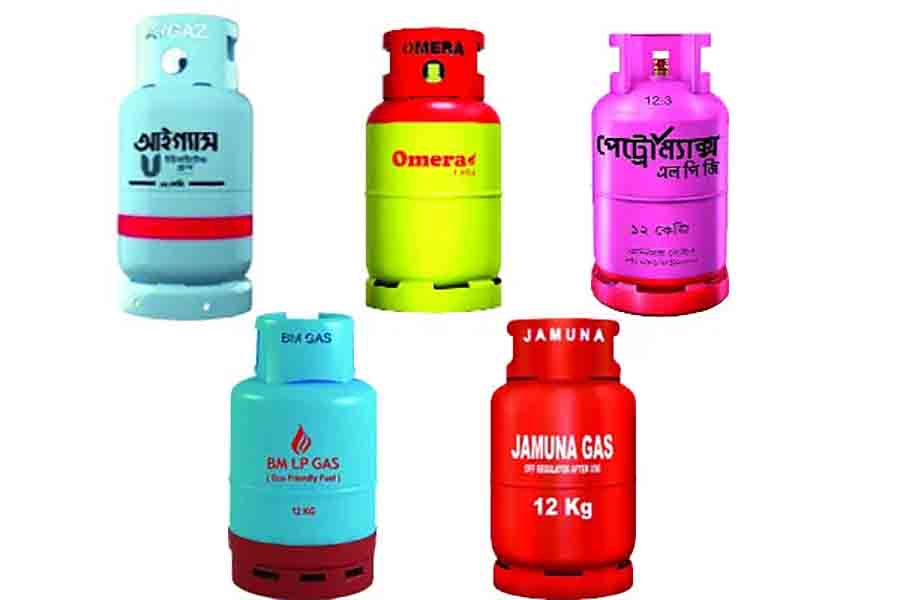
In addition, BM Energy holds 8 percent of the market, United IGas 7 percent, Delta 4 percent, and JMI and Premium LPG 3 percent.
Analysts say that since the entire market is under the control of a handful of companies, it is possible for them to exert any kind of control or influence over the market.
Amidst the endless suffering of consumers over LP gas, the issue of business manipulation has come to the fore. A report by the National Security Intelligence Service (NSI) says that some big companies may be involved in the ongoing manipulation. They may have created an opportunity to increase prices by creating an artificial crisis in the market by withholding supply.
The report submitted to the Ministry of Power, Energy and Mineral Resources names five companies as suspects – iGas, Petromax, BM Energy, Omera and Jamuna.
Based on intelligence information, the relevant agencies are investigating the entire process of importing, storing, and supplying LPG to the market.
BPC’s inefficiency
Speaking to those concerned, it was learned that although the government has emphasized increasing LPG imports to break the syndicate of traders, the BPC has shown extreme inefficiency in this regard.
Despite repeated requests from Prime Minister Tarique Rahman since taking office, the company has not been able to import even a single kilogram of LPG in the last seven and a half months.
BPC officials said that despite five rounds of tenders being called, no supplier could be found. They said that the supplier could not be finalized because the suppliers were demanding higher ship rent than the international market.
The investigation shows that while private importers are charging $200 per ton of LPG for themselves, suppliers are unwilling to go below $270 to supply it to BPC.
According to experts, this is due to various ‘hidden costs’ in supply chains in government institutions.
Initiative to increase reserves
According to experts, along with price fluctuations in the international market, one of the main reasons for the LPG crisis in the country is the weakness of government companies.
In addition to private entrepreneurs, there is also a company called LPG Gas Limited under the BPC to control the market. However, this company has a market share of less than 2 percent of the country’s total demand.
The main reason for this is that the company does not have much storage capacity. The good news is that the government has taken some new initiatives to address the problem.
Preparations are underway to build an 8,200-ton LPG storage tank on 6.37 acres of land in Mongla, Bagerhat. Plans have been made to set up a storage and bottling plant on 6.91 acres of land in Kalihati and Rajabari, Tangail.

https://stapravda.ru/20221228/reyting_samyh_populyarnyh_hostingov_v_rossii_196445.html, рейтинг хостингов России подтверждает, что выбор надежного провайдера важен для бизнеса.