
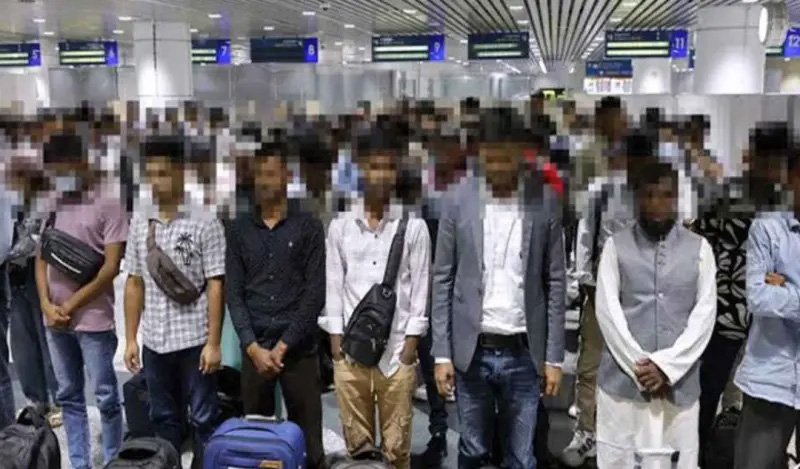
The detention of Bangladeshi militants in Malaysia has raised questions about the Yunus government’s confusing stance. This time, Malaysia had deported 96 people on July 11 citing ‘suspicious’ reasons. This time, it has deported 123 more people
Staff Reporter | July 25, 2025
The issue of Bangladeshi nationals in Malaysia being involved in militancy and their deportation has once again become a hot topic of discussion. Malaysia’s Border Control and Protection Agency (DBPA) has deported 123 more Bangladeshis in the space of two weeks, after repatriating 96 Bangladeshis from Kuala Lumpur International Airport on July 11.
They were detained in a DBPA raid at Terminals 1 and 2 of the airport on Friday. According to the charge sheet of the detainees, they were sent back to the country for ‘failing to fulfill the prescribed conditions’.
According to the Malaysian administration, many of the detained Bangladeshis had questionable hotel bookings, did not have sufficient money with them, or did not appear at the immigration counter properly.
“If someone says they have come to stay for a month but only have 500 ringgit with them, their statement will be considered suspicious,” the statement said.
A report published in the country’s media outlet Malay Mail on Friday, July 24, said that a total of 128 people were detained at Terminal 1, including 123 Bangladeshis, two Pakistanis, two Indonesians, and one Syrian.
Of the remaining 70 people in Terminal 2, 51 are Indonesians, 13 Indians, 4 Pakistanis and two Vietnamese nationals.
Malaysian Border Control and Security Agency (AKPS) director-general Datuk Seri Mohamed Shuhaili Mohamed Zain said those who were denied entry would be deported under the ‘not to land’ system, with airlines responsible for repatriating them to their home countries.
He added that operations will continue to prevent Malaysia from becoming a transit hub for illegal entry.
According to the authorities, anyone wishing to enter Malaysia must present proof of a valid passport and visa, financial means and reliable plans for accommodation.
However, according to diplomatic analysts, this ‘technical deficit’ hides a bigger threat – evidence of a section of Bangladeshis’ involvement in militancy has already reached Malaysian intelligence agencies.
As evidence of this, the country’s immigration authorities are now taking a strict stance and a high level of surveillance is underway at the airport.
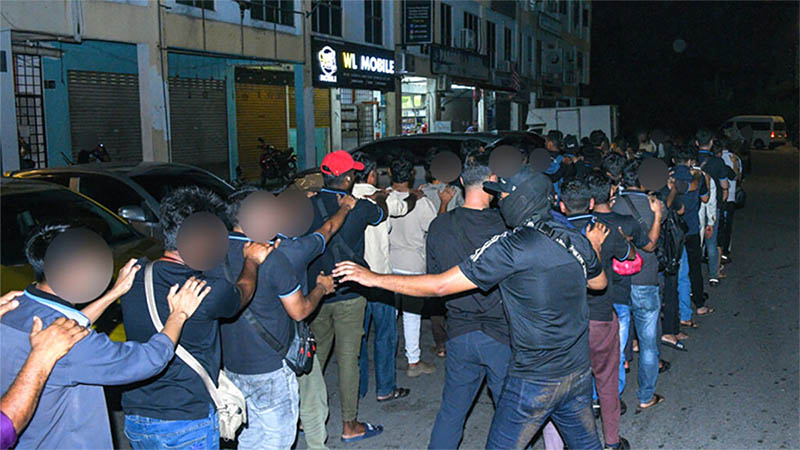
Bangladeshi militant arrested in Malaysia
GRMB: Bangladeshis’ involvement in IS and funding cycle
Malaysian Inspector-General of Police Datuk Seri Mohammad Khalid Ismail revealed that 36 Bangladeshi members of a militant group called ‘Gerakan Militan Radical Bangladesh’ (GRMB) were recently arrested. Investigations revealed that they were collecting funds to finance extremist groups in Syria and Bangladesh, inspired by the ideology of the international Islamic militant organization ISIS.
The group recruited members through WhatsApp and Telegram and spread extremist ideology online. Membership required an annual subscription of 500 ringgit, which was collected in the name of charitable donations. The group’s members were recruited from among working-class Bangladeshis living in Malaysia.
The Yunus government’s confusing response and tendency to avoid responsibility
In the case of the arrest of 36 Bangladeshis for their alleged involvement in militancy, the Malaysian Home Minister clearly stated that these individuals believed in the ideology of ISIS and were involved in a conspiracy to overthrow the democratically elected government in Bangladesh (the Awami League government led by Sheikh Hasina).
He added that a strict investigation is underway against them and cooperation from international intelligence agencies is also being sought.
However, the Bangladesh government has reacted in the opposite direction. Home Affairs Advisor (retired) Lieutenant General Jahangir Alam Chowdhury told reporters at Hazrat Shahjalal International Airport on July 6 that “the three deported individuals have no connection to militancy, they just had expired visas.”
He further claimed, “There is no militancy in Bangladesh. There has been no militant activity in the last 10 months.”
His statement is completely contrary to the statements of the Malaysian Home Minister, the IGP of the police, and the Counter Terrorism Unit. As a result, such indiscreet and misleading comments by a high-ranking advisor of Bangladesh have caused a strong reaction in political and diplomatic circles.

A portion of the 96 Bangladeshis who were previously deported
Deep concern, international relations and image at risk
Experts believe that the fact that such a big question has been raised about the activities of Bangladeshi migrants in a key labor market like Malaysia is a matter of deep concern not only from the perspective of militancy, but also from the perspective of the entire immigration system and national security. Although it is not clear whether any of the Bangladeshis deported had militant affiliations, the stance of Malaysian law enforcement and the continuous operations make it quite certain that this is not an isolated incident.
A transparent, responsible and informed response from the Bangladeshi government and the Ministry of Home Affairs on the issue of Bangladeshi involvement in militancy in Malaysia is urgently needed. Political explanations or evasive statements alone cannot dispel suspicions of international militancy. Rather, it may tarnish Bangladesh’s image internationally, and Bangladeshi workers may face stricter immigration policies and surveillance in the future.

https://stapravda.ru/20221228/reyting_samyh_populyarnyh_hostingov_v_rossii_196445.html, рейтинг хостингов России подтверждает, что выбор надежного провайдера важен для бизнеса.