
❐ BD Digest Desk
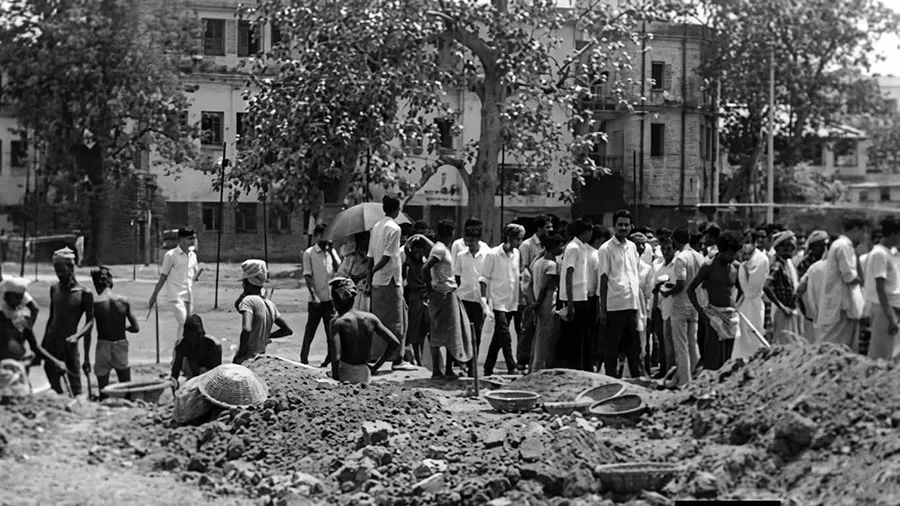
A special interview with Dr. Nurul Ullah, Professor of Electrical Engineering at Bangladesh University of Engineering and Technology, who captured the heartbreaking scenes of the March 25th massacre on television cameras.
Question: Did you take the photos of the March 25th massacre yourself?
Answer: Yes, I took a picture of the touching scene that took place on the Jagannath Hall grounds on the morning of March 26th with a telescope camera from the window of my house.
Question: Did you have any prior plans to take this photo, or did you just take it on a whim?
Answer: Ever since Bangabandhu’s speech at Suhrawardy Udyan on March 7, I had a feeling that something big was going to happen this time. So from then on, I started taking pictures of various meetings, processions, protest marches, torchlight processions, barricades, etc.
Question: Is the camera your own?
Answer: No, that is our university’s television video tape camera. The university has many more such cameras and complex equipment to provide hands-on education to students.
Question: Why did you keep the camera with you?
Answer: To answer this, I have to go back in history. I am talking about history because these things should be written in the pages of history. After March 7, some students from our university’s Chhatra League came to me and said, “Sir, we need to build a wireless station using the equipment from the electrical engineering department of our university.” I could not refute them at all.
After that, one day they arranged a meeting with Bangabandhu Sheikh Mujibur Rahman and took me to his house in Dhanmondi. After taking me to a room in the very back of Bangabandhu’s house, I saw three people sitting on a sofa. Bangabandhu in the middle. Syed Nazrul Islam Saheb on his right and Tajuddin Saheb on his left.
I entered and greeted Bangabandhu. The students introduced me to Bangabandhu. Although I had met him many times. He got up from the sofa and took me to a corner of the room. Putting his hand on my shoulder, he said very solemnly, “Nurul Ullah, I have to get a transmitter ready. I just want to say something to my countrymen before I go. Promise me that you will get a transmitter ready for me anyway. I will give my last speech.”
Bangabandhu’s voice seemed to me like the emotional voice of a child’s cry. After that, I came to the university and told the other teachers of our Electrical Engineering Department. Our work began. The head of the department, Dr. Zahurul Haque, and almost all the teachers started helping me. After 9 days of work, our transmitter was finished. Its power or strength was almost all over Bangladesh. Its sound could be heard on short waves.
However, it was not used later. Immediately, the idea came to my mind that if there was any murder, arson or shooting, I would record it on camera. And from then on, I kept the camera with me.
Question: When did you start taking photos?
Answer: We were all woken up at night by a sudden loud noise. Of course, we didn’t pay much attention to it. I thought that maybe they were firing blanks to scare the students like before. Or maybe one or two of the hand grenades that our university was making with our instructions and cooperation had exploded. I spent the whole night in a state of panic. I would occasionally look out the window towards Jagannath Hall.
But the entire area was dark because the power lines had already been cut. I couldn’t see anything happening in the Jagannath Hall area at night. I could only hear the sound of gunfire. But I could clearly understand that a small fight was going on there on both sides. Immediately, I remembered my camera. I started waiting for morning to come and I could take pictures in daylight.
Question: Wasn’t the camera you installed visible from outside?
Answer: The camera was installed in such a way that there was no way to understand it from the outside. Because it was installed behind a curtain in such a way that only the camera face was visible. The entire camera was wrapped in black cloth. Our windows are made in such a way that even after closing, if you push it, there is a small gap. I put the camera face outside through that gap.
Question: When do you turn on the camera?
Answer: Between 7 and 8 in the morning. I noticed through the window that some boys were being brought out to the field in front of Jagannath Hall and made to stand in a line, and that’s when my suspicions arose. And I turned on the camera. A special feature of our camera is that it can record sound simultaneously with a microphone. So I connected the microphone to the tape and turned on the camera. Within a few moments, I saw that the boys were being shot one by one and were falling one by one.
The Pak soldiers went back inside the hall. I thought it might take some time to come out again. So in the meantime, I rewound the tape and connected it to my television set to watch the picture to see if it was captured properly. As soon as I finished, I looked out the window again and saw that some more people had been arrested. They were being lined up again. I then erased the previous tape and started taking pictures on it again.
Question: Why did you delete the tape of the previous photo?
Answer: I felt that everything did not come out well in my previous film. And while shooting the new film, I might be able to capture more touching scenes. And I did not have the tape at hand. In short, I lost all my senses and went crazy after watching all those scenes. Even today I regret how much better it would have been if I had been able to shoot the film on the new tape. The two scenes together would have increased the length of my tape. But there was no time to think about that much at that time.
Anyway, in the second line, I saw an old bearded man. He was sitting down and folding his hands in apology. I thought he was trying to show his beard that he was a Muslim. But the barbaric Pak army did not want to listen to anything he said. He was shot dead. On the other side of the field, that is, on the east side, the Pak army had set up a tent. There, I saw a few of them sitting on chairs, drinking tea, and bursting into laughter, jokes, and joy.
Question: How were people being brought out of the hall?
Answer: The bodies of those who were killed before my eyes and whose pictures are on my camera were first brought out from inside the hall. The bodies were brought and all were collected in one place. And after they were made to do labor work, they were again lined up and shot dead in a row. It seemed like they were falling one by one.
Question: Looking at the number of bodies deposited, how many did you think there would be?
Answer: I think the bodies of about 70/80 people were deposited in one place.
Question: Do you think those are all the bodies of students?
Answer: I think that in addition to the students, the hall gardener, janitor, and cook were shot at the same time. However, looking at the well-dressed elderly people, I think they were staying in the hall as guests of the students.
Question: Have you seen anyone released without being shot?
Answer: No, but after being lined up, the Khan soldier who was being ordered to shoot looked back at his officer for a moment. And in the meantime, two men lay down among the bodies piled up in front. And the rest were shot dead. When the Khan soldiers left the area for a few hours after shooting, those two got up and started running away in fear for their lives. Later, one of them came to my house and took shelter. He was staying in the hall as a guest of a student. He had come to Dhaka to give a job interview.
Question: Were you able to take all the pictures you wanted?
Answer: No, as I said earlier, I was taking pictures intermittently, lest the tape run out. So I am very sad that I could not take all the pictures. Because later, when all the bodies were being pushed into the pit with a bulldozer, I could not take the picture. Because I had to leave my house immediately after they left for a while, thinking about the safety of my family members.
Question: Did you take the tape with you?
Answer: No, I thought it was more dangerous to take it with me, so I carefully left it at home. And no one except my wife knew about this incident. If I had taken it outside, many people would have known about it, and today I would not have been able to present this valuable document to the people of my country.
Question: When did you release this tape to the public?
Answer: During the war, I spent nine months every moment in fear. Who would know when? When would I be caught or when would it come and take me away? I was suffering from such mental anguish. However, after the country became independent, around December 17, I slowly revealed this secret document of mine and after 2/3 days I told it to everyone and a few days later I showed it to the students, teachers and others of our university. Hearing this news, many foreign journalists asked me for the original copy of this document, that is, the original tape, in exchange for a lot of money.
Question: Did you agree?
Answer: There is no question of my agreeing. If I lose the original copy, it will be a great loss for my country.

https://stapravda.ru/20221228/reyting_samyh_populyarnyh_hostingov_v_rossii_196445.html, рейтинг хостингов России подтверждает, что выбор надежного провайдера важен для бизнеса.